
#quantumcomputing
quantumcomputing
284,006 views
1,621 Discussing
Hot
Latest


·
--
Verified
Article
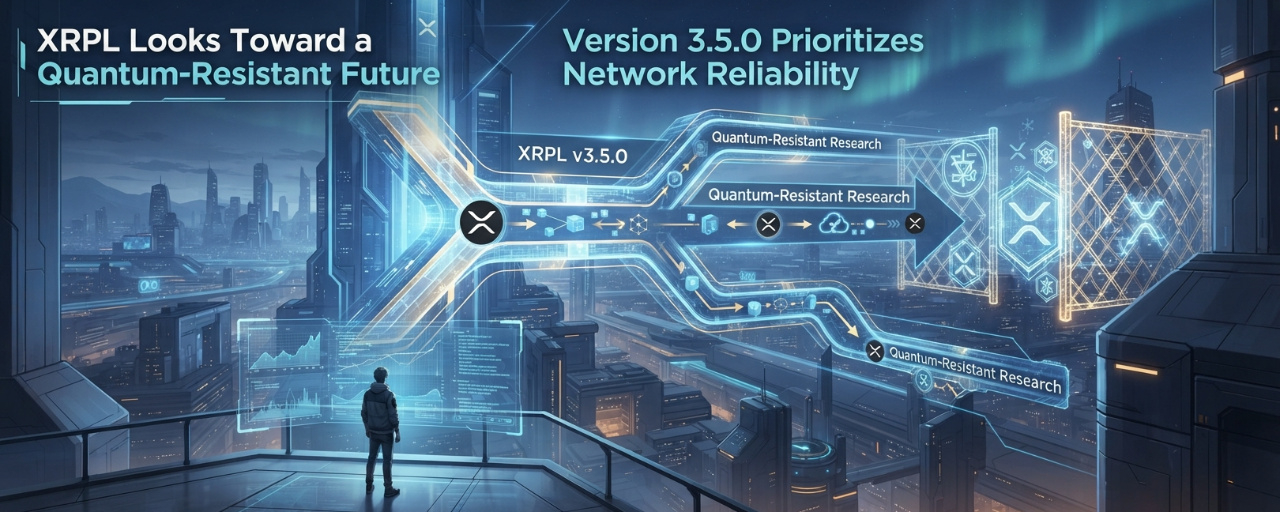
XRPL Looks Toward a Quantum-Resistant Future as Version 3.5.0 Prioritizes Network ReliabilityThe XRP Ledger (XRPL) is looking ahead to the potential risks posed by quantum computing, as developers consider how the network could strengthen its long-term cryptographic security. However, quantum-resistant protection remains a research and planning topic rather than an upcoming confirmed feature. The next documented update, version 3.5.0, is focused on improving network performance and reliability, particularly by addressing occasional ledger-closing delays. $XRP
{spot}(XRPUSDT)
Quantum computers could eventually threaten the elliptic-curve cryptography used by XRPL, Bitcoin, Ethereum, and other major blockchain networks. In theory, sufficiently powerful quantum machines could derive private keys from public keys. However, current quantum technology is still far from being capable of carrying out such attacks in practice. Preparing early is therefore important, especially because migrating wallets, validators, exchanges, and custodians to new cryptographic standards could take years.
{future}(XRPUSDT)
A potential quantum-resistant upgrade could introduce new address formats and post-quantum digital signatures instead of replacing the entire system at once. Such a transition would require extensive testing, broad validator approval, and clear migration guidance. Developers would also need to evaluate possible trade-offs, including larger transactions, higher fees, and changes to network capacity.
For now, XRPL's confirmed priority is improving operational stability through version 3.5.0. The key developments to watch are formal technical proposals, migration plans for users and institutions, and performance tests for post-quantum cryptography. For XRP holders, the practical details of any future transition will matter more than headlines suggesting that quantum protection is arriving immediately.
#xrp #XRPL #quantumcomputing
XRPL Looks Toward a Quantum-Resistant Future as Version 3.5.0 Prioritizes Network Reliability
The XRP Ledger (XRPL) is looking ahead to the potential risks posed by quantum computing, as developers consider how the network could strengthen its long-term cryptographic security. However, quantum-resistant protection remains a research and planning topic rather than an upcoming confirmed feature. The next documented update, version 3.5.0, is focused on improving network performance and reliability, particularly by addressing occasional ledger-closing delays. $XRP
Quantum computers could eventually threaten the elliptic-curve cryptography used by XRPL, Bitcoin, Ethereum, and other major blockchain networks. In theory, sufficiently powerful quantum machines could derive private keys from public keys. However, current quantum technology is still far from being capable of carrying out such attacks in practice. Preparing early is therefore important, especially because migrating wallets, validators, exchanges, and custodians to new cryptographic standards could take years.
A potential quantum-resistant upgrade could introduce new address formats and post-quantum digital signatures instead of replacing the entire system at once. Such a transition would require extensive testing, broad validator approval, and clear migration guidance. Developers would also need to evaluate possible trade-offs, including larger transactions, higher fees, and changes to network capacity.
For now, XRPL's confirmed priority is improving operational stability through version 3.5.0. The key developments to watch are formal technical proposals, migration plans for users and institutions, and performance tests for post-quantum cryptography. For XRP holders, the practical details of any future transition will matter more than headlines suggesting that quantum protection is arriving immediately.
#xrp #XRPL #quantumcomputing
Natalie-7:
👌! Thanks 🤝
1
13
1.3k

·
--
Quantum Risk Is a Long-Term Upgrade Challenge—not a Wallet Panic
Quantum computers are not cracking crypto wallets today—but preparation has a long lead time.
Google Research’s March 31, 2026 paper estimates that a future cryptographically relevant quantum computer could run Shor’s algorithm against 256-bit elliptic-curve cryptography with fewer than 1,200 logical qubits in one circuit. These are error-corrected logical qubits, not a working machine available today. The result is a resource estimate, not evidence that current wallets are compromised. Google recommends that blockchains plan for post-quantum cryptography before such hardware exists. What migration steps should networks prioritize first?
Source: Google Research: https://research.google/blog/safeguarding-cryptocurrency-by-disclosing-quantum-vulnerabilities-responsibly/
Market watch:
#CryptoEducation #QuantumComputing #BlockchainSecurity

·
--
Bearish
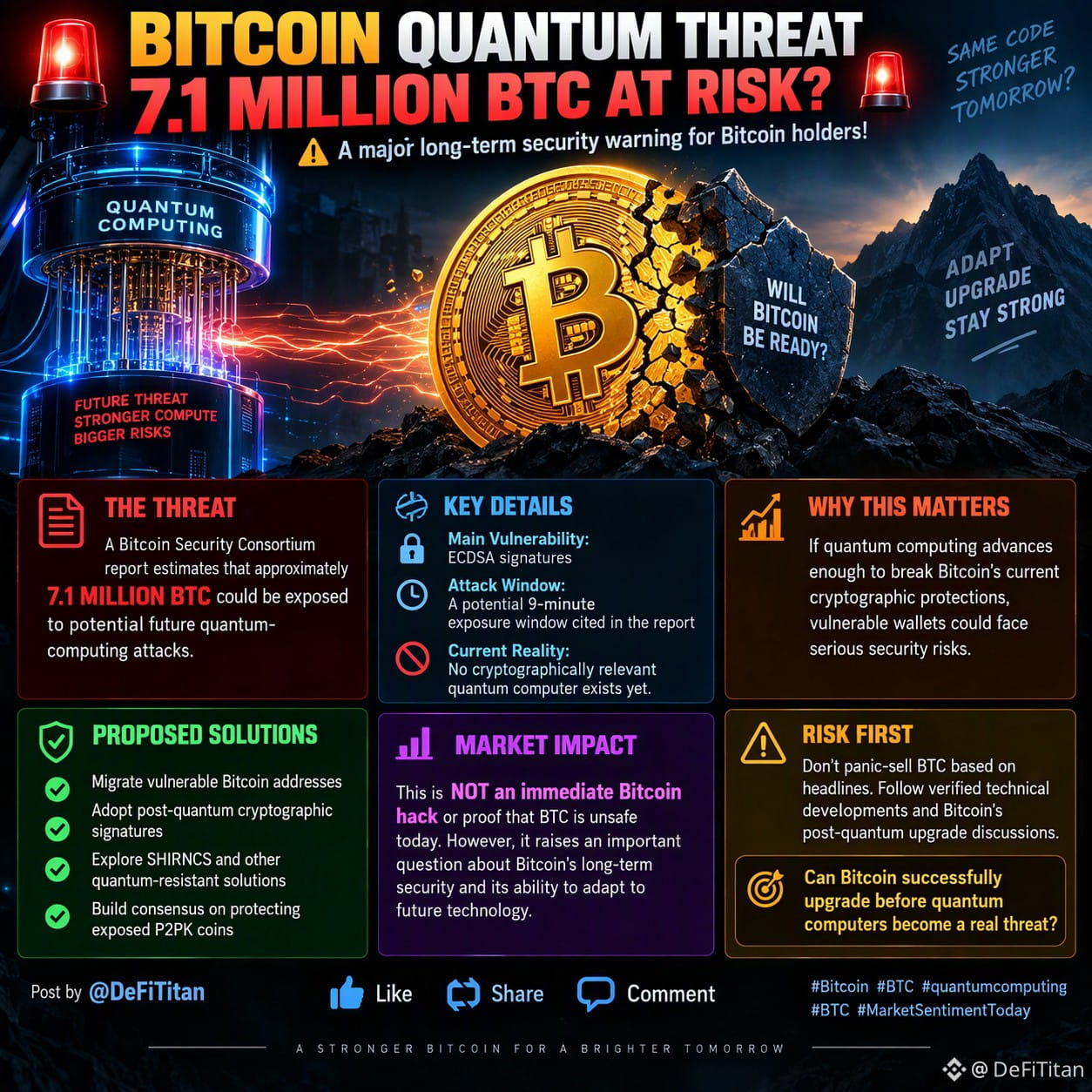
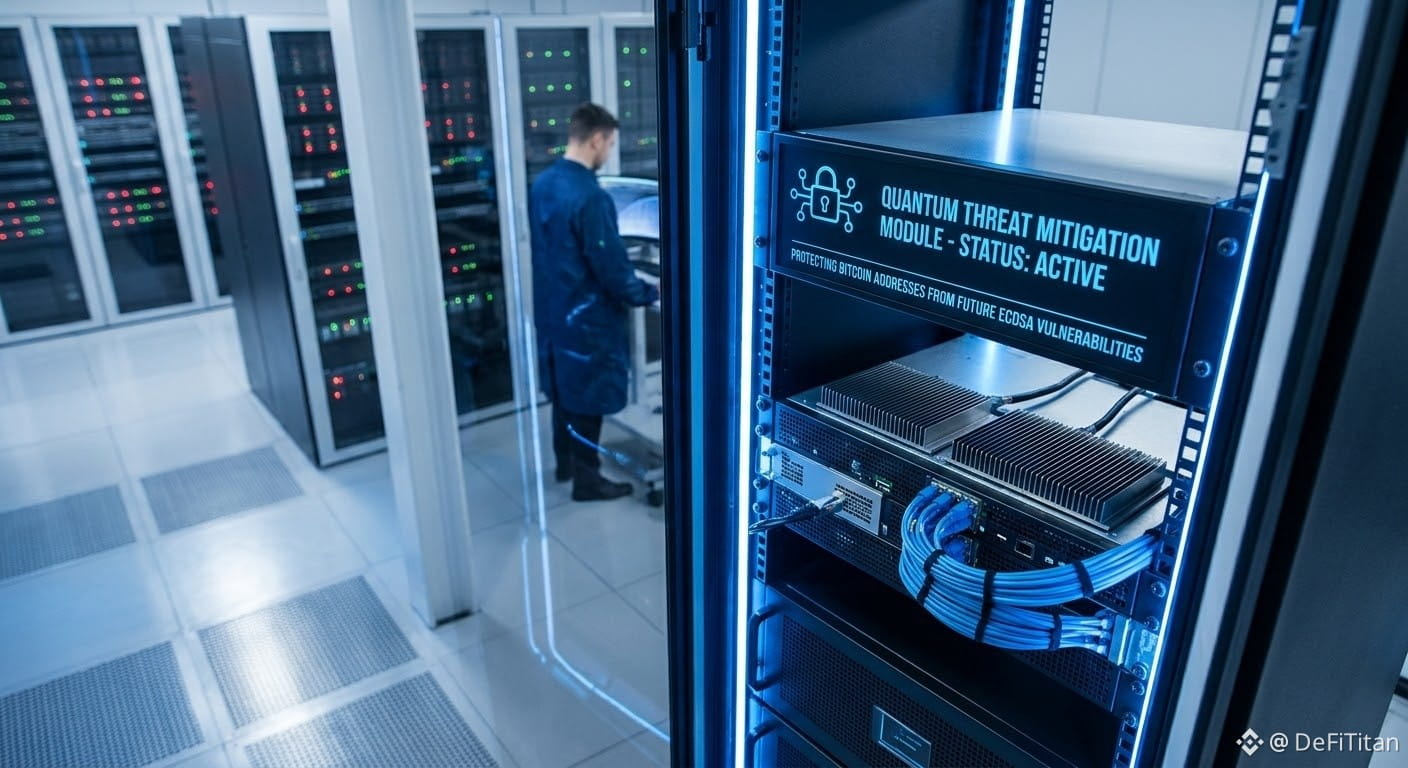
🚨 BITCOIN QUANTUM THREAT – 7.1 MILLION BTC AT RISK? 🚨
⚠️ **A major long-term security warning for Bitcoin holders!**
📍 **The Threat:**
A Bitcoin Security Consortium report estimates that approximately **7.1 million BTC** could be exposed to potential future quantum-computing attacks.
🔹 **Main Vulnerability:** ECDSA signatures
🔹 **Attack Window:** A potential 9-minute exposure window cited in the report
🔹 **Current Reality:** No cryptographically relevant quantum computer exists yet.
📉 **Why This Matters:**
If quantum computing advances enough to break Bitcoin's current cryptographic protections, vulnerable wallets could face serious security risks.
🔐 **Proposed Solutions:**
• Migrate vulnerable Bitcoin addresses
• Adopt post-quantum cryptographic signatures
• Explore SHIRNCS and other quantum-resistant solutions
• Build consensus on protecting exposed P2PK coins
⚠️ **Market Impact:**
This is NOT an immediate Bitcoin hack or proof that BTC is unsafe today. However, it raises an important question about Bitcoin's long-term security and its ability to adapt to future technology.
📌 **Risk First:**
Don't panic-sell BTC based on headlines. Follow verified technical developments and Bitcoin's post-quantum upgrade discussions.
**Can Bitcoin successfully upgrade before quantum computers become a real threat?**
📢 Post by @DeFiTitan
👍 Like 🔁 Share 💬 Comment
#Bitcoin #BTC #quantumcomputing #BTC #MarketSentimentToday
{future}(BTCUSDT)
{future}(SOLUSDT)
{future}(ETHUSDT)
$BTC $ETH $BNB
🚨 BITCOIN QUANTUM THREAT – 7.1 MILLION BTC AT RISK? 🚨
⚠️ **A major long-term security warning for Bitcoin holders!**
📍 **The Threat:**
A Bitcoin Security Consortium report estimates that approximately **7.1 million BTC** could be exposed to potential future quantum-computing attacks.
🔹 **Main Vulnerability:** ECDSA signatures
🔹 **Attack Window:** A potential 9-minute exposure window cited in the report
🔹 **Current Reality:** No cryptographically relevant quantum computer exists yet.
📉 **Why This Matters:**
If quantum computing advances enough to break Bitcoin's current cryptographic protections, vulnerable wallets could face serious security risks.
🔐 **Proposed Solutions:**
• Migrate vulnerable Bitcoin addresses
• Adopt post-quantum cryptographic signatures
• Explore SHIRNCS and other quantum-resistant solutions
• Build consensus on protecting exposed P2PK coins
⚠️ **Market Impact:**
This is NOT an immediate Bitcoin hack or proof that BTC is unsafe today. However, it raises an important question about Bitcoin's long-term security and its ability to adapt to future technology.
📌 **Risk First:**
Don't panic-sell BTC based on headlines. Follow verified technical developments and Bitcoin's post-quantum upgrade discussions.
**Can Bitcoin successfully upgrade before quantum computers become a real threat?**
📢 Post by @DeFiTitan
👍 Like 🔁 Share 💬 Comment
#Bitcoin #BTC #quantumcomputing #BTC #MarketSentimentToday
$BTC $ETH $BNB
93

⚡ XRP LEDGER IS PREPARING FOR THE QUANTUM ERA!
The XRP Ledger Foundation has outlined a roadmap for quantum-resistant accounts.
Why this matters:
🔹 New quantum-resistant signing keys.
🔹 ML-DSA-44 cryptographic technology.
🔹 Existing vulnerable keys can be disabled.
🔹 No additional base transaction fees proposed.
The roadmap targets a full quantum transition by 2028.
However, development and network testing are still ongoing.
Is quantum-resistant security becoming the next major blockchain competition?
What's your take on $XRP ? 👀
#XRP #XRPL #QuantumComputing #Blockchain #CryptoMatrix $XRP
{spot}(XRPUSDT)
⚡ XRP LEDGER IS PREPARING FOR THE QUANTUM ERA!
The XRP Ledger Foundation has outlined a roadmap for quantum-resistant accounts.
Why this matters:
🔹 New quantum-resistant signing keys.
🔹 ML-DSA-44 cryptographic technology.
🔹 Existing vulnerable keys can be disabled.
🔹 No additional base transaction fees proposed.
The roadmap targets a full quantum transition by 2028.
However, development and network testing are still ongoing.
Is quantum-resistant security becoming the next major blockchain competition?
What's your take on $XRP ? 👀
#XRP #XRPL #QuantumComputing #Blockchain #CryptoMatrix $XRP
1
185

·
--
Bearish
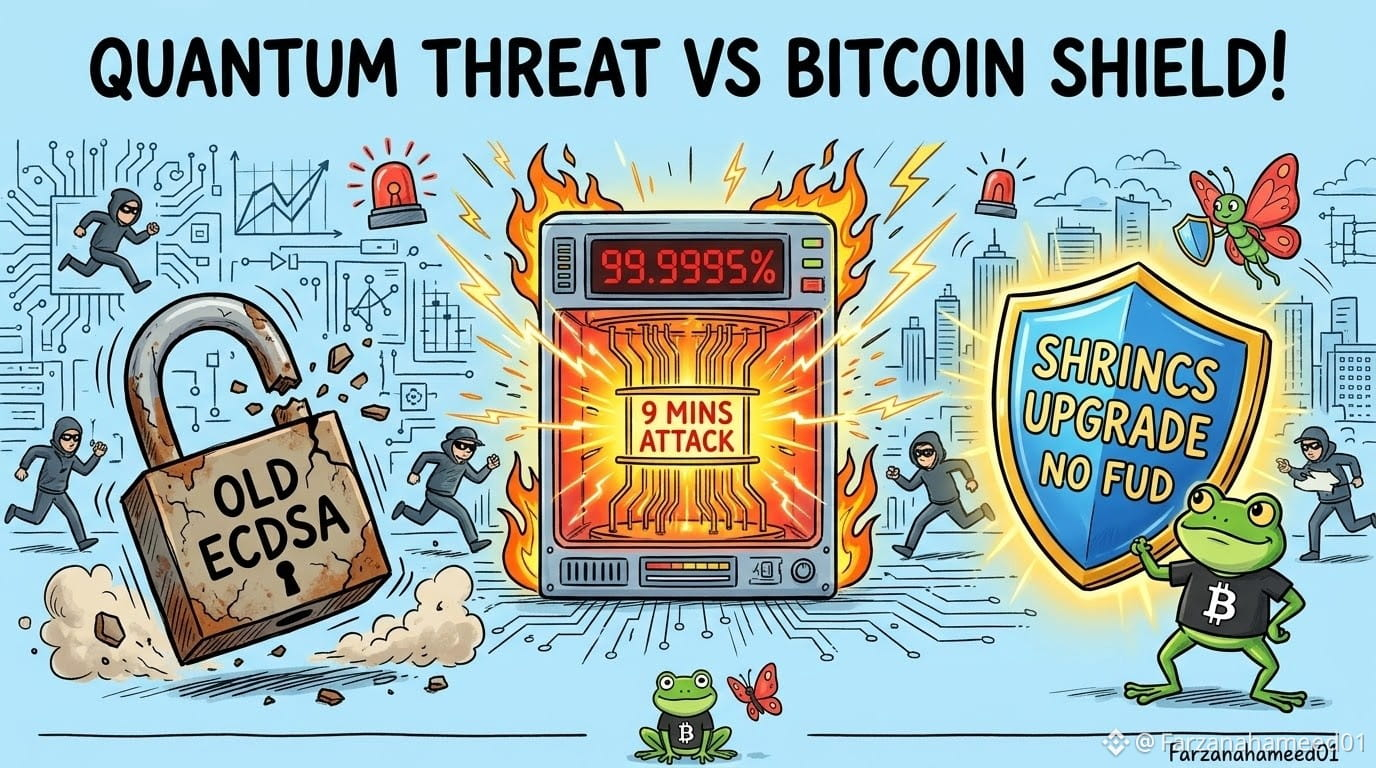
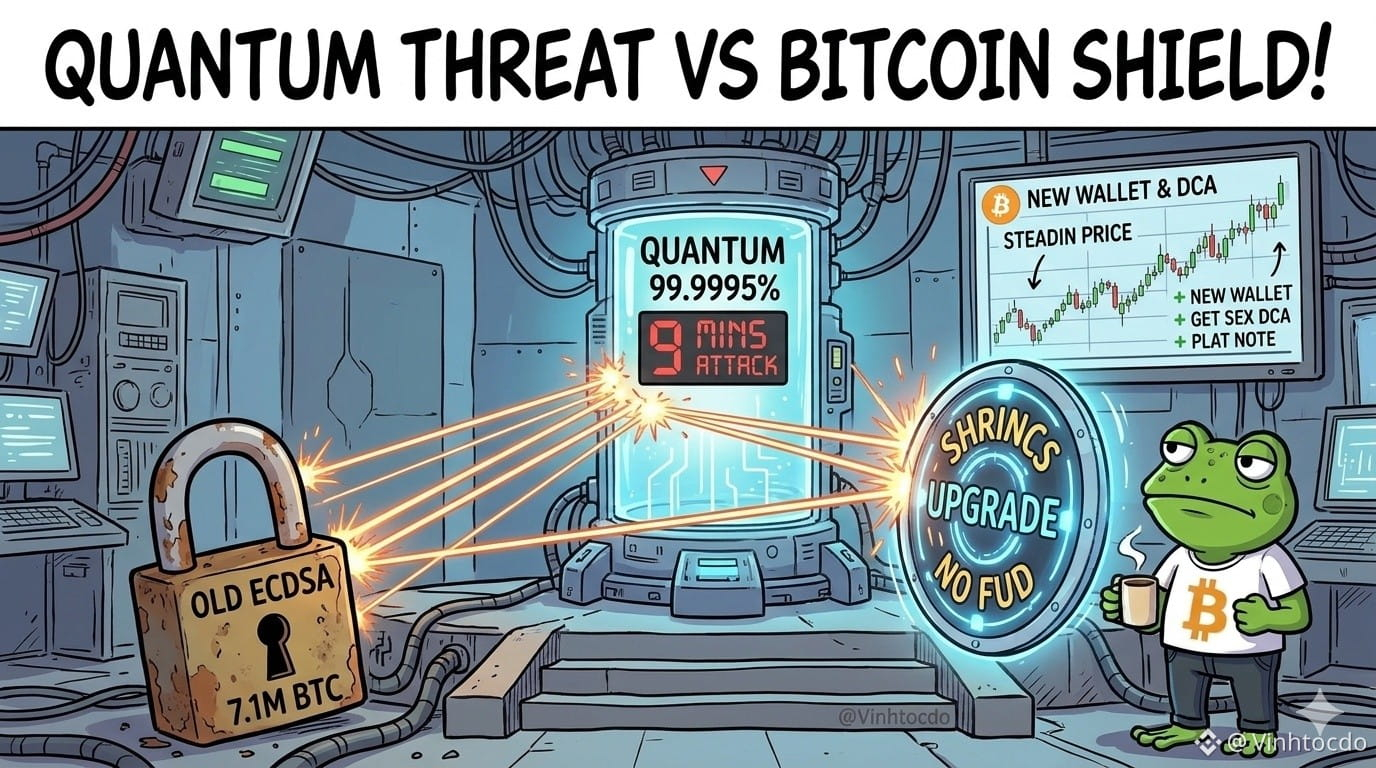
😱 𝐐𝐔𝐀𝐍𝐓𝐔𝐌 𝐓𝐇𝐑𝐄𝐀𝐓 𝐕𝐒 𝐁𝐈𝐓𝐂𝐎𝐈𝐍 𝐒𝐇𝐈𝐄𝐋𝐃!
#quantumcomputing Just set a new accuracy record of 99.9995%, and now there's more news: 7.1 million BTC could be at risk from quantum computers within a 9-minute attack window! 😱
Don't rush to withdraw your funds and panic! The vulnerability is concentrated in ECDSA signatures and old addresses (P2PK). In reality, no quantum supercomputer is currently powerful enough to crack Bitcoin, and the community already has a post-quantum signature solution, SHRINCS, ready for upgrades if needed. As quantum computing takes a step forward, blockchain can take a step forward in upgrading its shields! 🛡️
📊 Quick Analysis:
This is future FUD, not present danger! Quantum is getting stronger, but Bitcoin shields are also getting stronger!
🎯 What Should Traders Do?
1. Don't sell off because of FUD about the distant future! 2. Store your coins in a new wallet, avoid reusing old addresses! 3. Manage your capital with a sensible DCA strategy!
🛡️ This is not financial advice!
Tell me honestly, are you scared of quantum attack, or do you trust Bitcoin shields?👇✨
🪙$BTC - Watch for quantum FUD move, strong.
🪙 $ETH - Watch for pullback, strong.
🪙$AGT - Watch for security move, strong.
✨ 𝐅𝐀𝐑𝐙𝐀𝐍𝐀 𝐇𝐀𝐌𝐄𝐄𝐃 𝐎𝐅𝐅𝐈𝐂𝐈𝐀𝐋 • 🦋 ✨
#Bitcoin #CryptoSecurity #CyberSecurity #CryptoNews
8
447

·
--
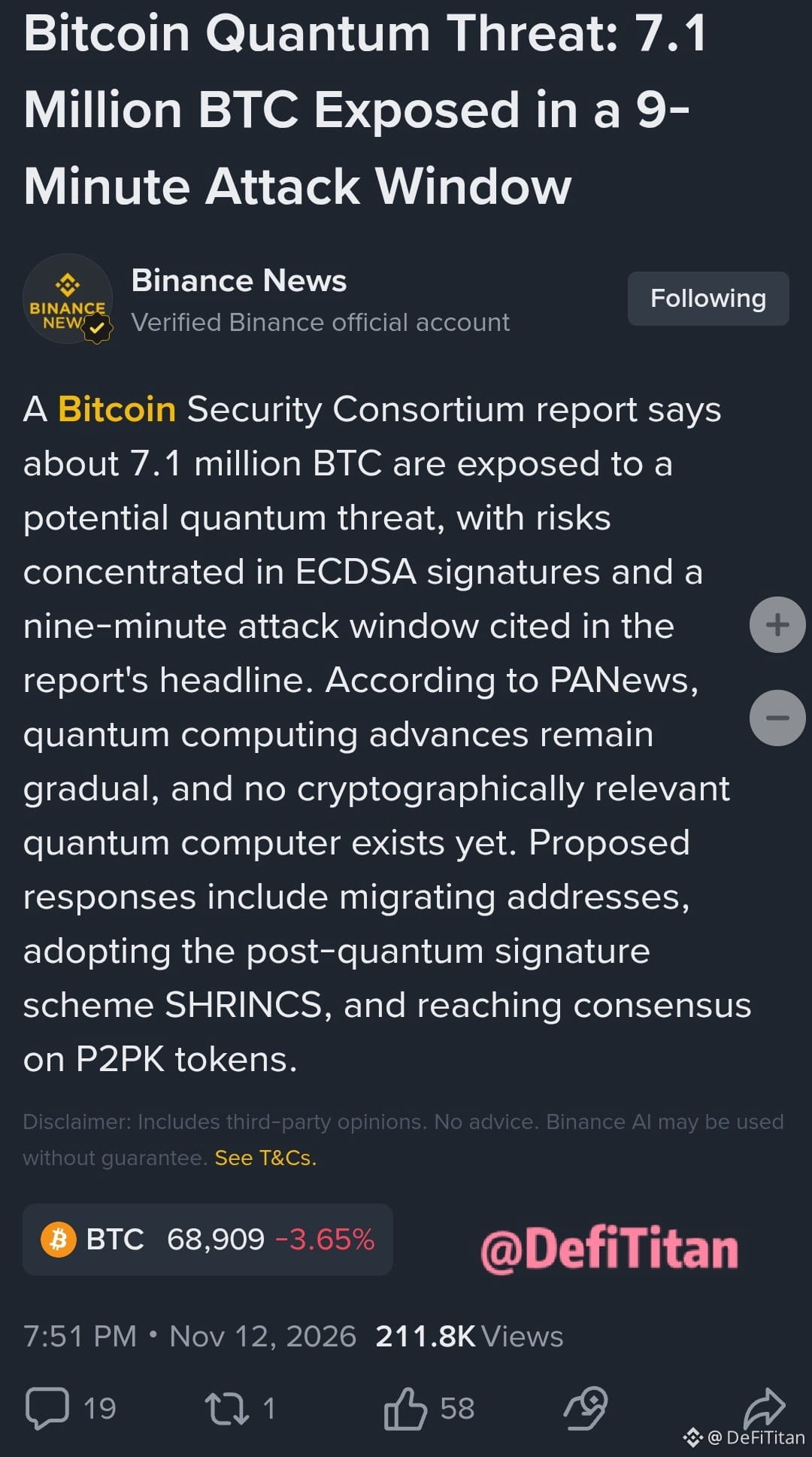
🚨 Bitcoin Quantum Threat: 7.1 Million BTC at Risk?
Bitcoin security is entering an important discussion about the future of quantum computing. 🔐
According to the Bitcoin Security Consortium report mentioned by Binance News, approximately 7.1 million BTC could be exposed to potential quantum-related risks.
⚡ Key takeaways:
Quantum computing may challenge existing cryptographic security.
ECDSA signatures are a major focus of concern.
No cryptographically relevant quantum computer exists yet.
Post-quantum cryptography could play an important role in Bitcoin's future security.
💡 The crypto community should focus on innovation, security, and long-term preparedness rather than panic.
Bitcoin's future depends on strong security and continuous innovation.
🚀 #Binance #CryptoSecurity #QuantumComputing #blockchain #CryptoNews
$BTC
{future}(BTCUSDT)
🚨 Bitcoin Quantum Threat: 7.1 Million BTC at Risk?
Bitcoin security is entering an important discussion about the future of quantum computing. 🔐
According to the Bitcoin Security Consortium report mentioned by Binance News, approximately 7.1 million BTC could be exposed to potential quantum-related risks.
⚡ Key takeaways:
Quantum computing may challenge existing cryptographic security.
ECDSA signatures are a major focus of concern.
No cryptographically relevant quantum computer exists yet.
Post-quantum cryptography could play an important role in Bitcoin's future security.
💡 The crypto community should focus on innovation, security, and long-term preparedness rather than panic.
Bitcoin's future depends on strong security and continuous innovation.
🚀 #Binance #CryptoSecurity #QuantumComputing #blockchain #CryptoNews
$BTC
31

·
--
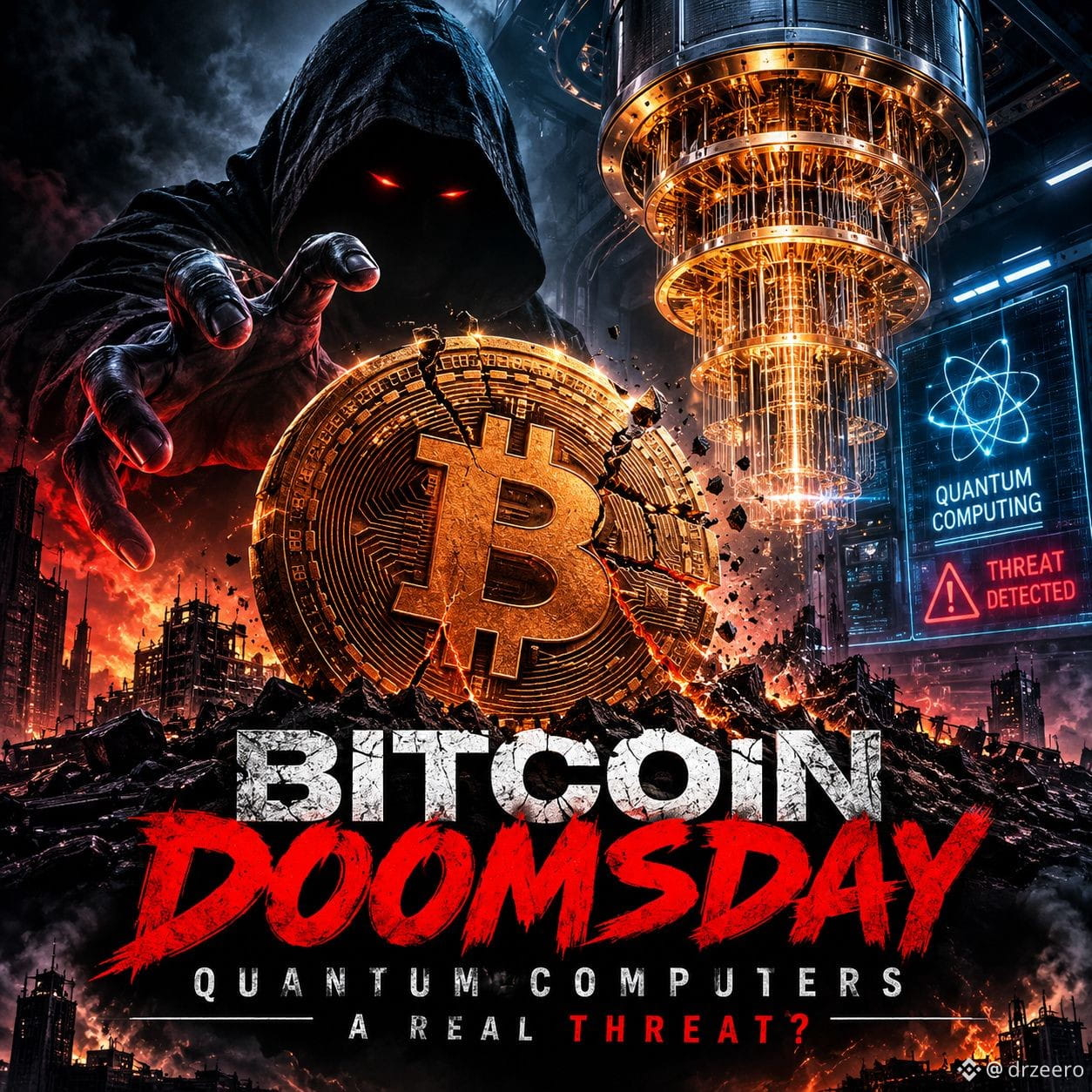
💀🚨 BITCOIN DOOMSDAY: QUANTUM COMPUTING THREAT?
⚠️ Around 6.4 MILLION BTC could face potential future risks from quantum computing.
While today's quantum computers cannot break Bitcoin's security, future breakthroughs could challenge the cryptography protecting billions in digital assets.
The crypto industry may need to prepare before it's too late.
🌑 Could quantum computing become Bitcoin's biggest threat?
#bitcoin #quantumcomputing #CryptoSecurity #BTC #BinanceSquare $BTC
2
62

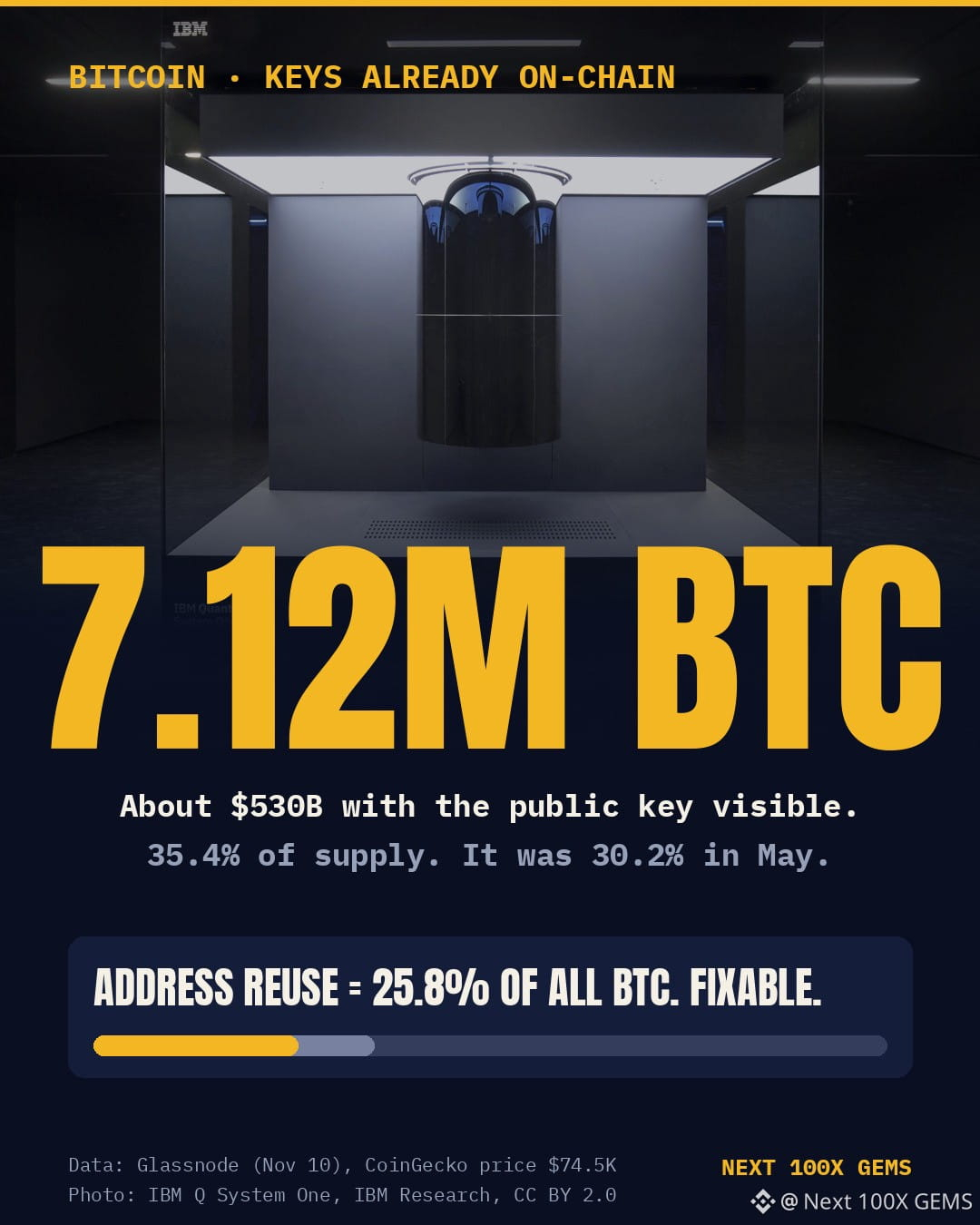
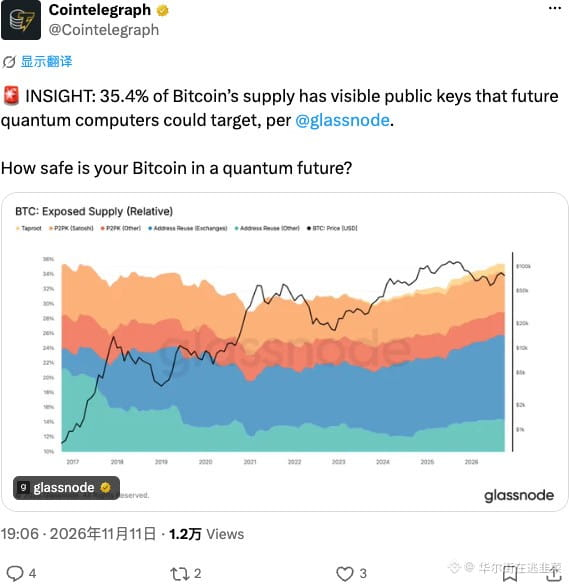
7.12 million $BTC now have their public key sitting in plain view on-chain.
That's 35.4% of all bitcoin, per Glassnode, or about $530B at $74.5K.
Back in May the number was 6.04 million. So in roughly six months another 1.08 million BTC, around $80B, joined the pile a future quantum computer would try first.
Nobody can break these keys today, and there's no date for when anyone could. The useful part is where the exposure comes from. Some of it is baked in: old pay-to-public-key coins, a big share of them tied to Satoshi, are never going to move. But nearly three quarters of the total is plain address reuse. That's a wallet habit, not a flaw in Bitcoin.
If you've spent from an address and left coins sitting on it, sending them to a fresh address ends that exposure. One transaction and you're out of the count.
#Bitcoin #QuantumComputing
NFA. DYOR.
134

Article
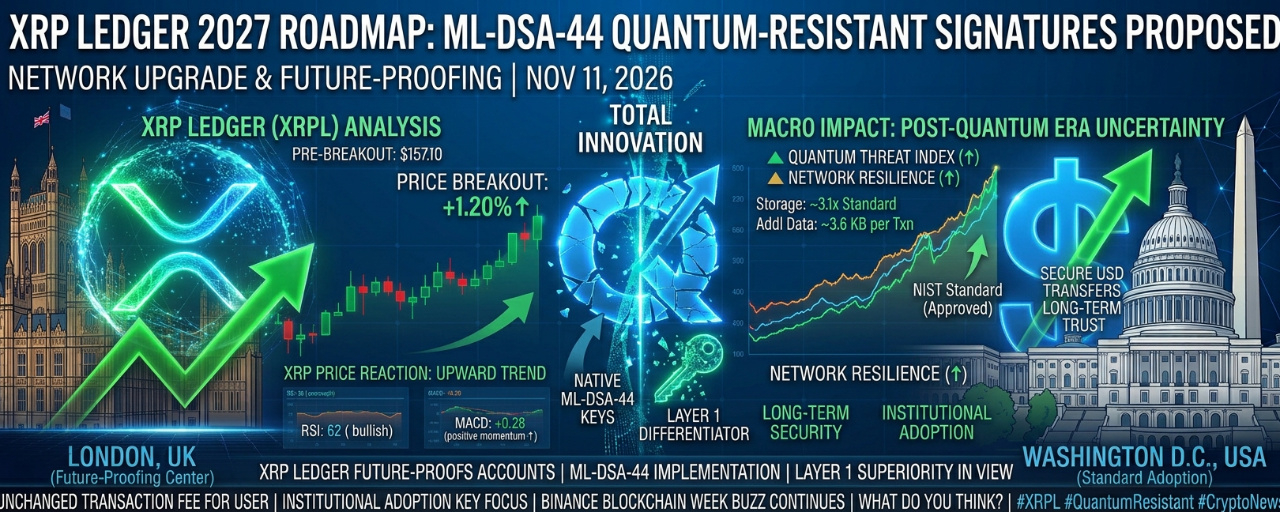
XRPL Proposes Post-Quantum Cryptography by 2027The XRP Ledger Foundation has unveiled its 2027 roadmap, proposing to future-proof the network with native support for quantum-resistant signatures. The plan involves allowing users to register ML-DSA-44 keys for their existing accounts, a vital security measure against emerging quantum computing threats.
While the upgrade will increase the data footprint of protected transactions by approximately 3.6 KB, making storage needs roughly 3.1 times that of a standard payment, the roadmap emphasizes that the base transaction fee for users will remain unchanged. This native integration of NIST-approved standards is set to position the XRP Ledger with a significant Layer 1 differentiator in the public blockchain sector within the next two years.
#XRP #XRP #QuantumComputing #2027Roadmap
{spot}(GOOGLBUSDT)
#Ripple
XRPL Proposes Post-Quantum Cryptography by 2027
The XRP Ledger Foundation has unveiled its 2027 roadmap, proposing to future-proof the network with native support for quantum-resistant signatures. The plan involves allowing users to register ML-DSA-44 keys for their existing accounts, a vital security measure against emerging quantum computing threats.
While the upgrade will increase the data footprint of protected transactions by approximately 3.6 KB, making storage needs roughly 3.1 times that of a standard payment, the roadmap emphasizes that the base transaction fee for users will remain unchanged. This native integration of NIST-approved standards is set to position the XRP Ledger with a significant Layer 1 differentiator in the public blockchain sector within the next two years.
#XRP #XRP #QuantumComputing #2027Roadmap
#Ripple
124

·
--
Bitcoin wallet makers face a quantum computing challenge! Trezor’s CTO reveals that building quantum-resistant solutions isn’t easy—it requires balancing security and practicality. As quantum computing advances, Bitcoin’s security is being put to the test, and wallet manufacturers are working to find the right balance. Is your Bitcoin safe? #Bitcoin #QuantumComputing $BTC
Bitcoin wallet makers face uphill battle for quantum resistance! Trezor CTO reveals balancing security with usability is key. As quantum tech advances, Bitcoin's security is tested. Wallet manufacturers are working hard to find the sweet spot. Is your Bitcoin safe? #Bitcoin #QuantumComputing $BTC
Bitcoin wallet makers face uphill battle for quantum resistance! Trezor CTO reveals balancing security with usability is key. As quantum tech advances, Bitcoin's security is tested. Wallet manufacturers are working hard to find the sweet spot. Is your Bitcoin safe? #Bitcoin #QuantumComputing $BTC
263

·
--
Bearish
#quantumcomputing Just set a new accuracy record of 99.9995%, and now there’s more news: 7.1 million BTC could be at risk from quantum computers within a 9-minute attack window! 😱
Don’t rush to withdraw your funds and panic! The vulnerability is concentrated in ECDSA signatures and old addresses (P2PK). In reality, no quantum supercomputer is currently powerful enough to crack Bitcoin, and the community already has a post-quantum signature solution, SHRINCS, ready for upgrades if needed. As quantum computing takes a step forward, blockchain can take a step forward in upgrading its shields! 🛡️
What should traders do now? Don’t sell off because of FUD about the distant future! Store your coins in a new wallet, avoid reusing old addresses, and manage your capital with a sensible DCA strategy. 🧠
This is not financial advice.
Click the trade button below to support me: $BTC
{spot}(BTCUSDT)
$ETH
{spot}(ETHUSDT)
$AGT
{future}(AGTUSDT)
#Bitcoin #CryptoSecurity #CyberSecurity #CryptoNews #VINHTOCDO
#quantumcomputing Just set a new accuracy record of 99.9995%, and now there’s more news: 7.1 million BTC could be at risk from quantum computers within a 9-minute attack window! 😱
Don’t rush to withdraw your funds and panic! The vulnerability is concentrated in ECDSA signatures and old addresses (P2PK). In reality, no quantum supercomputer is currently powerful enough to crack Bitcoin, and the community already has a post-quantum signature solution, SHRINCS, ready for upgrades if needed. As quantum computing takes a step forward, blockchain can take a step forward in upgrading its shields! 🛡️
What should traders do now? Don’t sell off because of FUD about the distant future! Store your coins in a new wallet, avoid reusing old addresses, and manage your capital with a sensible DCA strategy. 🧠
This is not financial advice.
Click the trade button below to support me: $BTC
$ETH
$AGT
#Bitcoin #CryptoSecurity #CyberSecurity #CryptoNews #VINHTOCDO
5
1.4k
·
--
Ethereum researchers are accelerating block generation, aiming to defend against quantum computing threats before 2027! Although users still need to switch signing methods themselves, Eth labs plans to launch quantum-resistant accounts next year. The ETH ecosystem is preparing for the quantum era! #Ethereum #QuantumComputing $ETH
Ethereum researchers speed up block generation racing toward quantum defenses by 2027! Eth labs targeting quantum-resistant accounts for next year, though wallet holders will need to switch signing methods themselves. ETH ecosystem prepping for the quantum era! #Ethereum #QuantumComputing $ETH
Ethereum researchers speed up block generation racing toward quantum defenses by 2027! Eth labs targeting quantum-resistant accounts for next year, though wallet holders will need to switch signing methods themselves. ETH ecosystem prepping for the quantum era! #Ethereum #QuantumComputing $ETH
113

·
--
Glassnode drops a bombshell: 35.4% of Bitcoin’s supply uses visible public keys, making these addresses direct targets for future quantum computers. The anxiety is through the roof. We can’t even be bothered to change our hot wallets; in the future, quantum computing power could crack them wide open. This isn’t mining—it’s playing with fire.
$BTC #QuantumComputing
$BTC #QuantumComputing
108

·
--
Project Eleven warns that quantum computers could simultaneously threaten crypto security, with a "Q-Day" potentially arriving as early as 2030. They estimate up to 6.9M $BTC might be vulnerable under specific conditions. Preparing for quantum resistance is crucial. #BTC #Crypto #QuantumComputing #BlockchainSecurity
Project Eleven warns that quantum computers could simultaneously threaten crypto security, with a "Q-Day" potentially arriving as early as 2030. They estimate up to 6.9M $BTC might be vulnerable under specific conditions. Preparing for quantum resistance is crucial. #BTC #Crypto #QuantumComputing #BlockchainSecurity
14


Article
Bitcoin Dev's 'Quantum Landmines': Make Thieves Lose Their Own BTCQuantum computing keeps coming up in Bitcoin circles, and this week a Bitcoin Core developer put a very creative idea on the table. Cory Fields, who works on Bitcoin software at MIT's Digital Currency Initiative, posted "quantum landmines" to the bitcoin-dev mailing list on Wednesday.
What Happened
Fields proposed a way to make future quantum thieves risk their own money before they can steal anyone else's. Before quantum attacks become possible, an owner could create a separate quantum-safe "landmine" holding hidden proof of ownership of their coins.
If a thief later drains vulnerable coins, they would have to supply matching collateral from a quantum-safe wallet. In his example, stealing 1 BTC means putting up another 1 BTC. Both are locked for a waiting period, such as 30 days.
During that window the real owner can reveal the proof, move the coins back and take the thief's collateral as a penalty. The thief cannot tell which holdings are trapped before committing their own funds.
Background
A sufficiently powerful quantum computer could calculate a wallet's secret key from its public key. Some early bitcoin payments exposed public keys from the start, so coins associated with Satoshi Nakamoto are among the potential targets.
The community has been split on a core question: should Bitcoin freeze vulnerable coins, or leave them spendable by whoever can produce a valid signature? A freeze could stop thieves, but it could also lock out owners who never upgraded.
Why It Matters
My take: this changes the framing. Instead of a hard freeze, it turns the attack into a gamble. Holders who prepare get a possible bonus, and attackers have to price in hidden traps.
There are real catches. Landmines only work for owners who still hold their keys, so coins believed lost are not covered. Fields sketched a separate auction idea for those inactive coins, where rivals stake hidden bids that pay out if a thief strikes.
There is also a cost for honest users. The chain cannot tell a thief from the true owner, so someone moving their own 1 BTC under these rules would need another 1 BTC as collateral. An early holder with a whole fortune in one old wallet would need matching funds just to move it.
Fields himself called these thought experiments. They assume Bitcoin first gets quantum-safe wallets, and the enforcement rules are still unwritten.
Market Impact
None of this moves price today. Bitcoin has been dealing with a very different kind of pressure: an AI-led tech selloff that drove more than $1 billion in liquidations. CoinDesk reported BTC steadying near $76,000 on Friday, and ETFs shedding $430 million after the rout.
Still, quantum risk is a long-term narrative that tends to resurface whenever the market gets nervous about Bitcoin's foundations.
What to Watch Next
First, how Bitcoin developers respond on the mailing list, since this is an idea and not a formal proposal. Second, progress on quantum-safe wallet designs, because every one of these schemes depends on them. Third, whether the freeze-versus-leave debate hardens into concrete proposals.
Would you rather see vulnerable coins frozen outright, or left open with game-theory traps like this? Tell me where you land.
#Bitcoin #QuantumComputing #BTC
$BTC
Bitcoin Dev's 'Quantum Landmines': Make Thieves Lose Their Own BTC
Quantum computing keeps coming up in Bitcoin circles, and this week a Bitcoin Core developer put a very creative idea on the table. Cory Fields, who works on Bitcoin software at MIT's Digital Currency Initiative, posted "quantum landmines" to the bitcoin-dev mailing list on Wednesday.
What Happened
Fields proposed a way to make future quantum thieves risk their own money before they can steal anyone else's. Before quantum attacks become possible, an owner could create a separate quantum-safe "landmine" holding hidden proof of ownership of their coins.
If a thief later drains vulnerable coins, they would have to supply matching collateral from a quantum-safe wallet. In his example, stealing 1 BTC means putting up another 1 BTC. Both are locked for a waiting period, such as 30 days.
During that window the real owner can reveal the proof, move the coins back and take the thief's collateral as a penalty. The thief cannot tell which holdings are trapped before committing their own funds.
Background
A sufficiently powerful quantum computer could calculate a wallet's secret key from its public key. Some early bitcoin payments exposed public keys from the start, so coins associated with Satoshi Nakamoto are among the potential targets.
The community has been split on a core question: should Bitcoin freeze vulnerable coins, or leave them spendable by whoever can produce a valid signature? A freeze could stop thieves, but it could also lock out owners who never upgraded.
Why It Matters
My take: this changes the framing. Instead of a hard freeze, it turns the attack into a gamble. Holders who prepare get a possible bonus, and attackers have to price in hidden traps.
There are real catches. Landmines only work for owners who still hold their keys, so coins believed lost are not covered. Fields sketched a separate auction idea for those inactive coins, where rivals stake hidden bids that pay out if a thief strikes.
There is also a cost for honest users. The chain cannot tell a thief from the true owner, so someone moving their own 1 BTC under these rules would need another 1 BTC as collateral. An early holder with a whole fortune in one old wallet would need matching funds just to move it.
Fields himself called these thought experiments. They assume Bitcoin first gets quantum-safe wallets, and the enforcement rules are still unwritten.
Market Impact
None of this moves price today. Bitcoin has been dealing with a very different kind of pressure: an AI-led tech selloff that drove more than $1 billion in liquidations. CoinDesk reported BTC steadying near $76,000 on Friday, and ETFs shedding $430 million after the rout.
Still, quantum risk is a long-term narrative that tends to resurface whenever the market gets nervous about Bitcoin's foundations.
What to Watch Next
First, how Bitcoin developers respond on the mailing list, since this is an idea and not a formal proposal. Second, progress on quantum-safe wallet designs, because every one of these schemes depends on them. Third, whether the freeze-versus-leave debate hardens into concrete proposals.
Would you rather see vulnerable coins frozen outright, or left open with game-theory traps like this? Tell me where you land.
#Bitcoin #QuantumComputing #BTC
$BTC
84

·
--
Verified
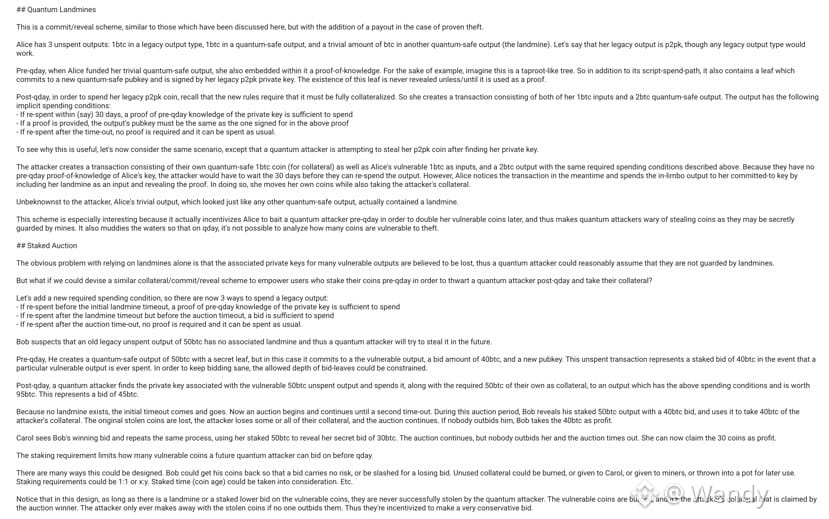
🚨 BITCOIN CORE DEVELOPER PROPOSES NEW DEFENSE AGAINST QUANTUM THEFT!
Bitcoin Core developer Cory Fields has outlined three mechanisms to discourage future quantum attacks on $BTC:
• Quantum Landmines
• Staked Auction
• Sats Auction
The proposal would require attackers targeting vulnerable Bitcoin to put up equivalent BTC as collateral, which they could lose.
Pre-registered owners could potentially claim that collateral, while auction mechanisms would create risks even for attacks on lost wallets.
The ideas remain conceptual, with no implementation confirmed.
#Bitcoin #QuantumComputing $BTC
{future}(BTCUSDT)
🚨 BITCOIN CORE DEVELOPER PROPOSES NEW DEFENSE AGAINST QUANTUM THEFT!
Bitcoin Core developer Cory Fields has outlined three mechanisms to discourage future quantum attacks on $BTC :
• Quantum Landmines
• Staked Auction
• Sats Auction
The proposal would require attackers targeting vulnerable Bitcoin to put up equivalent BTC as collateral, which they could lose.
Pre-registered owners could potentially claim that collateral, while auction mechanisms would create risks even for attacks on lost wallets.
The ideas remain conceptual, with no implementation confirmed.
#Bitcoin #QuantumComputing $BTC

6
1.9k

·
--
Bullish
Verified
🚨 $TAO IS PREPARING FOR THE QUANTUM COMPUTING ERA!
{future}(TAOUSDT)
Bittensor has introduced quantum-resistant wallet support, bringing post-quantum digital signatures and optional automatic signing-key rotation.
The upgrade aims to protect:
🔐 $TAO transfers
⚡ Staking operations
🛡️ Validator activities
Quantum threats may still be years away, but Bittensor is already taking steps toward stronger security.
The future of crypto isn't just about speed and scalability. It's also about staying secure. 🚀
#Bittensor #TAO #Crypto #Blockchain #QuantumComputing
🚨 $TAO IS PREPARING FOR THE QUANTUM COMPUTING ERA!
Bittensor has introduced quantum-resistant wallet support, bringing post-quantum digital signatures and optional automatic signing-key rotation.
The upgrade aims to protect:
🔐 $TAO transfers
⚡ Staking operations
🛡️ Validator activities
Quantum threats may still be years away, but Bittensor is already taking steps toward stronger security.
The future of crypto isn't just about speed and scalability. It's also about staying secure. 🚀
#Bittensor #TAO #Crypto #Blockchain #QuantumComputing

4
1.3k

·
--
On the day Nasdaq finally bounced, quantum stock IONQ was the wildest of them all: +23% in a day.
The facts: IonQ reported Q3 2026 results on Nov. 5 — revenue of $173.8 million, up 336% YoY, marking its sixth consecutive record quarter. Full-year guidance was raised to $505–515 million, up from $450–460 million previously and well above analysts’ consensus of around $456 million (IonQ’s official release, cited by CNBC via FactSet). Backlog stood at $1.2 billion, and Superion 256 system capacity for 2027 was already sold out. IONQ shares closed Friday, Nov. 6, up 23.42%.
Market context: Nasdaq rose 1.09% to 24,579.42 and the S&P 500 gained 0.31% to 7,376.86, while the Dow fell 0.46% — a modest bounce after Thursday became the worst day since April 2025 (Nasdaq −5.52%). Chips led the rebound: SOXX +3.5%, AMD +11%. Behind it was a hot U.S. jobs report: October payrolls rose by 165,000 versus expectations of around 65,000, and unemployment was 4.1% — increasing the odds of a Fed rate hike in December.
What I’m watching next: whether IONQ holds above Friday’s closing level as the market reassesses the valuation of a quantum company that is still losing money (Q3 adjusted EBITDA −$133.6 million), and U.S. CPI on Nov. 10 as next week’s key event.
My opinion: two guidance increases this year, plus a $1.2 billion backlog, explain why the market reacted so strongly. But it’s worth noting that some of this growth is supported by the SkyWater acquisition, and the company is still burning cash — this is a growth story, not a profitability story. A one-day bounce doesn’t prove a new trend.
This is my analysis, not financial advice — always DYOR.
What do you think: is IONQ’s surge the start of a rotation into quantum stocks, or just a bounce in a still-fragile market?
#QuantumComputing #SahamUSA
185

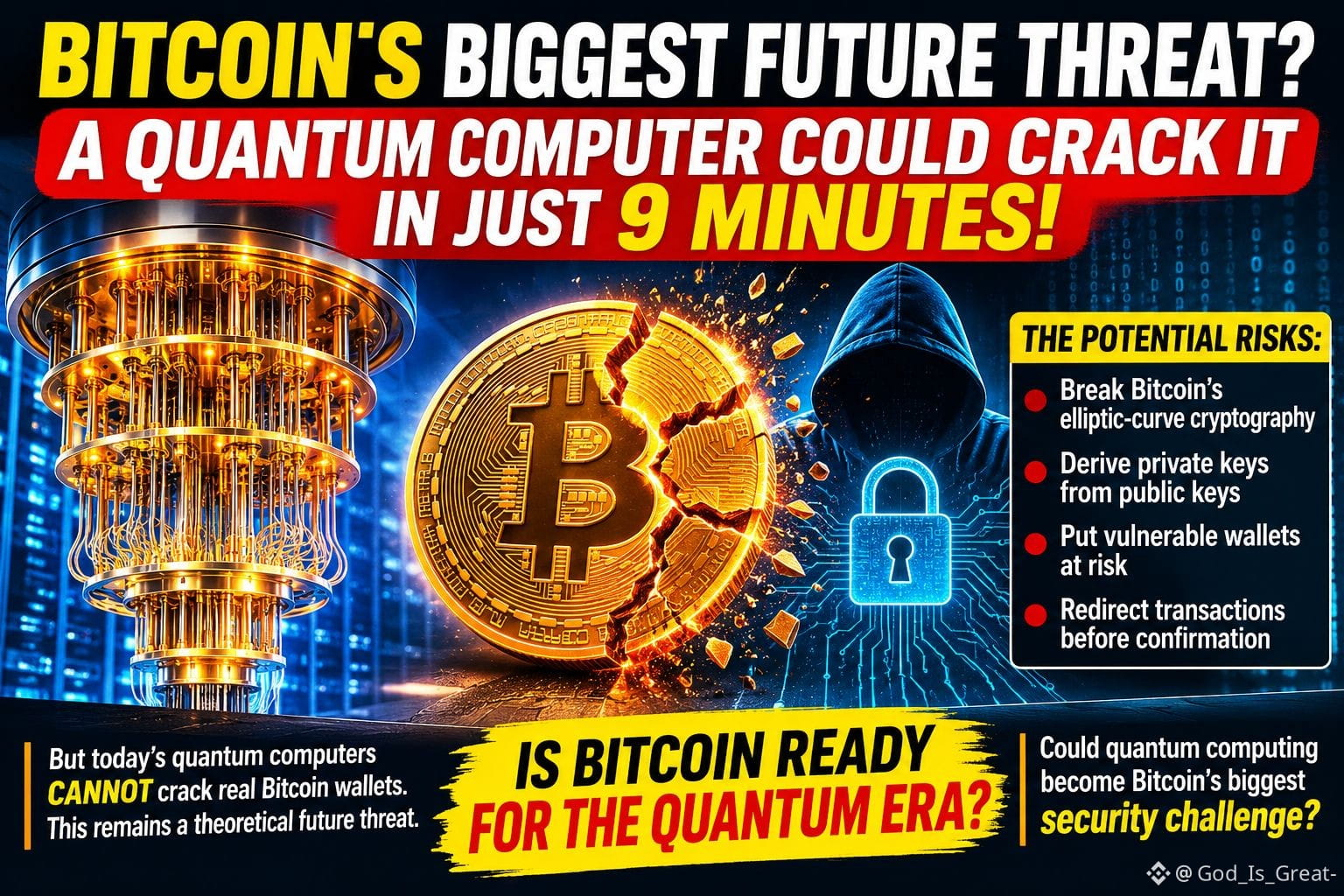
🚨 BITCOIN'S BIGGEST FUTURE THREAT? A QUANTUM COMPUTER COULD CRACK IT IN JUST 9 MINUTES!
What if the technology designed to power the future could also threaten Bitcoin?
Google Quantum AI research has raised serious questions about Bitcoin's long-term security.
A sufficiently powerful quantum computer could potentially:
Break Bitcoin's current elliptic-curve cryptography.
Derive private keys from exposed public keys.
Put vulnerable Bitcoin wallets at risk.
Potentially redirect transactions before confirmation.
But there is an important detail: today's quantum computers CANNOT crack real Bitcoin wallets. This remains a theoretical future threat.
The crypto industry may eventually need quantum-resistant security to protect digital assets.
The big question is: Is Bitcoin ready for the quantum era?
Could quantum computing become Bitcoin's biggest security challenge?
#bitcoin #quantumcomputing #BTC #CryptoSecurity #BinanceSquare
{spot}(ETHUSDT)
{spot}(BNBUSDT)
{spot}(BTCUSDT)
🚨 BITCOIN'S BIGGEST FUTURE THREAT? A QUANTUM COMPUTER COULD CRACK IT IN JUST 9 MINUTES!
What if the technology designed to power the future could also threaten Bitcoin?
Google Quantum AI research has raised serious questions about Bitcoin's long-term security.
A sufficiently powerful quantum computer could potentially:
Break Bitcoin's current elliptic-curve cryptography.
Derive private keys from exposed public keys.
Put vulnerable Bitcoin wallets at risk.
Potentially redirect transactions before confirmation.
But there is an important detail: today's quantum computers CANNOT crack real Bitcoin wallets. This remains a theoretical future threat.
The crypto industry may eventually need quantum-resistant security to protect digital assets.
The big question is: Is Bitcoin ready for the quantum era?
Could quantum computing become Bitcoin's biggest security challenge?
#bitcoin #quantumcomputing #BTC #CryptoSecurity #BinanceSquare
102

·
--
⚛️ QUANTUM COMPUTING VS. BITCOIN: IS BTC REALLY AT RISK? 🔓🧠⚡
A new theoretical study has emerged suggesting that a quantum computer would need “only” 29,588 physical qubits and about 1 hour to break the encryption of a Bitcoin public key. While sensationalists spread panic, those who analyze data and facts understand the reality behind these numbers.
📌 THE FACTS AND THE TECHNICAL REALITY:
1️⃣ The Calculation Is Purely Theoretical: The Alice & Bob projection requires extreme hardware conditions, perfect error-correction cycles, and an absence of noise—capabilities that current hardware is nowhere near delivering.
2️⃣ The Time Factor (1 Hour vs. 10 Minutes): Since quantum execution would take around 62 minutes, it would be unable to intercept and rewrite transactions in the mempool, given that the average Bitcoin block time is 10 minutes.
3️⃣ Exposed Keys vs. Reused Addresses: In theory, the quantum vulnerability affects only public keys that remain visible on the network for long periods (such as old, reused addresses).
4️⃣ Post-Quantum Transition (PQC): The Bitcoin developer community is already monitoring this research so it can implement quantum-resistant signatures (post-quantum cryptography) years in advance, before this hardware reaches the commercial market.
💡 ALEXANDRE 8 ANALYSIS:
Bitcoin’s security does not depend on illusions, but on mathematics, consensus, and continuous evolution. Quantum technology is advancing, but blockchain defense infrastructure is advancing in parallel. A smart investor doesn’t fall for short-term alarmism; they understand how decentralized governance is preparing for the challenges of the coming decades. (DYOR) 🔐
📌 Technical analysis, precision, and no guesswork. If you want to deeply understand the transformations in the crypto ecosystem, click FOLLOW now!
#Write2Earn #QuantumComputing #CryptoSecurity #RiskManagement

35
Log in to explore more content
Join global crypto users on Binance Square
⚡️ Get latest and useful information about crypto.
💬 Trusted by the world’s largest crypto exchange.
👍 Discover real insights from verified creators.
Email / Phone number
Trending Topics
1
#WhoWillSucceedJensenHuangatNvidia?
87,627 views
1,149 Discussing
2
#WhatWillDriveCryptoandStocks’NextRebound?
439,239 views
3,050 Discussing
3
#BitcoinActiveSupplyInProfitDropsBelow45%
26,051 views
365 Discussing
4
#KavaSaysAbnormalActivityLimitedToKavaLend
10,638 views
182 Discussing
5
#USSpotXRPETFsSeeLargestWeeklyOutflowIn8Months
9,738 views
175 Discussing
6
#USPPIMissMayEaseBTCPressure
211,130 views
2,062 Discussing
7
#WORPTLetsTouristsConvertCryptoToThaiBaht
2,831 views
51 Discussing
8
#TONStrategyReports$23.97MQ3NetLoss
3,714 views
41 Discussing
9
#PolkadotCommunityApprovesNewStrategyWith97%Vote
19,491 views
249 Discussing
10
#dYdXPlansV9.9UpgradeToShiftUSDCToInjective
12,350 views
200 Discussing