
#postquantum
postquantum
24,888 views
189 Discussing
Hot
Latest

Article
NEAR is preparing its first quantum-resistant signature… When will it launch?The first quantum-resistant digital signature option on the $NEAR network may be close: FIPS-204, known as ML-DSA, a lattice-based signature scheme approved by the National Institute of Standards and Technology (NIST).
The idea is that quantum computing poses a threat to every blockchain protocol, not just one network. The NEAR team believes its current architecture makes accounts and assets more resilient than those on many other networks in the face of this scenario.
NEAR is preparing its first quantum-resistant signature… When will it launch?
The first quantum-resistant digital signature option on the $NEAR network may be close: FIPS-204, known as ML-DSA, a lattice-based signature scheme approved by the National Institute of Standards and Technology (NIST).
The idea is that quantum computing poses a threat to every blockchain protocol, not just one network. The NEAR team believes its current architecture makes accounts and assets more resilient than those on many other networks in the face of this scenario.
The idea is that quantum computing poses a threat to every blockchain protocol, not just one network. The NEAR team believes its current architecture makes accounts and assets more resilient than those on many other networks in the face of this scenario.
58
·
--
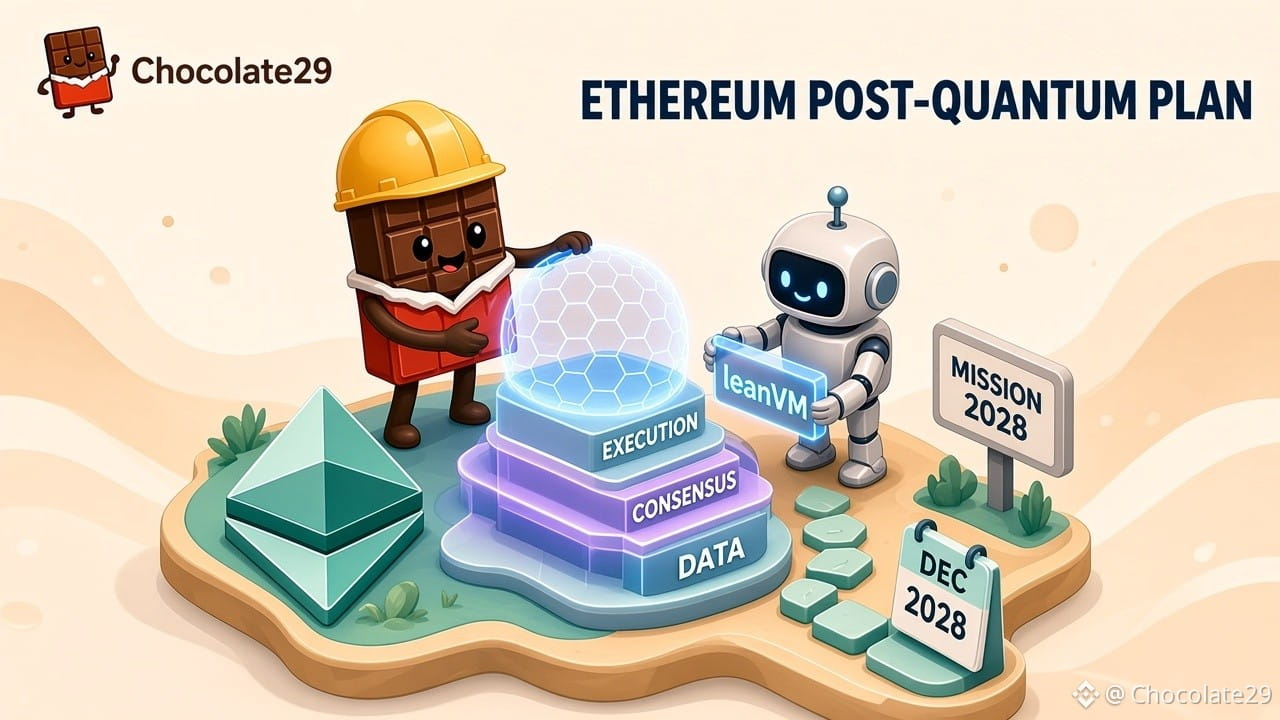
Ethereum just pulled its full post-quantum security target forward by a year, to December 2028.
At Devcon 8 in Mumbai on November 3, 2026, Ethereum Foundation researcher Justin Drake laid out "Mission 2028," aiming to make all three protocol layers quantum-resistant: post-quantum transactions on the execution layer, post-quantum attestations on the consensus layer and post-quantum sampling on the data layer. The September plan had pointed to December 2029. The new schedule sketches a mainnet upgrade milestone in January 2027, then roughly 24 months for three more forks.
Drake also said leanVM, a minimal zkVM that bundles hash-based post-quantum signatures into compact proofs, has reached end-to-end formal verification and can handle over 1,000 leanXMSS aggregations per second. leanXMSS is planned to replace BLS validator signatures. Specs and activation dates are not final yet, so December 2028 is a target, not a promise, but it is a clear long-term security signal for $ETH.
#Ethereum #PostQuantum #Devcon
DYOR. Not financial advice.
{spot}(ETHUSDT)
Ethereum just pulled its full post-quantum security target forward by a year, to December 2028.
At Devcon 8 in Mumbai on November 3, 2026, Ethereum Foundation researcher Justin Drake laid out "Mission 2028," aiming to make all three protocol layers quantum-resistant: post-quantum transactions on the execution layer, post-quantum attestations on the consensus layer and post-quantum sampling on the data layer. The September plan had pointed to December 2029. The new schedule sketches a mainnet upgrade milestone in January 2027, then roughly 24 months for three more forks.
Drake also said leanVM, a minimal zkVM that bundles hash-based post-quantum signatures into compact proofs, has reached end-to-end formal verification and can handle over 1,000 leanXMSS aggregations per second. leanXMSS is planned to replace BLS validator signatures. Specs and activation dates are not final yet, so December 2028 is a target, not a promise, but it is a clear long-term security signal for $ETH.
#Ethereum #PostQuantum #Devcon
DYOR. Not financial advice.
142

Hong Kong Launches Post-Quantum Cryptographic Vulnerability Assessment Tool for Banks
- The Hong Kong Monetary Authority (HKMA) and the Hong Kong University of Science and Technology announced the launch of a post-quantum cryptographic vulnerability assessment tool on November 2.
- The tool helps banks identify and standardize the risks that quantum computing poses to their current cryptographic infrastructure.
- The initiative aims to prepare Chinese banks for the transition from classical cryptography to post-quantum cryptography.
#BinanceSquare #CryptoNews #PostQuantum #Blockchain #Web3
$btc $eth
vlikevn Titanbot
Source: NewsBTC
262
Hong Kong Launches Post-Quantum Toolkit for Banks
- The Hong Kong Monetary Authority and the Hong Kong University of Science and Technology announced a post-quantum cryptography assessment toolkit.
- The toolkit helps banks prepare for risks posed by quantum computers.
- Announced on November 2.
#BinanceSquare #CryptoNews #PostQuantum #HongKong
$btc $eth
#vlikevn Titanbot
Source: NewsBTC
87

·
--
Quantum-proofing Ethereum is moving from theory to proposals.
An Ethereum Foundation researcher has put forward an EIP for post-quantum PeerDAS and variable-size blobs, per ME News (Nov 1). It targets the data-availability layer that rollups depend on.
My take: nothing urgent for price, but long-term security work like this is what institutions quietly check before committing capital. $ETH sits near $2,270 today.
Which matters more for ETH over the next year: quantum readiness or scaling throughput?
#Ethereum #PostQuantum #Layer2 $ETH $BTC
Not financial advice.
12

·
--
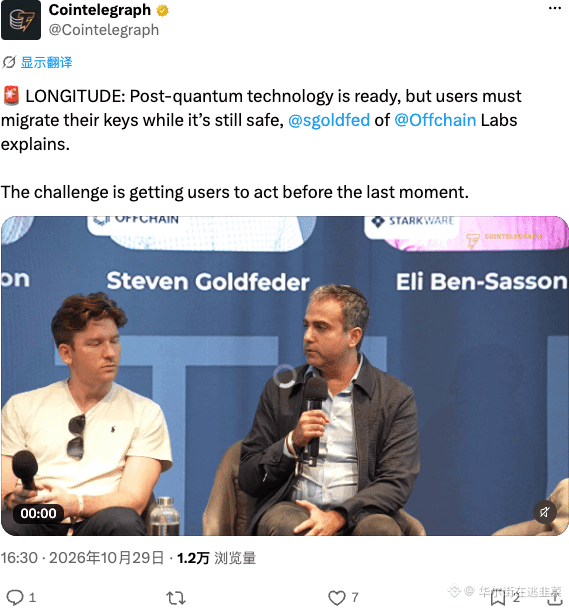
Post-quantum encryption is already solved, but the biggest risk isn’t the technology—it’s execution.
Users need to replace their keys ASAP. Don’t wait until quantum supremacy arrives to think about getting out; by then, your assets could be worth zero, and there’ll be nowhere to cry.
$ARB #PostQuantum
Users need to replace their keys ASAP. Don’t wait until quantum supremacy arrives to think about getting out; by then, your assets could be worth zero, and there’ll be nowhere to cry.
$ARB #PostQuantum
159


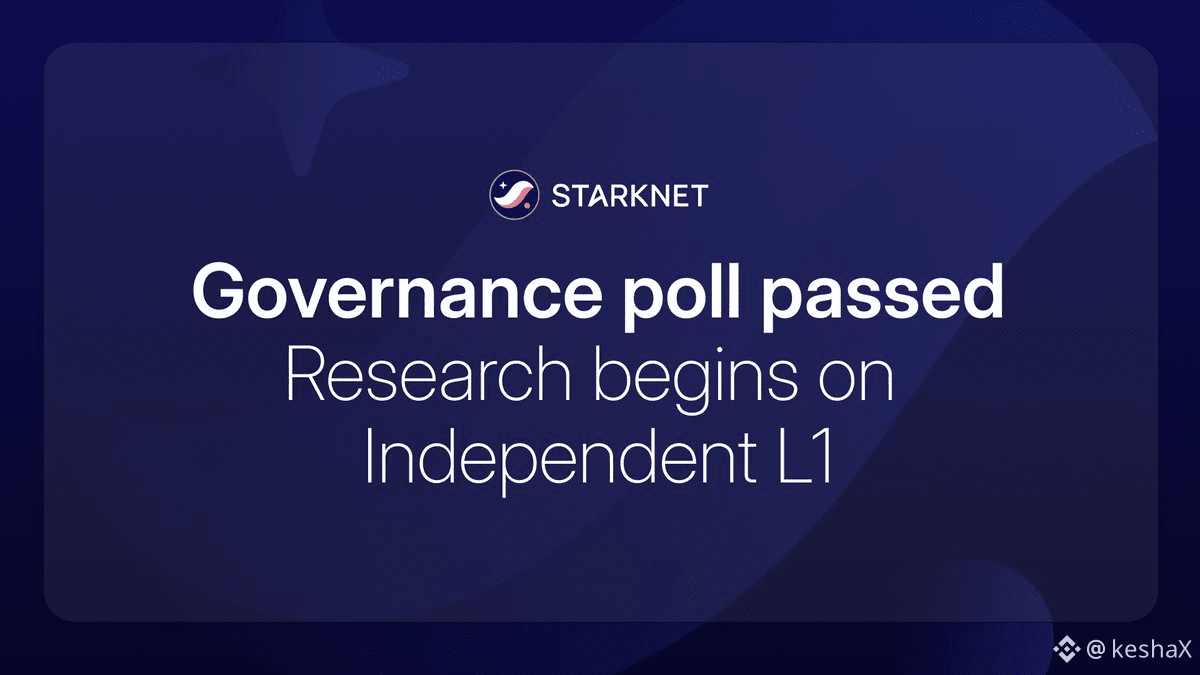
Starknet community votes to study going L1
Starknet's governance poll passed. Research now starts on whether Starknet should become an independent, post-quantum L1 instead of an Ethereum L2. A joint StarkWare and Starknet Foundation working group will publish a paper in the coming months.
Their reason is timing. Starknet targets full post-quantum security by 2027, and Ethereum targets 2029. Any real move still needs a separate community vote. $STRK
Would you back Starknet going solo?
#STARKNET #STRK #PostQuantum
Source: Starknet on X, follow-up post
{spot}(STRKUSDT)
Starknet community votes to study going L1
Starknet's governance poll passed. Research now starts on whether Starknet should become an independent, post-quantum L1 instead of an Ethereum L2. A joint StarkWare and Starknet Foundation working group will publish a paper in the coming months.
Their reason is timing. Starknet targets full post-quantum security by 2027, and Ethereum targets 2029. Any real move still needs a separate community vote. $STRK
Would you back Starknet going solo?
#STARKNET #STRK #PostQuantum
Source: Starknet on X, follow-up post
344

·
--
⚛️ STARKNET VOTED TO STUDY LEAVING ETHEREUM
→ 93.52% of voting power backed researching an independent, post-quantum L1
→ A StarkWare and Starknet Foundation working group starts today
→ A research paper is due "in the coming months"
Important: this approves research, not a migration. But an L2 openly asking whether it should be its own chain is a big narrative shift.
Should L2s go independent, or stay tied to Ethereum security? 👇
{spot}(STRKUSDT)
#STRK #Starknet #PostQuantum #Layer2
⚛️ STARKNET VOTED TO STUDY LEAVING ETHEREUM
→ 93.52% of voting power backed researching an independent, post-quantum L1
→ A StarkWare and Starknet Foundation working group starts today
→ A research paper is due "in the coming months"
Important: this approves research, not a migration. But an L2 openly asking whether it should be its own chain is a big narrative shift.
Should L2s go independent, or stay tied to Ethereum security? 👇
#STRK #Starknet #PostQuantum #Layer2
1
451

·
--
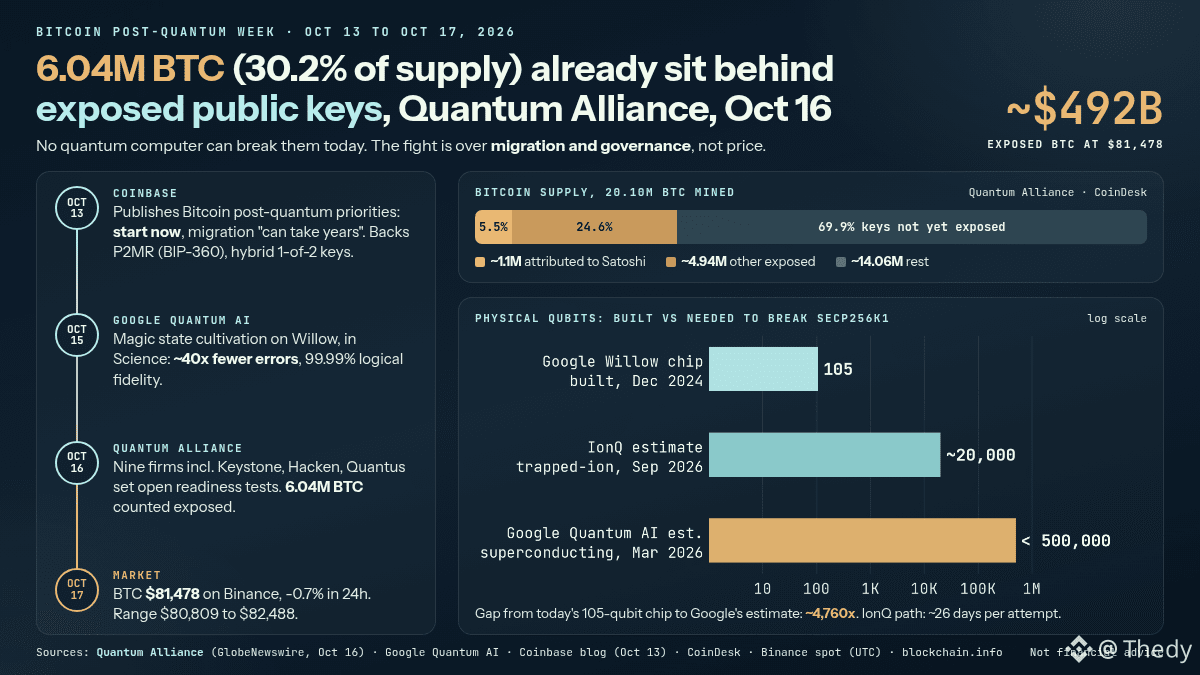
Bitcoin and quantum computing: in 4 days, Coinbase, Google, and the new Quantum Alliance reignited the debate, with a number to back it up: 6.04 M $BTC (30.2% of the supply) already have their public keys exposed.
The week’s timeline:
• 13/10: Coinbase publishes its post-quantum priorities for Bitcoin. We need to start now; migration “could take years.” Options: P2MR (BIP-360) and a hybrid 1-of-2 scheme.
• 15/10: Google Quantum AI publishes “magic state cultivation” on its Willow chip in Science: errors reduced by ~40, with 99.99% logical fidelity.
• 16/10: Nine players (including Keystone, Hacken, and Quantus) launch the Quantum Alliance. Their estimate: 6.04 M BTC exposed. CoinDesk says 6.4 M, Benzinga 6.26 M, but the ballpark remains ~30%.
• 17/10: $BTC at $81,478 on Binance (-0.7% over 24 h). The market is pricing in nothing.
The gap remains huge: according to Google’s March 2026 white paper, breaking secp256k1 (the curve used by Bitcoin and $ETH) would require fewer than 500,000 physical qubits. Willow has 105. No existing machine is capable of it.
My take: the near-term risk is political, not technical. The exposed coins include ~1.1 M BTC attributed to Satoshi (CoinDesk), and no one agrees on what should happen to them. Several Alliance members sell post-quantum solutions: take their 2028 timeline with a grain of salt.
Two possible paths:
1. The debate stays technical (BIP-360, Alliance tests), BTC trades on macro factors, with a 24 h range of $80,800 to $82,500.
2. A further reduction in qubit estimates or a formal proposal to freeze coins: fear returns, and security becomes a pricing factor.
Freezing exposed coins that never migrate (an idea raised by CZ and Jameson Lopp, according to CoinDesk): network protection or the end of the promise that “no one can confiscate your BTC”?
#Bitcoin #PostQuantum
Bitcoin and quantum computing: in 4 days, Coinbase, Google, and the new Quantum Alliance reignited the debate, with a number to back it up: 6.04 M $BTC (30.2% of the supply) already have their public keys exposed.
The week’s timeline:
• 13/10: Coinbase publishes its post-quantum priorities for Bitcoin. We need to start now; migration “could take years.” Options: P2MR (BIP-360) and a hybrid 1-of-2 scheme.
• 15/10: Google Quantum AI publishes “magic state cultivation” on its Willow chip in Science: errors reduced by ~40, with 99.99% logical fidelity.
• 16/10: Nine players (including Keystone, Hacken, and Quantus) launch the Quantum Alliance. Their estimate: 6.04 M BTC exposed. CoinDesk says 6.4 M, Benzinga 6.26 M, but the ballpark remains ~30%.
• 17/10: $BTC at $81,478 on Binance (-0.7% over 24 h). The market is pricing in nothing.
The gap remains huge: according to Google’s March 2026 white paper, breaking secp256k1 (the curve used by Bitcoin and $ETH ) would require fewer than 500,000 physical qubits. Willow has 105. No existing machine is capable of it.
My take: the near-term risk is political, not technical. The exposed coins include ~1.1 M BTC attributed to Satoshi (CoinDesk), and no one agrees on what should happen to them. Several Alliance members sell post-quantum solutions: take their 2028 timeline with a grain of salt.
Two possible paths:
1. The debate stays technical (BIP-360, Alliance tests), BTC trades on macro factors, with a 24 h range of $80,800 to $82,500.
2. A further reduction in qubit estimates or a formal proposal to freeze coins: fear returns, and security becomes a pricing factor.
Freezing exposed coins that never migrate (an idea raised by CZ and Jameson Lopp, according to CoinDesk): network protection or the end of the promise that “no one can confiscate your BTC”?
#Bitcoin #PostQuantum
58

·
--
New Track Under the Quantum Decryption Countdown: QIZ Security Completes a $1.7M Seed Round, Co-led by Evolution Equity Partners and Singtel Innov8.
Founded in 2025, the company is moving into an area that mainstream attention has not yet fully caught up with—but regulatory pressure is accumulating rapidly: Cryptographic Posture Management (CPM) and post-quantum cryptography (PQC) governance.
The product logic is straightforward:
· No agents required—pure API-based automated scanning of enterprise cryptographic assets
· Identify all keys, protocol versions, and weak encryption points
· Produce migration roadmaps aimed at Q-Day
· Align with PQC compliance frameworks from NIST, the EU, and more
Why it’s worth watching: NIST is already pushing for PQC standardization, and the U.S. OMB requires federal agencies to complete migration by 2035. Timelines are even tighter for the finance and telecom industries. Many enterprises don’t even know how much RSA/ECC they have running—this is the first slice of the pie QIZ wants to go after.
The seed round amount isn’t huge, but the storyline is long-term: Web3 private-key infrastructure, cross-chain bridges, and Layer 1 signature algorithms will all inevitably run into the PQC migration challenge.
Add it to your watchlist—not something to chase immediately.
#PostQuantum #加密安全 #融资观察
64

·
--
Top cryptographers just met and could not agree — and that is actually the most important signal.
Coinbase convened a panel to address whether $BTC needs post-quantum protection. The consensus: start preparing now. The disagreement: what to do with roughly 1 million BTC sitting in wallets with exposed public keys — including Satoshi's coins.
Two uncomfortable options:
→ Soft fork to freeze those wallets = a protocol-level precedent that changes what Bitcoin fundamentally is
→ Leave them exposed = quantum attackers eventually drain dormant supply back into circulation
This is not a distant sci-fi risk. It is an active governance debate. And $BTC has no fast-moving upgrade mechanism — that is by design, but it makes the timeline tighter than most people think.
Meanwhile $ETH has post-quantum architecture on its active roadmap. $ADA was designed with long-term cryptographic resilience in mind from day one.
The market is not pricing any of this. But in a 5-10 year window, post-quantum infrastructure could become the single most important L1 selection criterion for institutional allocators — not TPS, not fees.
Watch this debate. The answer reshapes the whole landscape.
#Bitcoin #PostQuantum #CryptoSecurity #Blockchain
77

·
--
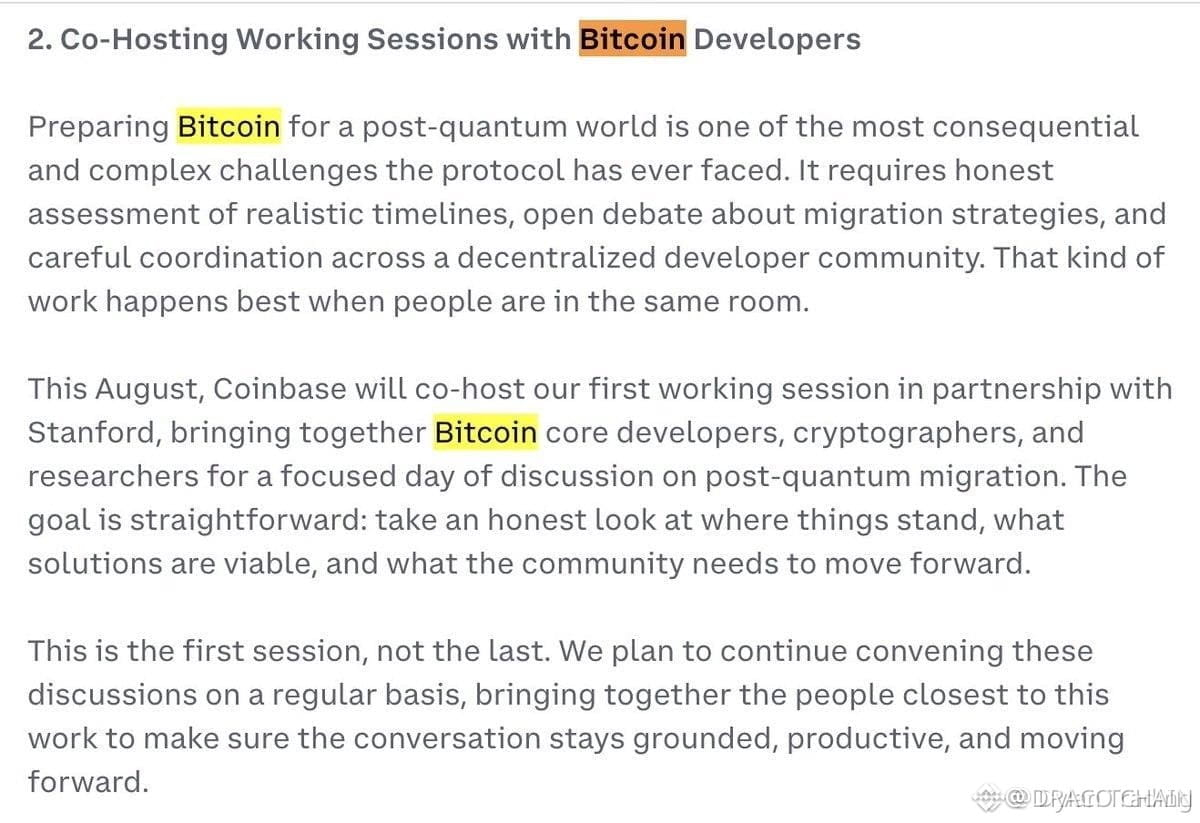
💥 COINBASE STANFORD COLLABORATION: POST-QUANTUM BITCOIN IS THE NEXT CATALYST 🦈
🚀 The intersection of institutional infrastructure and academic research is where foundational shifts occur. Coinbase and Stanford diving into post-quantum solutions isn't just news—it's a structural reinforcement of Bitcoin's long-term security thesis. 📊
🔍 This partnership signals deep capital allocation toward future-proofing the ecosystem. Smart money sees quantum resilience as a pivotal upgrade, not a distant risk. The focus on innovation and growth here is a direct tailwind for the entire Bitcoin layer. 💡
💬 How are you positioning for the next phase of Bitcoin's evolution—are you accumulating on these structural upgrades? 👇
⚠️ Not financial advice. Always manage your risk. 🛡️
🏷️ #Bitcoin #PostQuantum #CryptoInnovation #Coinbase #Stanford
🔥 📊
BTC-3.44%
COINUS-3.74%
53

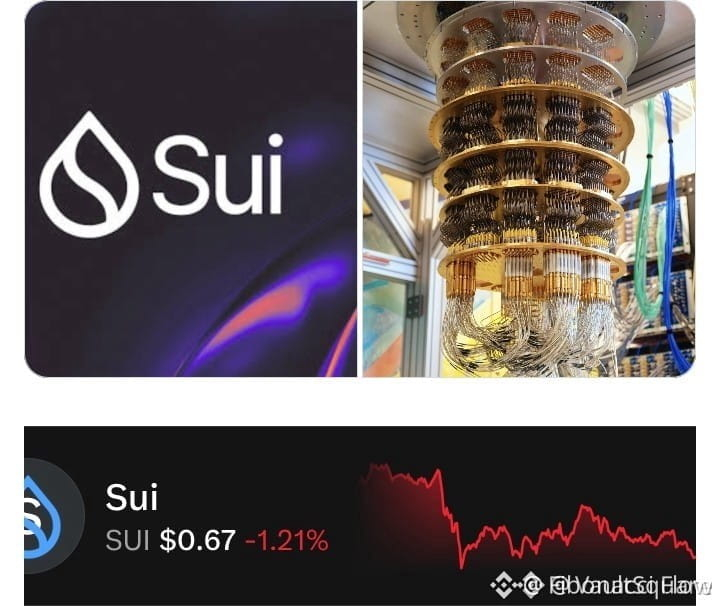
🚨 $SUI FUTURE-PROOFS ITSELF WITH NIST QUANTUM KEYS! ⚡
Sui just dropped a serious security bomb. Integrating two NIST-approved quantum-proof signature schemes means today's holders won't need to panic-migrate when the quantum era lands. No seed phrase gymnastics, no address swaps — just a clean, invisible upgrade built into the protocol. 💡
The timeline stretches to late 2026 into Q1 2027, but the catalyst is already here. This is the kind of backend armor that separates institutional-grade chains from the rest of the pack. It's a patience play, but the risk/reward calculus for holding $SUI just got sharper. Are you parking capital here for the quantum leap, or waiting for the mainstream panic to push prices up first? 👇
⚠️ Not financial advice. Always manage your risk. 🛡️
🏷️ #SUI #QuantumSafe #PostQuantum #CryptoNews
💎
84

·
--
Lightning’s post-quantum risk is not solved by a Bitcoin signature upgrade alone.
KEY FINDING
Bitcoin Layer 1 consensus support is needed to protect channel funds if spending cryptography changes. Separately, Lightning needs upgrades for off-chain surfaces: node identities, transport, gossip, invoices, offers, payment onions, channel state, and penalty transactions.
WHY IT MATTERS
Lightning relies on elliptic-curve cryptography, including ECDSA/Schnorr-style signatures and elliptic-curve key exchange. A capable quantum computer could threaten these assumptions through Shor’s algorithm. “Harvest now, decrypt later” could expose identities, node relationships, and payment metadata—not only funds.
PROPOSED DIRECTION
The PQLN preprint describes a hybrid approach: retain classical mechanisms while adding post-quantum protection. It targets Lightning’s off-chain surfaces with ML-DSA, NIST’s lattice-based signature scheme (FIPS 204), and ML-KEM, its key-encapsulation mechanism (FIPS 203). Deployment requires migration and downgrade-resistance testing.
THE CRITICAL DISTINCTION
Lightning can upgrade transport, authentication, onion encryption, and payment semantics. But if channel funds require new spending rules or signature types, Bitcoin Layer 1 consensus must recognize and enforce them. No Lightning-only patch can create that base-layer support.
BOTTOM LINE
Readiness requires two tracks: Lightning upgrades for off-chain confidentiality and authentication, plus Bitcoin consensus changes where channel-fund rules require them. Neither substitutes for the other. This is forward-looking analysis, not a claim that a quantum computer exists today.
Sources:
https://arxiv.org/abs/2609.13781
https://csrc.nist.gov/pubs/fips/203/final
https://csrc.nist.gov/pubs/fips/204/final
https://github.com/lightning/bolts/blob/master/04-onion-routing.md
https://github.com/lightning/bolts/blob/master/08-transport.md
#Bitcoin #LightningNetwork #PostQuantum #BinanceAngels
90
·
--
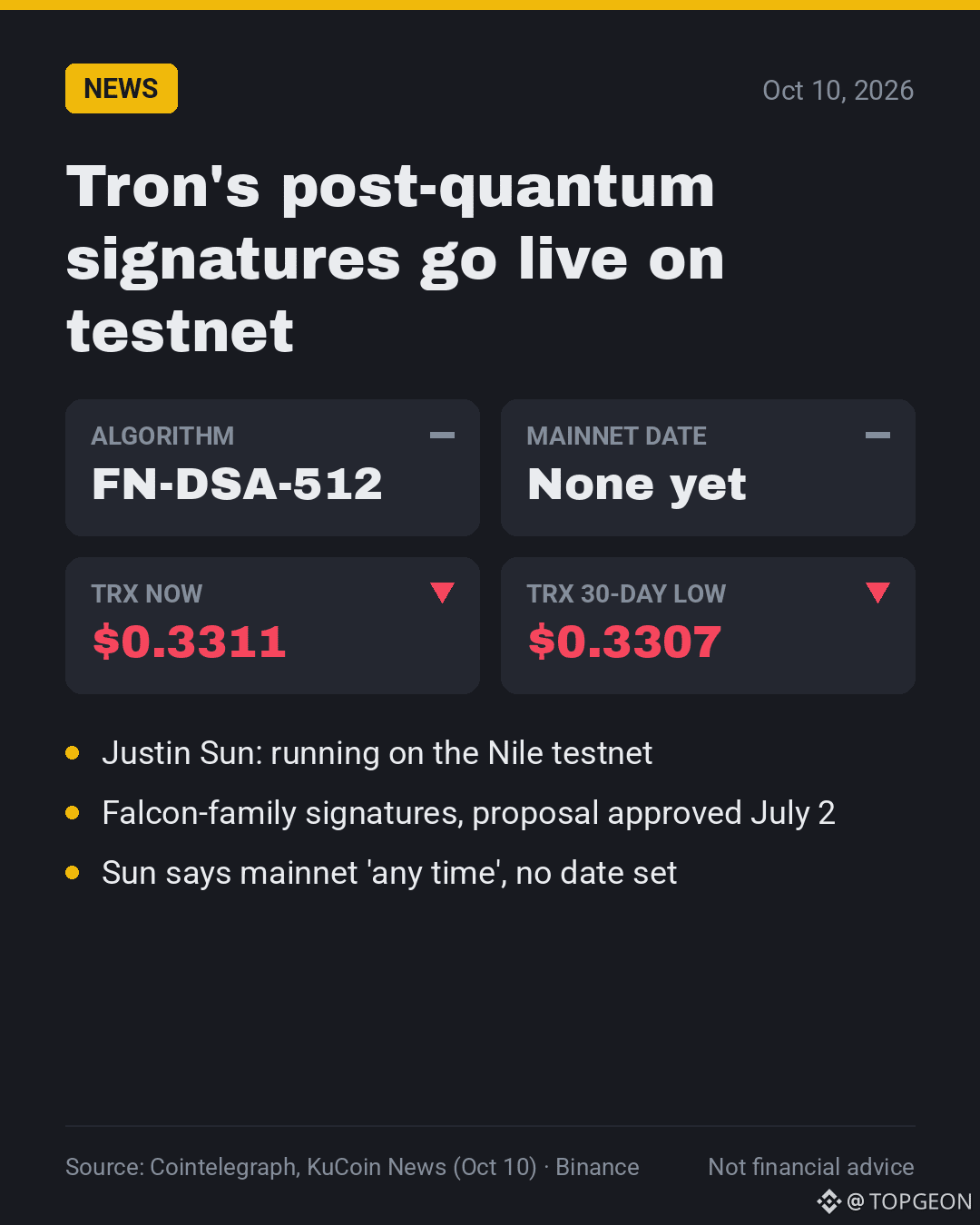
🔐 $TRX goes post-quantum on testnet, price sits at a 30-day low
1️⃣ Justin Sun: quantum-safe signatures now live on the Nile testnet
2️⃣ Uses FN-DSA-512 (Falcon family), a NIST-backed scheme
3️⃣ Mainnet "any time", per Sun, but no date is set
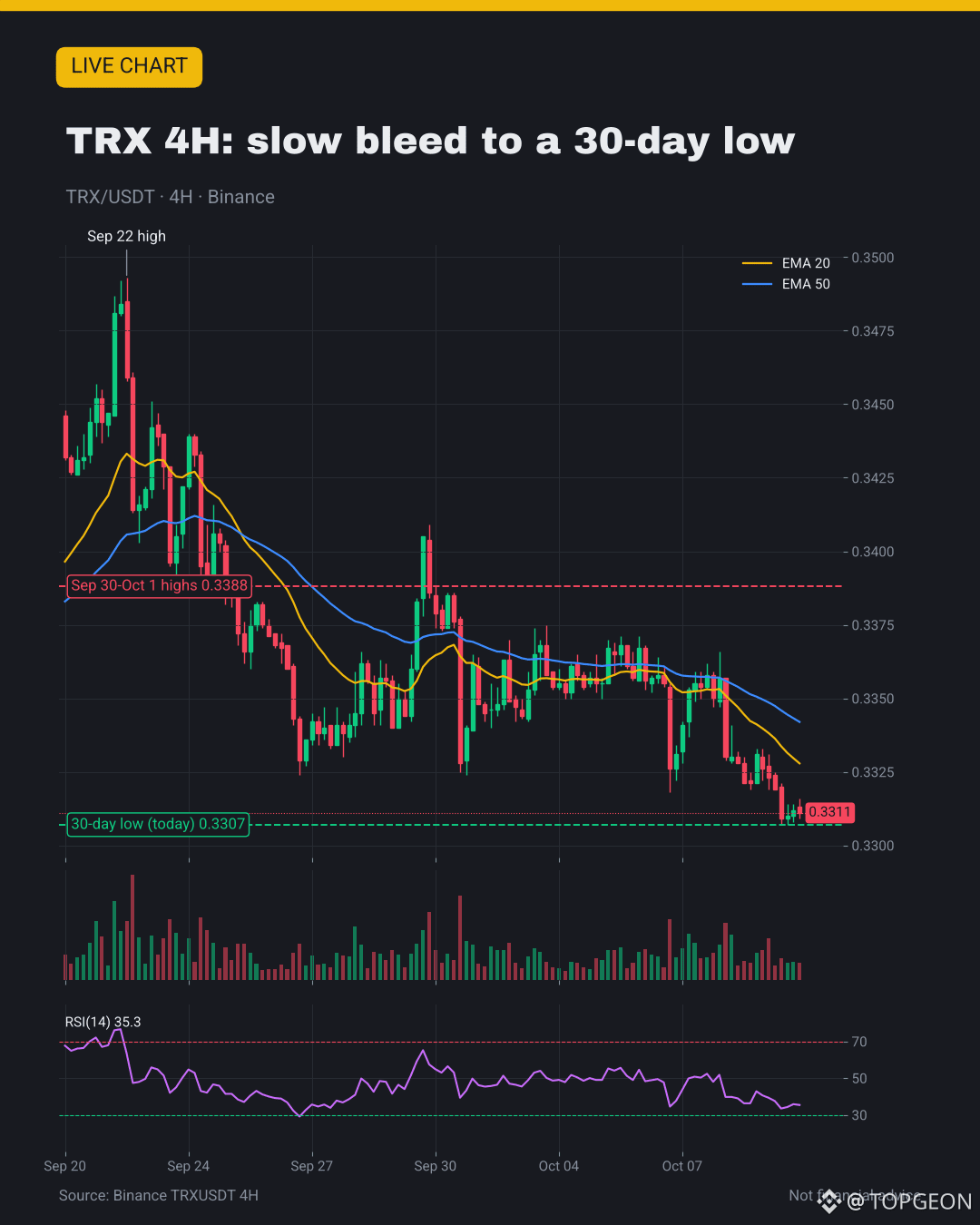
📉 TRX $0.3311: tagged $0.3307 today, lowest in 30 days
📊 Under falling 4H 20/50 EMA ($0.333/$0.334), RSI 35
🎯 My take: news isn't price yet; reclaim $0.3388 or $0.33 gives way
💬 Should every chain ship quantum-safe keys before 2030? 👇
#Tron #QuantumComputing #PostQuantum
18

Verified
#nearaccountssupportpostquantummldsa
While Bitcoin Debates Quantum Risk, NEAR Is Letting Users Swap Their Keys in Place
After a week of headlines about exposed public keys and AI-driven cryptography worries, one network is pointing to a practical answer: rotate the key, keep the account.
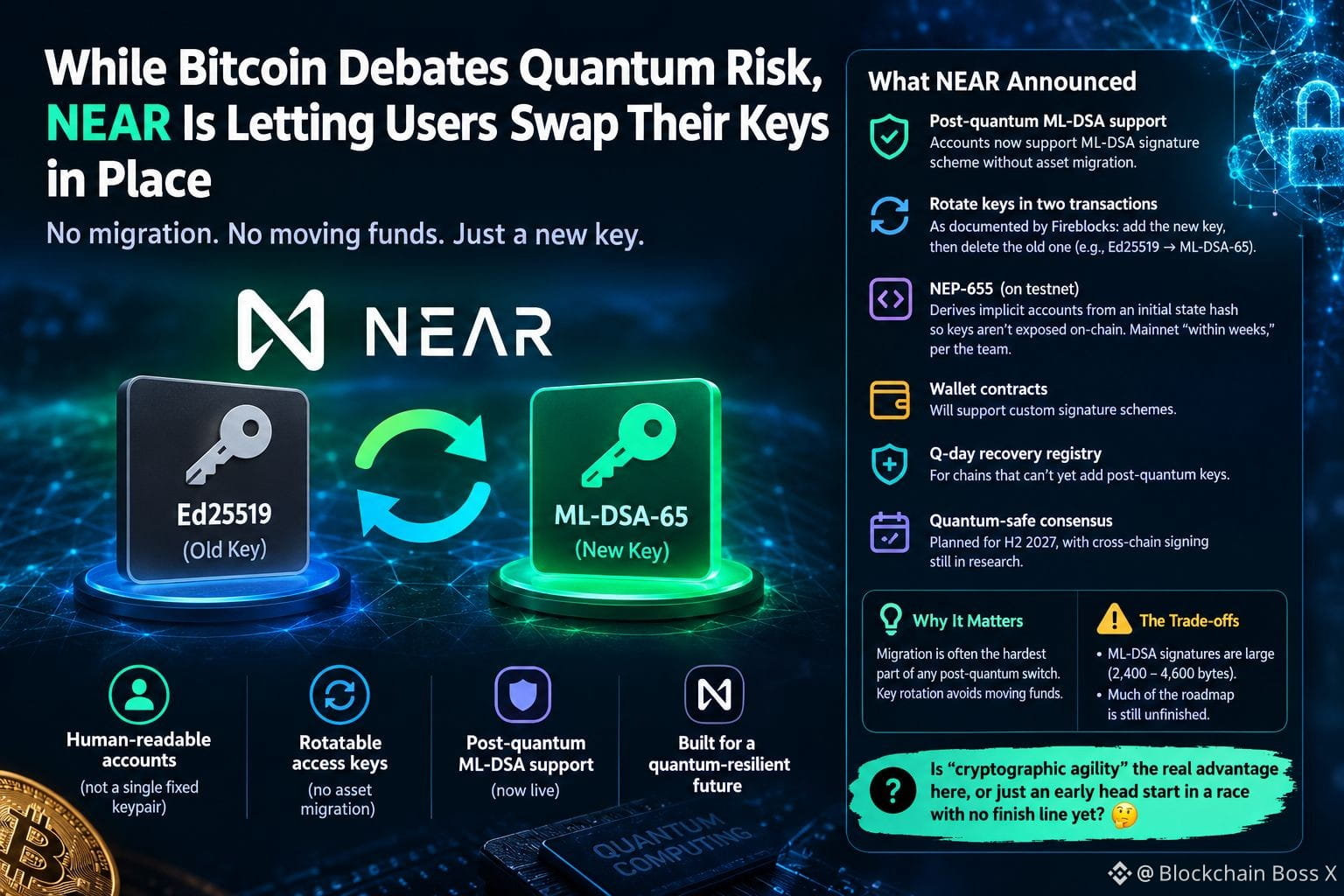
Here's what NEAR announced: its accounts now support the post-quantum ML-DSA signature scheme without asset migration. That works because NEAR accounts use human-readable IDs controlled by rotatable access keys, not a single fixed keypair. Fireblocks recently documented rotating a funded account from Ed25519 to ML-DSA-65 in two transactions: add the new key, then delete the old one. Ahead are NEP-655, which would derive implicit accounts from an initial state hash so keys aren't exposed on-chain (live on testnet, mainnet "within weeks," per the team), wallet contracts supporting custom signature schemes, and a "Q-day recovery registry" for chains that can't yet add post-quantum keys. NEAR's roadmap puts quantum-safe consensus in the second half of 2027, with cross-chain signing still in research.
Why does this matter? Migration is often cited as the hardest part of any post-quantum switch, and designs that allow key rotation avoid moving funds. The trade-offs are real, though: ML-DSA signatures run from about 2,400 to 4,600 bytes, far larger than today's, and much of the roadmap is still unfinished.
Is "cryptographic agility" the real advantage here, or just an early head start in a race with no finish line yet? 🤔
#Near #PostQuantum #blockchain
$LUMIA $BTC $NEAR
{future}(NEARUSDT)
{future}(BTCUSDT)
{future}(LUMIAUSDT)
#nearaccountssupportpostquantummldsa
While Bitcoin Debates Quantum Risk, NEAR Is Letting Users Swap Their Keys in Place
After a week of headlines about exposed public keys and AI-driven cryptography worries, one network is pointing to a practical answer: rotate the key, keep the account.
Here's what NEAR announced: its accounts now support the post-quantum ML-DSA signature scheme without asset migration. That works because NEAR accounts use human-readable IDs controlled by rotatable access keys, not a single fixed keypair. Fireblocks recently documented rotating a funded account from Ed25519 to ML-DSA-65 in two transactions: add the new key, then delete the old one. Ahead are NEP-655, which would derive implicit accounts from an initial state hash so keys aren't exposed on-chain (live on testnet, mainnet "within weeks," per the team), wallet contracts supporting custom signature schemes, and a "Q-day recovery registry" for chains that can't yet add post-quantum keys. NEAR's roadmap puts quantum-safe consensus in the second half of 2027, with cross-chain signing still in research.
Why does this matter? Migration is often cited as the hardest part of any post-quantum switch, and designs that allow key rotation avoid moving funds. The trade-offs are real, though: ML-DSA signatures run from about 2,400 to 4,600 bytes, far larger than today's, and much of the roadmap is still unfinished.
Is "cryptographic agility" the real advantage here, or just an early head start in a race with no finish line yet? 🤔
#Near #PostQuantum #blockchain
$LUMIA $BTC $NEAR
4
2.3k

·
--
The fundamental transformation here is massive! 🛡️ Watching $ZEC spearhead this post-quantum privacy layer proves that the market is finally moving away from speculative hype and shifting toward institutional-grade cryptography.
While this advanced ecosystem experiences a well-deserved structural repricing phase, keeping an eye on alternative setups like $2Z and $1000CHEEMS is highly tactical, as asymmetric liquidity tends to cascade into under-the-radar market structures right before the broader crowd catches on. The narrative shift is real! ⚡
#PostQuantum #AdvancedCryptography #StructuralRepricing #AsymmetricLiquidity #NarrativeShift

crypto 93
·
--
🚀🔥 Zcash $ZEC is absolutely RIPPING while most people are still sitting on the sidelines 😳📈
And honestly… this no longer feels like just another “privacy coin” story 👀⚡
🛡️ Zcash Foundation and Electric Coin Company already support fully shielded transactions 🔒
Meaning:
👤 Sender hidden
👤 Receiver hidden
💰 Transaction amount encrypted
All powered by advanced zk-proofs 🤯💎
⚛️ While most blockchains barely talk about quantum threats…
$ZEC is already preparing for a post-quantum future 🚀🧠
The team has discussed:
✅ Quantum-recoverable wallets
✅ Major protocol upgrades
✅ Long-term security resilience 🔥
And don’t forget the massive Halo upgrade 👇
🌀 Halo removed the old trusted setup assumption, making Zcash:
⚡ More trustless
📈 More scalable
🔐 More secure
As AI surveillance keeps expanding 🤖👁️ and quantum concerns grow ⚛️📡
Privacy is starting to feel less OPTIONAL… and more INEVITABLE 🌍🔥
📊 ZEC is already up over 15x in the past year 🚀
Yet many still believe the move is over 😳
But what if the REAL repricing phase is only beginning? 👀💥
At this point… four-digit $ZEC no longer sounds impossible anymore 💸🌕
#ZEC #Zcash #Crypto #Privacy #Bitcoin #Quantum #AI #Blockchain 🚀🔥
1
318
·
--
$XRP POST QUANTUM READINESS ROADMAP UNVEILED WITH 5 MAJOR UPGRADES 🔥
Entry: No specific trade signal available
The $XRP ecosystem is witnessing significant advancements with the introduction of a post quantum roadmap, focusing on long-term resilience and security, which could potentially boost investor confidence and drive adoption, but will this development be enough to trigger a major price movement?
Not financial advice, manage your risk
#XRP #PostQuantum #LongSetup
⚡️
89
·
--
Quantum threats are shifting from “future risk” to “compliance countdown.”
QIZ Security has just secured a $17 million seed round, led by Bessemer and Merlin Ventures, with participation from Evolution, Singtel Innov8, and others. The team’s background is especially noteworthy: Co-founder Itan Barmes previously led Deloitte’s global quantum network security readiness business, focusing on the hardest-to-crack piece—“crypto-asset discovery + a PQC migration roadmap.”
What I care about more is how it lands in the real world: the four highly sensitive industries—finance, telecom, healthcare, and critical infrastructure—are already using it. Partners can directly engage with Cisco, AWS, Google, CrowdStrike, and IBM. This means enterprise-grade PQC migration is no longer just a whitepaper topic, but a line item in a procurement budget.
The knock-on impact for the crypto industry can’t be ignored: the underlying signature schemes of BTC and ETH (ECDSA/Schnorr) are, in theory, within the range of quantum attacks. Once traditional security vendors push the on-chain migration timeline to accelerate, PQC concepts (lattice cryptography, hash signatures) may be the first to get spotlighted in managed services, cross-chain bridges, and institutional wallet scenarios.
In the short term, it won’t cause a market crash, but this kind of “invisible infrastructure funding” often serves as a setup for the next round of narrative. Worth adding to an observation list.
#PostQuantum #CyberSecurity #CryptoInfra
30

·
--
$ETH 'S CRYPTOGRAPHIC REVOLUTION: POSEIDON OUT, SHA2 IN 🔐⚡
Ethereum L1 is making a historic pivot. Justin Drake confirmed the network will abandon Poseidon — the SNARK-friendly hash standard since 2019 — in favor of battle-tested traditional hashes like SHA2 and BLAKE2s. The catalyst? A SNARK design breakthrough.
By natively aligning binary field operations with traditional hashes, proofs now hit 1 million per second at just ~100x overhead. Drake calls it "science fiction-grade cryptography," crediting Binius and Flock. This accelerates Ethereum's roadmap — leanVM lands in 2027, with full layer deployment in 2028.
In the post-quantum arms race, hash-based schemes are emerging victorious over lattice and isogeny approaches. AI-powered cryptographic analysis is shifting the battlefield, and Ethereum sits at the front line.
How do you see this shift impacting Ethereum's long-term security narrative? 👇
⚠️ Not financial advice. Always manage your risk. 🛡️
🏷️ $ETH #Ethereum #Cryptography #PostQuantum #Blockchain
🔐⚡
34
Log in to explore more content
Join global crypto users on Binance Square
⚡️ Get latest and useful information about crypto.
💬 Trusted by the world’s largest crypto exchange.
👍 Discover real insights from verified creators.
Email / Phone number
Trending Topics
1
#WhoWillSucceedJensenHuangatNvidia?
194,321 views
1,766 Discussing
2
#WhatWillDriveCryptoandStocks’NextRebound?
609,508 views
3,598 Discussing
3
#TradFiForBeginners
745,437 views
4,570 Discussing
4
#BitcoinActiveSupplyInProfitDropsBelow45%
86,864 views
792 Discussing
5
#KavaSaysAbnormalActivityLimitedToKavaLend
52,344 views
447 Discussing
6
#USSpotXRPETFsSeeLargestWeeklyOutflowIn8Months
36,982 views
390 Discussing
7
#USPPIMissMayEaseBTCPressure
321,748 views
2,313 Discussing
8
#WORPTLetsTouristsConvertCryptoToThaiBaht
11,505 views
110 Discussing
9
#TONStrategyReports$23.97MQ3NetLoss
11,165 views
49 Discussing
10
#PolkadotCommunityApprovesNewStrategyWith97%Vote
31,352 views
303 Discussing