
#coinbase
coinbase
2.5M views
8,918 Discussing
Hot
Latest


·
--
🤖 Armstrong: AI agents may process up to $5 trillion by 2030
Coinbase CEO Brian Armstrong posted the remarks he planned for CNBC after the channel cut him off to cover Jensen Huang resigning from Nvidia. Security is what clients ask about most: more than 99% of crypto Coinbase stores is in cold storage, no single person, laptop, or system can move customer money, seven of the world's largest banks work with the exchange, and it holds 80+ licenses.
He said there will soon be more AI agents than humans, cited forecasts of $3 trillion to $5 trillion in agent transactions by 2030, called crypto an ideal execution rail, said an AI-enabled financial account is a top priority, and wrote that he is "incredibly bullish on agentic finance (AiFi)." Tokenized-stock volume on Base has passed $5 billion, and he said those stocks are more useful with DeFi; he thanked SEC Chair Paul Atkins and CFTC Chair Michael Selig for bringing equity perps to U.S. traders, and said Coinbase Pro, closed in 2022, is coming back.
⭐ A major U.S. exchange is tying custody, AI agents, and on-chain stocks to one product roadmap.
#Coinbase #AiFi #Tokenization
1
136

·
--
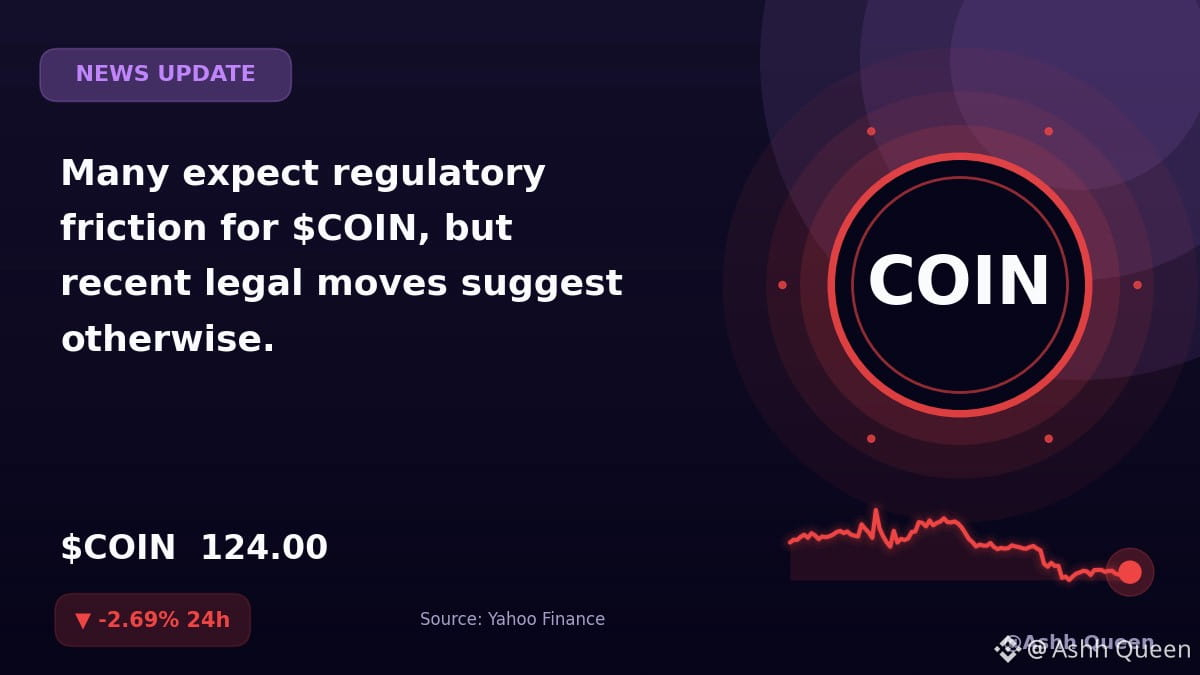
Many expect regulatory friction for $COIN, but recent legal moves suggest otherwise.
According to Yahoo Finance, Coinbase has joined other entities in a court brief supporting the CFTC. This move is aimed at resolving jurisdictional disputes between regulators regarding stock perpetual contracts.
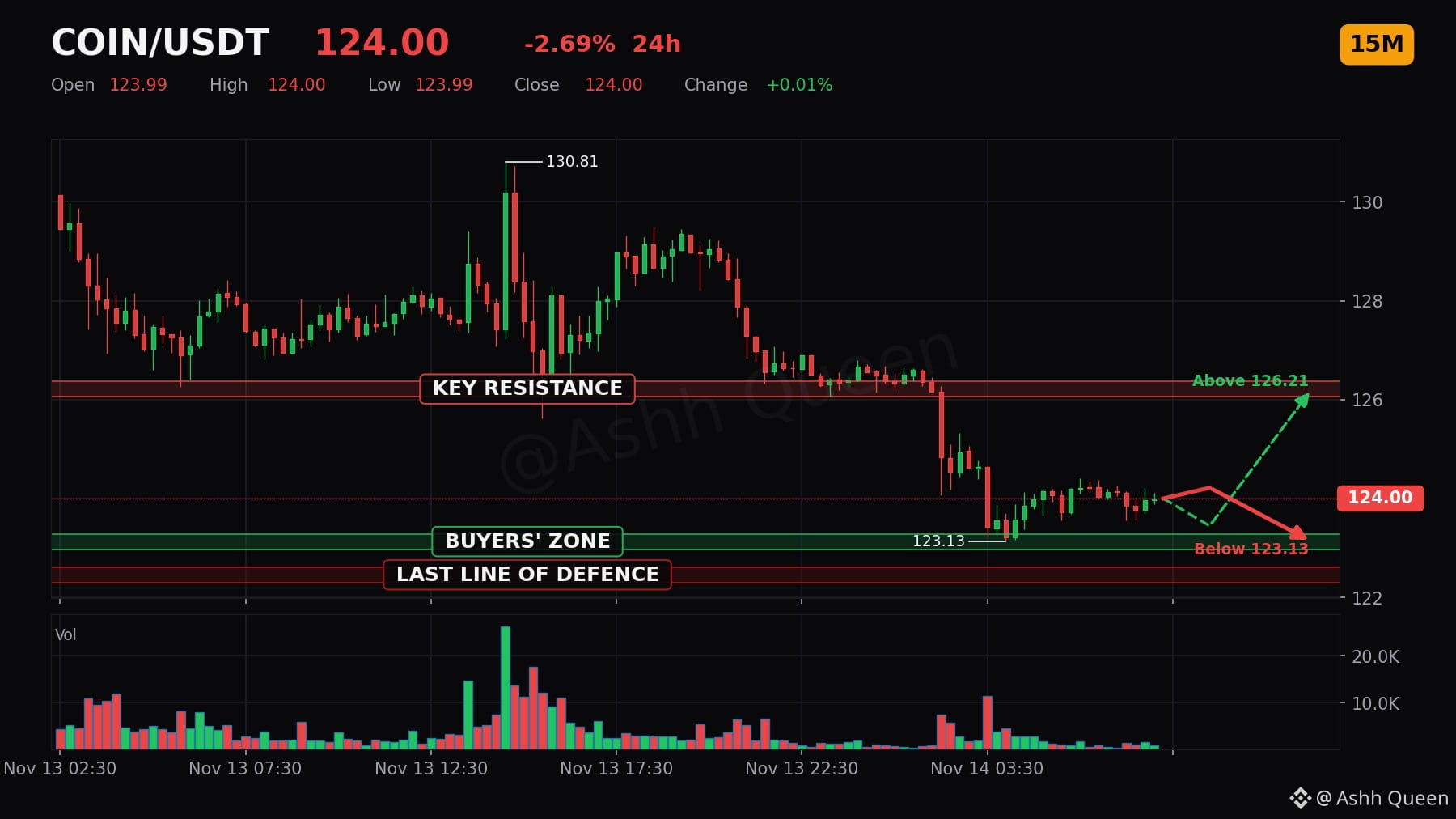
The COINUSDT perp is currently trading at 124.00 with a 24h move of -2.69%. The price is hovering near the support at 123.13.
💡 🔍 ✅
Which technical level are you watching on the chart right now and why?
#COIN #Coinbase #MarketUpdate #COINStock
⚠️ Perpetual contracts are leveraged derivatives, not the stock or commodity itself.
Not financial advice. Markets are volatile, so use stop-losses and only risk what you can afford to lose.
Many expect regulatory friction for $COIN , but recent legal moves suggest otherwise.
According to Yahoo Finance, Coinbase has joined other entities in a court brief supporting the CFTC. This move is aimed at resolving jurisdictional disputes between regulators regarding stock perpetual contracts.
The COINUSDT perp is currently trading at 124.00 with a 24h move of -2.69%. The price is hovering near the support at 123.13.
💡 🔍 ✅
Which technical level are you watching on the chart right now and why?
#COIN #Coinbase #MarketUpdate #COINStock
⚠️ Perpetual contracts are leveraged derivatives, not the stock or commodity itself.
Not financial advice. Markets are volatile, so use stop-losses and only risk what you can afford to lose.
7

·
--
The Coinbase premium has stayed negative for 51 straight days, and US buyers are still missing. 📉
CoinGlass data reported by WiseVoter shows the Coinbase Premium Index below zero since September 23, latest reading minus 0.10 percent, with a 30 day average of minus 0.14 percent. ⚠️ At the same time futures open interest rose 3.3 percent to 701,900 BTC between November 8 and 11 while price fell 2.6 percent, so traders are adding leveraged positions into weakness while US spot demand stays quiet. My reading is that a market cannot bottom on leverage alone, it needs real spot buyers, and the premium says they have not arrived yet.
What brings US buyers back first, a reclaim of 70,000 or a deeper washout to 64,800? 🤔
Follow for more trades.
#Crypto #Bitcoin #FuturesTrading #TradingSignals #Coinbase
·
--
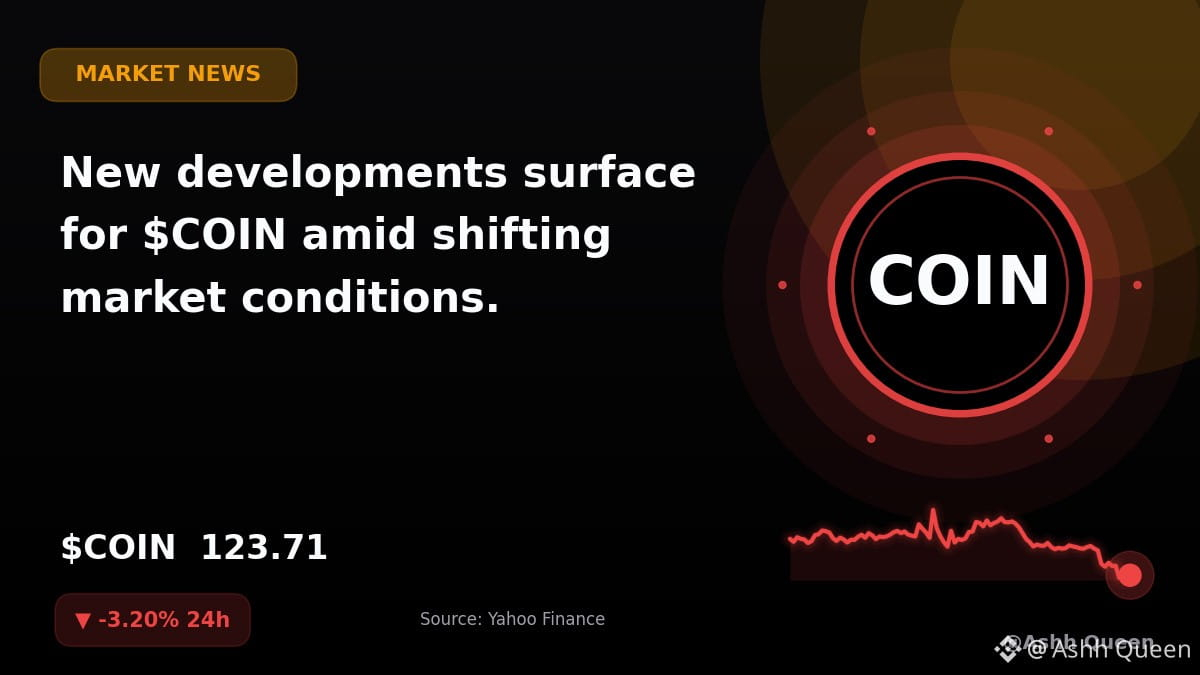
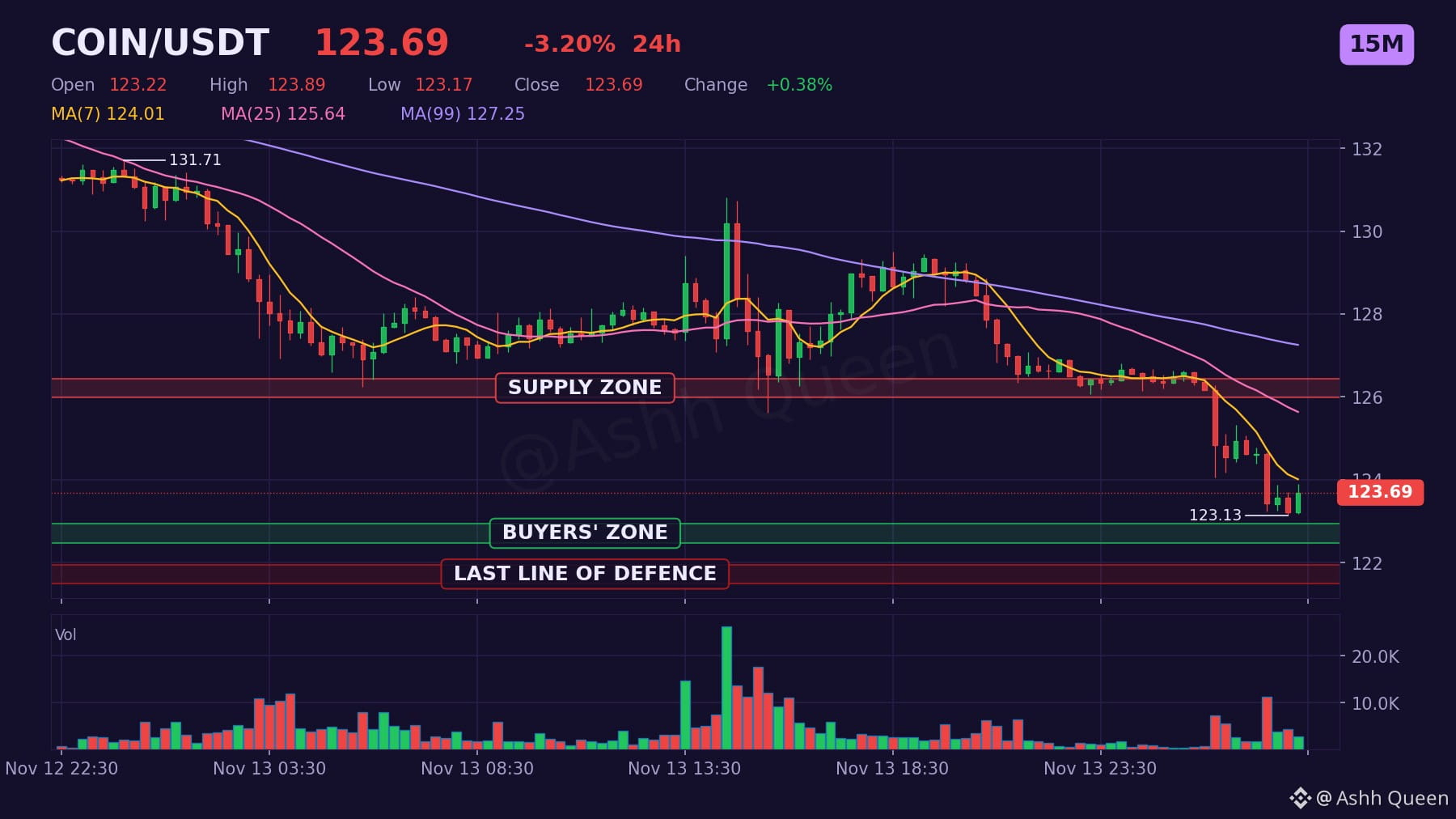
New developments surface for $COIN amid shifting market conditions.
According to Yahoo Finance, the platform has secured a federal trust charter. Simultaneously, higher inflation figures have created pressure on consumer lending equities.
The COINUSDT perpetual contract is currently priced at 123.71 with a 24h change of -3.20%. The asset is testing support at 122.71.
💡 🔍 ✅
How have you adjusted your approach when regulatory milestones coincide with broader macro volatility?
#COIN #Coinbase #BinanceSquare #TradFiForBeginners
⚠️ Perpetual contracts are leveraged derivatives, not the stock or commodity itself.
Not financial advice. Protect your capital first, the next setup always comes.
11
·
--
Coinbase just won final OCC clearance for its federal trust company, while the US seized 1.2 billion dollars from a hack. 📰
01 Capital reports Coinbase received final OCC clearance for its US trust company, completing a process that had conditional approval since April, while US authorities obtained court authority to seize 1.2 billion dollars tied to a North Korea linked Binance hack, after freezing more than 2.7 billion dollars in associated proceeds. ⚠️ My reading is that these two stories are the two faces of the same market, real institutions getting federal custody stamps while law enforcement cleans up the criminal side, and the long term direction is clear even if the short term price is still falling.
Does the Coinbase trust win matter more for crypto, or the 1.2 billion dollar seizure? 🤔
Follow for more trades.
#Crypto #Bitcoin #FuturesTrading #TradingSignals #Coinbase

5

Coinbase just became a federally chartered trust company. 🏦
The OCC gave final approval for Coinbase National Trust Company — charter effective Nov 6, after conditional approval back in April. It's the third crypto-native firm to get one this year, after Circle and Ripple.
What it means: federally supervised custody for digital assets. Coinbase plans to move its custody business — $245.7B in custody assets — under the federal charter over 3 years. Not a regular bank though: no deposits, no loans, no stablecoin issuance.
The rails keep getting built while the market panics: $BTC is ~$68,700 after dipping to a 12-week low near $67,500, and Fear & Greed sits at 20 — extreme fear.
Not financial advice. DYOR.
#Bitcoin #Crypto #Coinbase
75

·
--

Article
Crypto Companies Are Earning Less and Less from Crypto TradingIf you work at a bank, a brokerage or a payments company and you are weighing a crypto business, you probably picture it as a trading business: users buy and sell, the platform takes a fee, good markets pay more and bad markets pay less.
The third-quarter 2026 filings tell a different story.
In Robinhood’s 10-Q, crypto transaction revenue fell from $268M a year earlier to $120M, down 55%, and its share of total net revenue dropped from 21% to 8%. In the same table, prediction markets (event contracts) rose from $27M to $173M. A year ago crypto trading brought in a fifth of this broker’s revenue; in Q3 it earned more from prediction markets than from crypto trading.
Coinbase reported Q3 net income of $718.7M, which looks like a good quarter. Read further down the income statement and it includes $715.0M (pre-tax) of “gains on crypto assets held for investment”, meaning the coins on its own balance sheet went up. For the first nine months combined, Coinbase lost money (−$34.9M).
Both numbers point the same way: the place where crypto companies actually make money is moving away from trading.
This piece started from 16 issues of Delphi Digital’s newsletter over the past three months. In early November Delphi ran a table of Q3 results and concluded, in short, that strong reported profits did not necessarily reflect stronger operating performance. What the table did not answer is where the profit comes from if not from trading, and what keeps each of those sources going.
The trading layer: half of it gone in a year
Coinbase’s Q3 transaction revenue was $590.2M, against $1,046.3M a year earlier, down 44%. The company’s own explanation is plain: total market spot volume fell 6% quarter over quarter, derivatives volume fell 11%, and crypto asset volatility dropped 15% to multi-year lows.
Volatility is an exchange’s raw material. When prices swing, people trade; when prices drift sideways, they stay away. There is only so much a platform can do here; this layer of revenue mostly follows the market. BTC rose about 40% in Q3, and Coinbase’s transaction revenue was still down 44% year over year: prices were rising while volatility sat at multi-year lows, and retail attention was being pulled elsewhere.
Pulled where? Delphi spent most of the past three months writing about it: memecoin launchpads on Pump.fun and Robinhood Chain, perpetuals on Hyperliquid, and the prediction markets that Robinhood and Coinbase both now run. Coinbase also said its prediction markets business has passed a $200M annualized revenue run rate.
The trading layer has two problems: it is highly cyclical, and the traffic is moving. The same user is still trading, just not on your spot order book.
Animation 1: Same year, two layers, very different outcomes
The balance layer: rates fell, and it only lost single digits
The Fed hiked in September, and the 10-year Treasury yield touched 5.37%, its highest since 2002. Seeing those two facts, it is easy to assume crypto companies’ interest income rose this year. The catch is that the long end and the short end are different things.
Crypto companies’ interest income sits mostly at the short end: stablecoin reserves are held in T-bills and reverse repos, and customer cash sits in overnight and short-term products. Short-term rates are lower than a year ago. The Fed cut three times in 2025, reaching 3.50%–3.75% in December, and only hiked back to 3.75%–4.00% in September 2026. Circle’s 10-Q says it plainly: the average yield on its reserve assets fell 61 basis points year over year in Q3.
Rates fell, and balance-layer revenue barely moved:
Coinbase stablecoin revenue: $306.9M, down 5.4% year over year;Circle reserve income: down 7.5% year over year;Robinhood net interest revenues: $415M, down 9% year over year;Tether: $1.5B of Q3 net operating profit, flat with Q2, mainly from U.S. Treasuries and reverse repos (BDO attestation).
Rates down 0.6 percentage points, this layer down 5% to 9%; the trading layer down 44% to 55% over the same period.
Coinbase’s revenue makes the point most clearly when split apart. I added stablecoin revenue, interest and finance fee income, and corporate interest and other income together as “balance-type revenue”. A year ago that was $495.1M, and transaction revenue was 2.1 times it. Now balance-type revenue is $430.6M and transaction revenue is only 1.4 times it. Another 30% drop in transaction revenue and the two would be level.
Animation 2: Coinbase: trading revenue shrinking, balance revenue barely moving
Why does the balance layer hold up against falling rates? Because balances are growing. Coinbase’s 10-Q splits the change in stablecoin revenue in two: lower average rates cost it $52.8M, and higher average USDC balances in Coinbase products added $84.6M. Circle uses the same split: lower yields cost $106.5M, and an 8% rise in average USDC in circulation added $52.8M.
Under the same rate cuts, Circle’s balance growth offset only half the damage, while balance growth on Coinbase’s platform offset more than all of it. Circle is the issuer of USDC and holds the reserves, but it pays a large share of reserve income to distributors. Coinbase is the largest of them, and how much it receives depends on how much USDC sits on Coinbase’s platform.
The issuer holds the reserves; the interest is split according to where the balances sit.
A post-mortem: Hyperliquid turned an exchange into a balance business
Hyperliquid applies this rule most directly.
It was the project Delphi wrote about most over these three months. It started as a classic trading-layer company: an onchain perpetuals exchange that uses its fees to buy back its own token, HYPE. More volume, more buybacks; less volume, fewer.
In August 2026 it made USDC the platform’s “Aligned Quote Asset”. In exchange, about 90% of the eligible net yield on the USDC reserves backing balances on the platform goes to Hyperliquid. The yield started accruing on August 26, and the first payment of $14.58M, covering about 30 days, arrived in early October and went straight into the Assistance Fund to buy back HYPE.
$14.58M is not a lot. Fee-funded buybacks in September were estimated at about $55.67M, so the balance share is roughly a quarter of that. But it is a different kind of money: fee-funded buybacks follow volume, while the balance share follows how much USDC sits on the platform and where rates are. When volume cools, the money keeps coming as long as the USDC stays.
What changed is who gets a seat at the negotiating table. For eight years, the interest on USDC reserves went largely to the issuer and its largest distribution partner. Hyperliquid has not issued any stablecoin. It has one thing: a large amount of USDC parked on its platform. On that alone, it took about nine tenths of the yield from the issuer.
Whoever holds the balances gets a seat at the table. This is what a distributor’s “channel tax” on an issuer looks like in stablecoins.
Animation 3: How a dollar of reserve interest gets divided
Figure 1: The interest belongs to the reserves; the split follows the balances
The rent layer: mines becoming data centers
The third layer is the furthest from crypto, yet one of Delphi’s mid-August newsletters was titled after it: AI Wants Bitcoin’s Megawatts.
In August Riot signed a data center lease: 191MW of critical IT capacity at its Rockdale campus in Texas for a frontier AI lab, with an initial term of 20 years running to June 2048 and about $9.1B of contract revenue. The company expects an average annual NOI contribution of $365M to $411M. Over the same period, Riot’s cost to mine had reached 69.6% of production value, up from 49.6% a year earlier.
The same megawatt, used to compute hashes, earns according to bitcoin’s price and network hashrate; leased to an AI lab, its revenue is written into a 20-year contract.
Galaxy’s Q3 segment data lays out the contrast: the Data Centers segment posted $68.7M of adjusted EBITDA, while the Digital Assets segment posted −$9.0M. A company built on crypto trading and investment banking made its operating money in Q3 from data centers.
This layer is the most stable and the heaviest: you have to build, wire up power and borrow. Galaxy’s Data Centers segment carried $75.4M of notes interest in Q3 alone, so on a net income basis the segment still lost a little. Rent is a good business, but it is an infrastructure company’s business, valued in a completely different way from an exchange.
The fourth layer is not a business: mark-to-market
One more layer has to be taken out of the profit, because it is the easiest to misread.
Coinbase’s Q3 net income of $718.7M includes $715.0M (pre-tax) of gains on crypto it holds. Customers did not pay a cent of it. Adjusted EBITDA, a better read on operations, was $332.9M, against $800.7M a year earlier, down almost 60%.
Strategy is more extreme: Q3 net income of $19.53B, almost all of it from a $20.91B gain on digital assets; for the first nine months combined it lost $1.23B. Its quarterly profit is driven mainly by how much BTC moved in the quarter. BTC was around $85,000 at the end of Q3, and Delphi’s November 9 newsletter had it at about $73,700. If it ends Q4 near there, Q4 will carry a large mark-to-market loss.
Valuation gains are not meaningless, but they are different in kind from the first three layers: the first three are what customers pay, this one is what the market prices. Counting them toward “crypto companies are very profitable” amounts to using the coin price to prove the coin price.
Figure 2: Reading a crypto company’s results: three layers of revenue, one layer of marks
How a professional reader would push back
Objection one: the balance layer lives on rates, so a cutting cycle makes it more fragile than trading.
The risk is real. Circle’s 61-basis-point drop in yield cost it $106.5M of reserve income directly. If the Fed returns to cutting, the balance layer takes a hit every quarter.
But Q3 shows two things. First, balance growth can offset much of a rate cut; on Coinbase’s platform, revenue from higher balances exceeded what lower rates took away. Second, trading and balances often react to rates in opposite directions: hikes tend to dampen risk appetite and hurt trading while lifting interest income. Coinbase’s Q4 outlook has exactly that shape: transaction revenue through October 25 was only about $165M, while subscription and services revenue is guided at $550M to $630M, partly on higher average rates. One quarter’s guidance does not prove a long-run pattern, but it shows the two layers can cushion each other inside the same company.
Objection two: the balance layer’s revenue split is set by regulators and contracts, and can change at any time.
This one is more worrying. U.S. banks have long opposed stablecoins passing yield to holders, and it has been one of the points of contention in the CLARITY Act negotiations. According to Delphi’s November 9 newsletter, Democrats won both chambers of Congress in the midterms, raising the odds of tighter rules. In Europe, MiCA requires stablecoin issuers to keep a large share of reserves in bank deposits, which directly lowers reserve yields, and Circle is lobbying against it. Hyperliquid’s 90% and Coinbase’s on-platform share are, at bottom, contract terms, and contracts can be renegotiated.
What the balance layer can hold on to is the balances themselves; the split is in the hands of issuers, regulators and counterparties.
If you are building one, or analyzing one
When you pick up a crypto company’s results, do three things first:
Split revenue into the four layers. Trading, balances, rent and marks: how big each one is and what it follows, whether volatility, balances times rates, contracts or coin prices. The bigger the trading share, the harder next quarter is to predict.Look at where the balances sit. Within balance-layer revenue, how much comes from balances the platform keeps itself, and how much is someone else’s balances shared with you. The first gives you bargaining power; the second depends on how much others are willing to share. Coinbase discloses the average USDC held in its products every quarter, and it is the line most worth reading in its report.Take valuation gains out of net income. What remains is what the company earned as a business.
If you are designing a crypto business rather than investing in one: trading is how you acquire users, balances are how you keep them and make money. A user who trades once pays you one fee; a user who leaves money with you pays you every day.
Conclusion
Animation 4: Four layers of revenue, and the shock each one fears
Trading is traffic, balances are profit, rent is the foundation, marks are noise.
In Q3 results, the trading layer lost half its revenue in a year, the balance layer slipped only single digits despite rate cuts, and the rent layer signed 20-year contracts. Crypto companies’ profits depend less and less on crypto trading, and more on where users leave their money.
What is worth watching next quarter is whether more platforms follow Hyperliquid: no token sale for the purpose, no stablecoin of their own, just the balances in hand, used to negotiate a share from the issuer.
Sources
Coinbase Q3 2026 10-Q (filed 2026-10-29): transaction revenue, stablecoin revenue and its change breakdown, net income, gains on crypto held for investment, adjusted EBITDA, nine-month net loss. Q4 outlook and volatility description from its Q3 earnings materials (as reported by Investing).Robinhood Q3 2026 10-Q (filed 2026-10-28): crypto and event contract revenue, shares of revenue, net interest revenues, Cash Sweep impact from short-term rates.Circle Q3 2026 10-Q (filed 2026-11-04): reserve income change and its split into rate and circulation effects, change in distribution costs paid to Coinbase.Galaxy Q3 2026 10-Q (filed 2026-11-09): segment adjusted EBITDA, Data Centers notes interest.Strategy Q3 2026 10-Q (filed 2026-11-02): quarterly net income, digital asset gains, nine-month net loss.Riot Q2 2026 results release, August 10, 2026 (8-K Exhibit 99.1): 191MW lease terms and NOI estimate; cost-to-mine ratio from Yahoo Finance reporting (original not checked).Tether Q3 BDO attestation: per multiple media reports, original not read.Hyperliquid’s first $14.58M USDC reserve yield payment and ~90% share: FinanceFeeds and Cryptonomist, October 2026; September fee-funded buybacks of ~$55.67M are a FinanceFeeds estimate, not official.Fed rate path: hike to 3.75%–4.00% on September 16, 2026, hold on October 28 (CNBC, U.S. Bank).Market and industry background, midterm results: Delphi Digital newsletters, August 10 to November 9, 2026 (not independently verified).
#Stablecoins #Coinbase
Crypto Companies Are Earning Less and Less from Crypto Trading
If you work at a bank, a brokerage or a payments company and you are weighing a crypto business, you probably picture it as a trading business: users buy and sell, the platform takes a fee, good markets pay more and bad markets pay less.
The third-quarter 2026 filings tell a different story.
In Robinhood’s 10-Q, crypto transaction revenue fell from $268M a year earlier to $120M, down 55%, and its share of total net revenue dropped from 21% to 8%. In the same table, prediction markets (event contracts) rose from $27M to $173M. A year ago crypto trading brought in a fifth of this broker’s revenue; in Q3 it earned more from prediction markets than from crypto trading.
Coinbase reported Q3 net income of $718.7M, which looks like a good quarter. Read further down the income statement and it includes $715.0M (pre-tax) of “gains on crypto assets held for investment”, meaning the coins on its own balance sheet went up. For the first nine months combined, Coinbase lost money (−$34.9M).
Both numbers point the same way: the place where crypto companies actually make money is moving away from trading.
This piece started from 16 issues of Delphi Digital’s newsletter over the past three months. In early November Delphi ran a table of Q3 results and concluded, in short, that strong reported profits did not necessarily reflect stronger operating performance. What the table did not answer is where the profit comes from if not from trading, and what keeps each of those sources going.
The trading layer: half of it gone in a year
Coinbase’s Q3 transaction revenue was $590.2M, against $1,046.3M a year earlier, down 44%. The company’s own explanation is plain: total market spot volume fell 6% quarter over quarter, derivatives volume fell 11%, and crypto asset volatility dropped 15% to multi-year lows.
Volatility is an exchange’s raw material. When prices swing, people trade; when prices drift sideways, they stay away. There is only so much a platform can do here; this layer of revenue mostly follows the market. BTC rose about 40% in Q3, and Coinbase’s transaction revenue was still down 44% year over year: prices were rising while volatility sat at multi-year lows, and retail attention was being pulled elsewhere.
Pulled where? Delphi spent most of the past three months writing about it: memecoin launchpads on Pump.fun and Robinhood Chain, perpetuals on Hyperliquid, and the prediction markets that Robinhood and Coinbase both now run. Coinbase also said its prediction markets business has passed a $200M annualized revenue run rate.
The trading layer has two problems: it is highly cyclical, and the traffic is moving. The same user is still trading, just not on your spot order book.
Animation 1: Same year, two layers, very different outcomes
The balance layer: rates fell, and it only lost single digits
The Fed hiked in September, and the 10-year Treasury yield touched 5.37%, its highest since 2002. Seeing those two facts, it is easy to assume crypto companies’ interest income rose this year. The catch is that the long end and the short end are different things.
Crypto companies’ interest income sits mostly at the short end: stablecoin reserves are held in T-bills and reverse repos, and customer cash sits in overnight and short-term products. Short-term rates are lower than a year ago. The Fed cut three times in 2025, reaching 3.50%–3.75% in December, and only hiked back to 3.75%–4.00% in September 2026. Circle’s 10-Q says it plainly: the average yield on its reserve assets fell 61 basis points year over year in Q3.
Rates fell, and balance-layer revenue barely moved:
Coinbase stablecoin revenue: $306.9M, down 5.4% year over year;Circle reserve income: down 7.5% year over year;Robinhood net interest revenues: $415M, down 9% year over year;Tether: $1.5B of Q3 net operating profit, flat with Q2, mainly from U.S. Treasuries and reverse repos (BDO attestation).
Rates down 0.6 percentage points, this layer down 5% to 9%; the trading layer down 44% to 55% over the same period.
Coinbase’s revenue makes the point most clearly when split apart. I added stablecoin revenue, interest and finance fee income, and corporate interest and other income together as “balance-type revenue”. A year ago that was $495.1M, and transaction revenue was 2.1 times it. Now balance-type revenue is $430.6M and transaction revenue is only 1.4 times it. Another 30% drop in transaction revenue and the two would be level.
Animation 2: Coinbase: trading revenue shrinking, balance revenue barely moving
Why does the balance layer hold up against falling rates? Because balances are growing. Coinbase’s 10-Q splits the change in stablecoin revenue in two: lower average rates cost it $52.8M, and higher average USDC balances in Coinbase products added $84.6M. Circle uses the same split: lower yields cost $106.5M, and an 8% rise in average USDC in circulation added $52.8M.
Under the same rate cuts, Circle’s balance growth offset only half the damage, while balance growth on Coinbase’s platform offset more than all of it. Circle is the issuer of USDC and holds the reserves, but it pays a large share of reserve income to distributors. Coinbase is the largest of them, and how much it receives depends on how much USDC sits on Coinbase’s platform.
The issuer holds the reserves; the interest is split according to where the balances sit.
A post-mortem: Hyperliquid turned an exchange into a balance business
Hyperliquid applies this rule most directly.
It was the project Delphi wrote about most over these three months. It started as a classic trading-layer company: an onchain perpetuals exchange that uses its fees to buy back its own token, HYPE. More volume, more buybacks; less volume, fewer.
In August 2026 it made USDC the platform’s “Aligned Quote Asset”. In exchange, about 90% of the eligible net yield on the USDC reserves backing balances on the platform goes to Hyperliquid. The yield started accruing on August 26, and the first payment of $14.58M, covering about 30 days, arrived in early October and went straight into the Assistance Fund to buy back HYPE.
$14.58M is not a lot. Fee-funded buybacks in September were estimated at about $55.67M, so the balance share is roughly a quarter of that. But it is a different kind of money: fee-funded buybacks follow volume, while the balance share follows how much USDC sits on the platform and where rates are. When volume cools, the money keeps coming as long as the USDC stays.
What changed is who gets a seat at the negotiating table. For eight years, the interest on USDC reserves went largely to the issuer and its largest distribution partner. Hyperliquid has not issued any stablecoin. It has one thing: a large amount of USDC parked on its platform. On that alone, it took about nine tenths of the yield from the issuer.
Whoever holds the balances gets a seat at the table. This is what a distributor’s “channel tax” on an issuer looks like in stablecoins.
Animation 3: How a dollar of reserve interest gets divided
Figure 1: The interest belongs to the reserves; the split follows the balances
The rent layer: mines becoming data centers
The third layer is the furthest from crypto, yet one of Delphi’s mid-August newsletters was titled after it: AI Wants Bitcoin’s Megawatts.
In August Riot signed a data center lease: 191MW of critical IT capacity at its Rockdale campus in Texas for a frontier AI lab, with an initial term of 20 years running to June 2048 and about $9.1B of contract revenue. The company expects an average annual NOI contribution of $365M to $411M. Over the same period, Riot’s cost to mine had reached 69.6% of production value, up from 49.6% a year earlier.
The same megawatt, used to compute hashes, earns according to bitcoin’s price and network hashrate; leased to an AI lab, its revenue is written into a 20-year contract.
Galaxy’s Q3 segment data lays out the contrast: the Data Centers segment posted $68.7M of adjusted EBITDA, while the Digital Assets segment posted −$9.0M. A company built on crypto trading and investment banking made its operating money in Q3 from data centers.
This layer is the most stable and the heaviest: you have to build, wire up power and borrow. Galaxy’s Data Centers segment carried $75.4M of notes interest in Q3 alone, so on a net income basis the segment still lost a little. Rent is a good business, but it is an infrastructure company’s business, valued in a completely different way from an exchange.
The fourth layer is not a business: mark-to-market
One more layer has to be taken out of the profit, because it is the easiest to misread.
Coinbase’s Q3 net income of $718.7M includes $715.0M (pre-tax) of gains on crypto it holds. Customers did not pay a cent of it. Adjusted EBITDA, a better read on operations, was $332.9M, against $800.7M a year earlier, down almost 60%.
Strategy is more extreme: Q3 net income of $19.53B, almost all of it from a $20.91B gain on digital assets; for the first nine months combined it lost $1.23B. Its quarterly profit is driven mainly by how much BTC moved in the quarter. BTC was around $85,000 at the end of Q3, and Delphi’s November 9 newsletter had it at about $73,700. If it ends Q4 near there, Q4 will carry a large mark-to-market loss.
Valuation gains are not meaningless, but they are different in kind from the first three layers: the first three are what customers pay, this one is what the market prices. Counting them toward “crypto companies are very profitable” amounts to using the coin price to prove the coin price.
Figure 2: Reading a crypto company’s results: three layers of revenue, one layer of marks
How a professional reader would push back
Objection one: the balance layer lives on rates, so a cutting cycle makes it more fragile than trading.
The risk is real. Circle’s 61-basis-point drop in yield cost it $106.5M of reserve income directly. If the Fed returns to cutting, the balance layer takes a hit every quarter.
But Q3 shows two things. First, balance growth can offset much of a rate cut; on Coinbase’s platform, revenue from higher balances exceeded what lower rates took away. Second, trading and balances often react to rates in opposite directions: hikes tend to dampen risk appetite and hurt trading while lifting interest income. Coinbase’s Q4 outlook has exactly that shape: transaction revenue through October 25 was only about $165M, while subscription and services revenue is guided at $550M to $630M, partly on higher average rates. One quarter’s guidance does not prove a long-run pattern, but it shows the two layers can cushion each other inside the same company.
Objection two: the balance layer’s revenue split is set by regulators and contracts, and can change at any time.
This one is more worrying. U.S. banks have long opposed stablecoins passing yield to holders, and it has been one of the points of contention in the CLARITY Act negotiations. According to Delphi’s November 9 newsletter, Democrats won both chambers of Congress in the midterms, raising the odds of tighter rules. In Europe, MiCA requires stablecoin issuers to keep a large share of reserves in bank deposits, which directly lowers reserve yields, and Circle is lobbying against it. Hyperliquid’s 90% and Coinbase’s on-platform share are, at bottom, contract terms, and contracts can be renegotiated.
What the balance layer can hold on to is the balances themselves; the split is in the hands of issuers, regulators and counterparties.
If you are building one, or analyzing one
When you pick up a crypto company’s results, do three things first:
Split revenue into the four layers. Trading, balances, rent and marks: how big each one is and what it follows, whether volatility, balances times rates, contracts or coin prices. The bigger the trading share, the harder next quarter is to predict.Look at where the balances sit. Within balance-layer revenue, how much comes from balances the platform keeps itself, and how much is someone else’s balances shared with you. The first gives you bargaining power; the second depends on how much others are willing to share. Coinbase discloses the average USDC held in its products every quarter, and it is the line most worth reading in its report.Take valuation gains out of net income. What remains is what the company earned as a business.
If you are designing a crypto business rather than investing in one: trading is how you acquire users, balances are how you keep them and make money. A user who trades once pays you one fee; a user who leaves money with you pays you every day.
Conclusion
Animation 4: Four layers of revenue, and the shock each one fears
Trading is traffic, balances are profit, rent is the foundation, marks are noise.
In Q3 results, the trading layer lost half its revenue in a year, the balance layer slipped only single digits despite rate cuts, and the rent layer signed 20-year contracts. Crypto companies’ profits depend less and less on crypto trading, and more on where users leave their money.
What is worth watching next quarter is whether more platforms follow Hyperliquid: no token sale for the purpose, no stablecoin of their own, just the balances in hand, used to negotiate a share from the issuer.
Sources
Coinbase Q3 2026 10-Q (filed 2026-10-29): transaction revenue, stablecoin revenue and its change breakdown, net income, gains on crypto held for investment, adjusted EBITDA, nine-month net loss. Q4 outlook and volatility description from its Q3 earnings materials (as reported by Investing).Robinhood Q3 2026 10-Q (filed 2026-10-28): crypto and event contract revenue, shares of revenue, net interest revenues, Cash Sweep impact from short-term rates.Circle Q3 2026 10-Q (filed 2026-11-04): reserve income change and its split into rate and circulation effects, change in distribution costs paid to Coinbase.Galaxy Q3 2026 10-Q (filed 2026-11-09): segment adjusted EBITDA, Data Centers notes interest.Strategy Q3 2026 10-Q (filed 2026-11-02): quarterly net income, digital asset gains, nine-month net loss.Riot Q2 2026 results release, August 10, 2026 (8-K Exhibit 99.1): 191MW lease terms and NOI estimate; cost-to-mine ratio from Yahoo Finance reporting (original not checked).Tether Q3 BDO attestation: per multiple media reports, original not read.Hyperliquid’s first $14.58M USDC reserve yield payment and ~90% share: FinanceFeeds and Cryptonomist, October 2026; September fee-funded buybacks of ~$55.67M are a FinanceFeeds estimate, not official.Fed rate path: hike to 3.75%–4.00% on September 16, 2026, hold on October 28 (CNBC, U.S. Bank).Market and industry background, midterm results: Delphi Digital newsletters, August 10 to November 9, 2026 (not independently verified).
#Stablecoins #Coinbase
90

·
--
📰 Coinbase's Bitcoin (BTC) Order Book Shows an $8.62 Million Sell-Side Lead
Coinbase’s $30.26 million in visible asks topped the sell-side totals on Binance spot, OKX perpetuals and Hyperliquid perpetuals; each market also had more asks than bids.
Source : Econotimes
Time : 2026-11-12 10:26:21
Credit : miriam hart
#coinbase #cryptocurrency_markets #digital_currency_revolution #order_books #bitcoin
$BTC
Share your opinion in the comment section below
1
1

·
--
📰 Coinbase's Bitcoin (BTC) Order Book Shows an $8.62 Million Sell-Side Lead
Coinbase’s $30.26 million in visible asks topped the sell-side totals on Binance spot, OKX perpetuals and Hyperliquid perpetuals; each market also had more asks than bids.
Source : Econotimes
Time : 2026-11-12 10:26:21
Credit : miriam hart
#coinbase #cryptocurrency_markets #digital_currency_revolution #order_books #bitcoin
$BTC
Share your opinion in the comment section below
📰 Coinbase's Bitcoin (BTC) Order Book Shows an $8.62 Million Sell-Side Lead
Coinbase’s $30.26 million in visible asks topped the sell-side totals on Binance spot, OKX perpetuals and Hyperliquid perpetuals; each market also had more asks than bids.
Source : Econotimes
Time : 2026-11-12 10:26:21
Credit : miriam hart
#coinbase #cryptocurrency_markets #digital_currency_revolution #order_books #bitcoin
$BTC
Share your opinion in the comment section below
Coinbase’s $30.26 million in visible asks topped the sell-side totals on Binance spot, OKX perpetuals and Hyperliquid perpetuals; each market also had more asks than bids.
Source : Econotimes
Time : 2026-11-12 10:26:21
Credit : miriam hart
#coinbase #cryptocurrency_markets #digital_currency_revolution #order_books #bitcoin
$BTC
Share your opinion in the comment section below
1

·
--
Crypto loves a three-word headline: **approved, listed, launched.**
But those words don't mean the same thing.
Coinbase has introduced Coinbase National Trust Company in an announcement describing it as a federally chartered trust company with OCC approval.
That's an important institutional development. It deserves attention.
It also deserves precision.
A charter describes a legal and supervisory framework. It doesn't automatically tell us which products are available to customers today, what every permitted activity is, or how adoption will develop.
The temptation is to turn a regulatory milestone into a complete victory story.
I'd rather ask the next question: **What exactly can the entity do, and what will customers actually use?**
Those details aren't footnotes. They're the story that follows the announcement.
Regulatory progress is real progress. But in crypto, confusing permission with performance is an easy way to misread the market.
Do you see a charter announcement as the finish line — or the starting line?
#Coinbase #CryptoRegulation #OCC
*Based on the cited announcement; specific permitted activities require separate verification.*
79

·
--
🗒️ **Watchlist**
- Coinbase’s India site has confirmed that rupee withdrawals remain unavailable and have been down for 5 days.
- The disruption was caused by a payment system failure at a banking partner, affecting all of the bank’s customers. The platform emphasized that funds are safe.
- Deposits (including UPI) and bank account linking are working normally, and there is no estimated restoration time.
💡 **Why it matters**: Withdrawals are essential to users’ day-to-day liquidity. A prolonged outage could affect engagement and trust; however, deposit channels remain unaffected, meaning users can still deposit assets.
❓ **Still to be confirmed**: When will the bank fix its system? Does Coinbase have an alternative channel?
This is not investment advice.
#Coinbase #India #CryptoLiquidity #Write2Earn


·
--
Conditional approval from the OCC in April became final approval on November 9: Coinbase’s national trust company can open for business. The company says the charter gives its custody business a unified federal regulatory framework.
This path isn’t open only to Coinbase. On May 18, Warren wrote to the OCC questioning the approval of at least nine crypto trust charters, and requesting application materials, legal analyses supporting the approvals, and relevant communications involving OCC officials. On November 5, Blumenthal reiterated his request for records from Binance, Tether, and two affiliated companies, with a deadline for voluntary submission of January 4, 2027.
The charters are moving forward, while Congress is following up on the basis for their approval. There’s no suspense about Coinbase opening for business; the question is whether the materials Warren requested will be made public. They will determine not just the fate of one charter, but whether this batch of crypto trust approvals can withstand scrutiny.
#Coinbase #CryptoRegulation
4

#CoinbaseIndiaWithdrawalFreeze
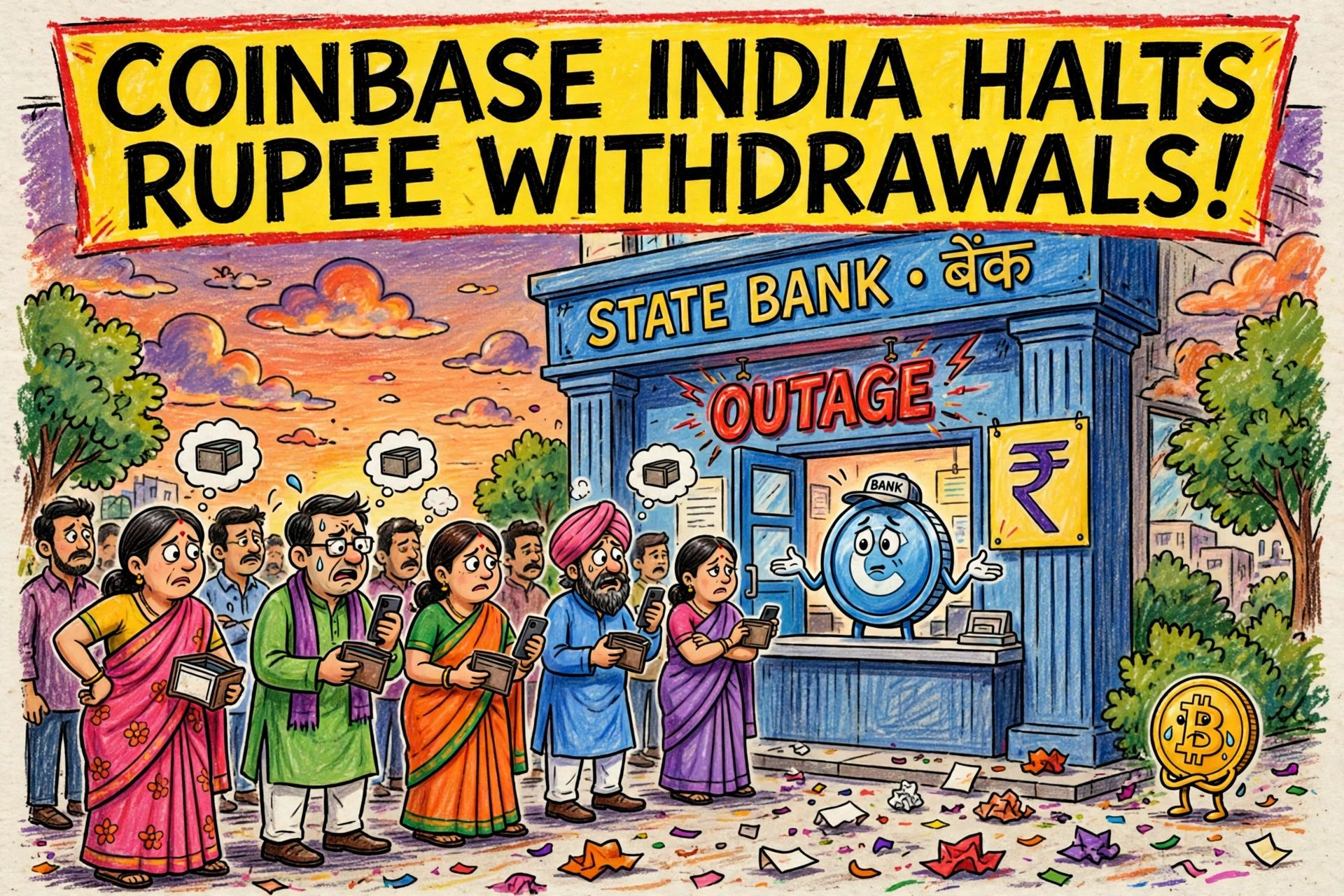
🚨 COINBASE INDIA FREEZES RUPEE WITHDRAWALS, ALL 3 MAJOR EXCHANGES HIT
Users in India are getting anxious: Coinbase has just confirmed that rupee withdrawals remain paralyzed because its banking partner is experiencing an issue. It’s been more than 5 days with no restoration date, although deposits via UPI are still working normally. Coinbase isn’t alone: Unocoin has frozen both deposits and withdrawals since 9/11, while ZebPay rupee withdrawals have slowed sharply since 11/11 — all 3 major exchanges are caught in the same banking bottleneck. $BTC Perpetuals are hovering around $66,730, near the intraday low of $66,456, and this news is making users even more worried.
Biggest perpetual move today: $H 0,0198 dollars, $ZEC 881 dollars
#Coinbase #AnDo #Withdrawals
12

🚨 COINBASE India withdrawals still suspended after five days 🧠
📊 | $BTC | $ETH | $BNB |
- Follow us, like, and leave a comment for more market insights 📈
- Coinbase confirmed that Indian rupee withdrawals have remained unavailable since November 14.
- Its status page had already flagged an outage affecting a banking partner five days earlier.
- Indian users are currently unable to complete fiat withdrawals, and the impact continues to grow.
- The incident highlights the risks of crypto platforms’ dependence on traditional banking infrastructure. 🔥
- Market sentiment may come under pressure in the short term, with panic-driven volatility potentially intensifying.
- Some whales may seize the opportunity to accumulate at lower prices, while others may choose to sell into strength.
- If service restoration is delayed, more users are expected to move to other platforms.
- Overall, the incident poses a short-term challenge to trust in the Coinbase brand.
- What do you think about crypto platforms’ reliance on the banking system? Share your views in the comments.
- If you enjoyed this analysis, follow and comment. We’ll continue tracking market developments.
#Coinbase #Crypto #Whales #Banking #MarketRisk
301

·
--
Down 3.99% in a day isn’t earth-shattering for an individual stock, but Coinbase is closing right near its low. $COIN is trading at 124.85, just a step above today’s low of 124.12. The high above, at 130.84, was yesterday’s.
This is the Coinbase USDT perpetual contract price on OKX. U.S. stock markets are closed for the weekend, but the contract is still moving. Anyone holding it is probably not sleeping easy this weekend—sell, and you worry you’re selling at the low; hold, and you worry it’ll drop again when the market opens Monday.
I’m leaning toward sitting tight for now, since 124.12 is right there—if it breaks, that’s a new low. But if it gets back above 130.84, I’ll change my mind immediately. That would mean buyers are back.
Coinbase is heading into the weekend near its low. Do you think it’ll rebound first when the market opens Monday, or keep probing lower?
$COIN
#美股 #Coinbase
7
·
--
At this level, the bulls and bears are already arguing. Coinbase $COIN is trading at 123.89, down 2.91% for the day. It’s just a step away from its 24-hour low of 123.12; yesterday it was still at 130.84, and today it’s hovering right near the bottom.
Put simply: COIN is the crypto market’s shadow on the US stock market, and $BTC is also down 2.27% over the past 24 hours. COIN is falling faster than the broader market, bringing the crypto market’s chill to US stocks first. Anyone holding it is probably wondering right now: is crypto weighing it down, or is COIN weakening on its own?
I’m inclined to sit tight for now, because it hasn’t broken below 123.12 yet. If it does, that would be a new low, and sentiment could push it down further. But if it can get back above 130.84, I’ll change my mind right away—that would mean the selling pressure has eased.
COIN is hovering near its low. Do you think this is the tail end of a pullback, or the start of another leg down?
$COIN
#美股 #Coinbase
7

Coinbase CEO Extremely Bullish on AiFi: Forecasts $5 Trillion in AI Agent Transactions by 2030
- Brian Armstrong (Coinbase CEO) expresses strong optimism about AiFi (AI + Finance)
- Cites a forecast of up to $5 trillion in AI agent transactions by 2030
- Confirms Coinbase Pro will return
- The RSS source has not provided further details about the specific roadmap
#BinanceSquare #CryptoNews #Coinbase #AI #AiFi
$btc $eth
vlikevn Titanbot
Source: U.Today
276

🔐 How secure is your exchange account?
On November 10, Coinbase launched “Security Score,” a feature that lets you see your account’s security rating at a glance, from “Needs attention” to “Excellent,” along with top recommendations ranked by impact.
📋 What you’ll find on the score page
• Security rating: From “Needs attention” to “Excellent.” Enable all available protections to reach the highest rating.
• Top recommendations: For example, if you’re still using SMS for two-step verification, you’ll be advised to switch to an authenticator app or a hardware security key (the strongest phishing protection).
• Factor breakdown: Review the strength of your sign-in, transfers, devices and sessions, and connected apps.
• Complete each recommendation right on the score page—no need to dig through settings menus.
⚠️ Why it’s worth taking two minutes
Coinbase noted in its announcement that most account thefts don’t happen because someone “breaks through the walls,” but because a door is left unlocked: a phishing-prone verification method, an unfamiliar device, or a moment of panic during a scam call.
🛡 You can give your Binance account a quick check, too
• Enable an authenticator app or a passkey/security key, and rely less on SMS verification.
• Check your signed-in devices and sign out of unfamiliar sessions.
• Set an anti-phishing code and enable a withdrawal address whitelist.
• Remove third-party permissions and API keys you no longer use.
📉 As for the market, BTC is currently around $67,000, with a 24-hour range of about $66,456–$70,214. When volatility is high, phishing and scams are also at their most active.
How many of these security measures have you set up? Share in the comments 👇
👉 Trade BTC: https://binance.bnstatic.com/zh-CN/trade/BTC_USDT
#加密安全 #Coinbase #账户安全 #BTC
⚠️ This is not investment advice. Please be aware of the risks.

231
·
--
Imagine your company gets paid in USDC.
Now imagine the money arrives in your regular bank account as dollars — without your finance team needing to hold the token.
That's the workflow Coinbase has described for eligible PNC corporate clients. Coinbase's developer account says its payment APIs can convert incoming USDC into USD and send the proceeds as bank deposits.
The interesting part isn't that crypto moves value. We've heard that pitch for years.
It's that the recipient can experience the result without managing the crypto asset itself.
For a corporate finance team, that raises practical questions: Who handles conversion? What does reconciliation look like? What happens if a payment needs investigating? Those operational details will matter more than a flashy headline.
This is a service for eligible corporate clients, not an announcement of universal retail access. The cited posts also don't provide transaction-volume figures.
Maybe the next breakthrough in crypto payments won't look like a new wallet.
Maybe it will look like an ordinary bank deposit — with a very different rail behind it.
#USDC #Coinbase #Payments #CryptoInfrastructure
*Informational only. No affiliation with SpaceCoin is implied.*
1
85
·
--
Coinbase CEO Brian Armstrong teased the upcoming launch of Coinbase Pro on X, but gave no timeline. He said the company has spent years pushing to bring stock perpetual futures to the U.S. in a compliant way. These products are currently traded only outside the U.S.
The product hasn’t launched yet, but compliance is already being touted. We’ll have to wait until launch day to see what Coinbase Pro actually adds.
#Coinbase #StockPerpetualFutures
The product hasn’t launched yet, but compliance is already being touted. We’ll have to wait until launch day to see what Coinbase Pro actually adds.
#Coinbase #StockPerpetualFutures
29
Log in to explore more content
Join global crypto users on Binance Square
⚡️ Get latest and useful information about crypto.
💬 Trusted by the world’s largest crypto exchange.
👍 Discover real insights from verified creators.
Email / Phone number
Trending Topics
1
#WhoWillSucceedJensenHuangatNvidia?
142,890 views
1,542 Discussing
2
#WhatWillDriveCryptoandStocks’NextRebound?
537,000 views
3,387 Discussing
3
#BitcoinActiveSupplyInProfitDropsBelow45%
61,539 views
650 Discussing
4
#KavaSaysAbnormalActivityLimitedToKavaLend
33,406 views
361 Discussing
5
#USSpotXRPETFsSeeLargestWeeklyOutflowIn8Months
25,443 views
316 Discussing
6
#USPPIMissMayEaseBTCPressure
275,301 views
2,214 Discussing
7
#WORPTLetsTouristsConvertCryptoToThaiBaht
9,075 views
87 Discussing
8
#TONStrategyReports$23.97MQ3NetLoss
9,668 views
42 Discussing
9
#PolkadotCommunityApprovesNewStrategyWith97%Vote
25,831 views
285 Discussing
10
#dYdXPlansV9.9UpgradeToShiftUSDCToInjective
23,059 views
243 Discussing