
#nodesecurity
nodesecurity
453 views
8 Discussing
Hot
Latest

🚨 CORE LIGHTNING FLAGS VULNERABILITIES AS $BTC NODE OPERATORS PREPARE FOR PATCH! ⚠️
Core Lightning developers confirmed multiple security flaws uncovered during AI report reviews, though zero exploits or asset losses have occurred. Node operators are advised to deploy the upcoming security update immediately or toggle nodes to offline mode to block payment routing. 🛡️
Running offline shields active channel balances while maintaining chain monitoring against hostile force-closes. 💡 Savvy network participants safeguard node liquidity long before exploit vectors hit the open wire. 📊
Are you maintaining your active channels or taking your node routing offline until the patch rolls out? 👇
⚠️ Not financial advice. Always manage your risk. 🛡️
🏷️ #BTC #LightningNetwork #NodeSecurity #Crypto
⚡ 🛡️
🚨 CORE LIGHTNING FLAGS VULNERABILITIES AS $BTC NODE OPERATORS PREPARE FOR PATCH! ⚠️
Core Lightning developers confirmed multiple security flaws uncovered during AI report reviews, though zero exploits or asset losses have occurred. Node operators are advised to deploy the upcoming security update immediately or toggle nodes to offline mode to block payment routing. 🛡️
Running offline shields active channel balances while maintaining chain monitoring against hostile force-closes. 💡 Savvy network participants safeguard node liquidity long before exploit vectors hit the open wire. 📊
Are you maintaining your active channels or taking your node routing offline until the patch rolls out? 👇
⚠️ Not financial advice. Always manage your risk. 🛡️
🏷️ #BTC #LightningNetwork #NodeSecurity #Crypto
⚡ 🛡️
Core Lightning developers confirmed multiple security flaws uncovered during AI report reviews, though zero exploits or asset losses have occurred. Node operators are advised to deploy the upcoming security update immediately or toggle nodes to offline mode to block payment routing. 🛡️
Running offline shields active channel balances while maintaining chain monitoring against hostile force-closes. 💡 Savvy network participants safeguard node liquidity long before exploit vectors hit the open wire. 📊
Are you maintaining your active channels or taking your node routing offline until the patch rolls out? 👇
⚠️ Not financial advice. Always manage your risk. 🛡️
🏷️ #BTC #LightningNetwork #NodeSecurity #Crypto
⚡ 🛡️
43

·
--
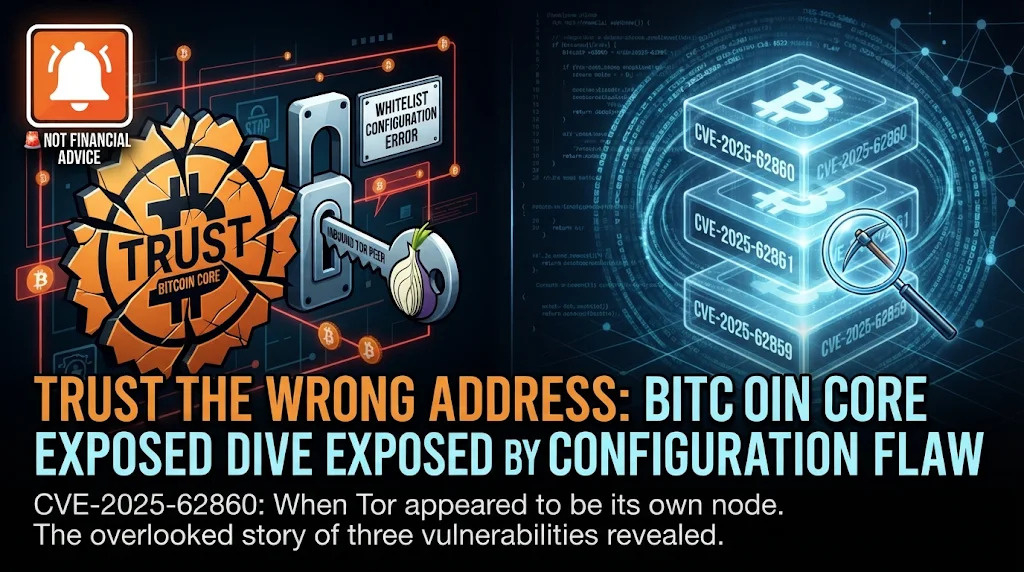
🚨Tor wasn't broken. Bitcoin Core trusted the wrong address.
#bitcoincoredisclosestortrafficvulnerability
On November 10, Bitcoin Core disclosed medium-severity CVE-2025-62860. In certain configurations, an inbound Tor peer appeared to the node as its local Tor daemon. If that daemon's IP matched a non-default -whitelist range, incoming onion peers could inherit trusted-peer permissions that relax denial-of-service limits and some privacy protections.
Bitcoin Core says vendor bundles and common Tor configurations left thousands of reachable mainnet nodes exposed. But nodes without the optional whitelist setting were never affected.
This was not a break of Tor encryption, a Bitcoin consensus failure or proof that users' real IP addresses were exposed.
The more overlooked story: the Tor bug was one of three vulnerabilities disclosed together. CVE-2025-62861, rated high severity, could leave an affected mining node unable to build block templates after a chain reorganization until restart. CVE-2025-62859 could stall block processing under specific peer conditions.
The fixes shipped in 2025. The detailed disclosure arrived November 10, two weeks after the last affected 29.x branch reached end-of-life on October 27, following Bitcoin Core's published security policy.
The lesson: network security can fail through configuration assumptions, not just cryptographic flaws.
Not financial advice.
$BTC
{future}(BTCUSDT)
#BitcoinCoreDisclosesTorTrafficVulnerability #BitcoinCore #BitcoinBreaksBelow200WeekMovingAverage #NodeSecurity
🚨Tor wasn't broken. Bitcoin Core trusted the wrong address.
#bitcoincoredisclosestortrafficvulnerability
On November 10, Bitcoin Core disclosed medium-severity CVE-2025-62860. In certain configurations, an inbound Tor peer appeared to the node as its local Tor daemon. If that daemon's IP matched a non-default -whitelist range, incoming onion peers could inherit trusted-peer permissions that relax denial-of-service limits and some privacy protections.
Bitcoin Core says vendor bundles and common Tor configurations left thousands of reachable mainnet nodes exposed. But nodes without the optional whitelist setting were never affected.
This was not a break of Tor encryption, a Bitcoin consensus failure or proof that users' real IP addresses were exposed.
The more overlooked story: the Tor bug was one of three vulnerabilities disclosed together. CVE-2025-62861, rated high severity, could leave an affected mining node unable to build block templates after a chain reorganization until restart. CVE-2025-62859 could stall block processing under specific peer conditions.
The fixes shipped in 2025. The detailed disclosure arrived November 10, two weeks after the last affected 29.x branch reached end-of-life on October 27, following Bitcoin Core's published security policy.
The lesson: network security can fail through configuration assumptions, not just cryptographic flaws.
Not financial advice.
$BTC
#BitcoinCoreDisclosesTorTrafficVulnerability #BitcoinCore #BitcoinBreaksBelow200WeekMovingAverage #NodeSecurity
#bitcoincoredisclosestortrafficvulnerability
On November 10, Bitcoin Core disclosed medium-severity CVE-2025-62860. In certain configurations, an inbound Tor peer appeared to the node as its local Tor daemon. If that daemon's IP matched a non-default -whitelist range, incoming onion peers could inherit trusted-peer permissions that relax denial-of-service limits and some privacy protections.
Bitcoin Core says vendor bundles and common Tor configurations left thousands of reachable mainnet nodes exposed. But nodes without the optional whitelist setting were never affected.
This was not a break of Tor encryption, a Bitcoin consensus failure or proof that users' real IP addresses were exposed.
The more overlooked story: the Tor bug was one of three vulnerabilities disclosed together. CVE-2025-62861, rated high severity, could leave an affected mining node unable to build block templates after a chain reorganization until restart. CVE-2025-62859 could stall block processing under specific peer conditions.
The fixes shipped in 2025. The detailed disclosure arrived November 10, two weeks after the last affected 29.x branch reached end-of-life on October 27, following Bitcoin Core's published security policy.
The lesson: network security can fail through configuration assumptions, not just cryptographic flaws.
Not financial advice.
$BTC
#BitcoinCoreDisclosesTorTrafficVulnerability #BitcoinCore #BitcoinBreaksBelow200WeekMovingAverage #NodeSecurity
SHERAZ FAHEEM 01:
Open-source transparency helps build confidence, even when technical challenges are discovered.
2
1
321

🚨 Bitcoin Core just disclosed a high-severity bug that could let miners crash your node or worse, execute code on it.
It was patched quietly.
Months before anyone was told.
And thousands of nodes may still be running the vulnerable version.
This isn't a minor glitch.
A use-after-free vulnerability in the script validation engine the core of how Bitcoin verifies transactions is about as deep as bugs get.
This is the engine room. And it had a hole in it.
Use-after-free means memory that's already been freed gets accessed again.
In the wrong hands, that's not just a crash.
That's arbitrary code execution meaning a bad actor could potentially run their own code on your node.
On a Bitcoin node.
Let that land.
The patch was silent by design.
Bitcoin Core developers quietly shipped the fix months ago standard protocol for critical vulnerabilities.
You don't announce a live exploit before most people have patched.
But that window? It existed. And not everyone closed it.
Here's the part that should make every node operator check their version right now.
Bitcoin's security model depends on a decentralized network of nodes independently verifying the chain.
Crash enough nodes at the right moment or worse, compromise them and that independence becomes a fiction.
Bitcoin didn't break.
The protocol held. The patch worked. This is the system functioning as designed.
But it's a reminder that Bitcoin's real attack surface was never the blockchain.
It was always the software running underneath it.
Check your node version.
Update before someone else does it for you.
#Bitcoin #BitcoinCore #CyberSecurity #Crypto #NodeSecurity
🚨 Bitcoin Core just disclosed a high-severity bug that could let miners crash your node or worse, execute code on it.
It was patched quietly.
Months before anyone was told.
And thousands of nodes may still be running the vulnerable version.
This isn't a minor glitch.
A use-after-free vulnerability in the script validation engine the core of how Bitcoin verifies transactions is about as deep as bugs get.
This is the engine room. And it had a hole in it.
Use-after-free means memory that's already been freed gets accessed again.
In the wrong hands, that's not just a crash.
That's arbitrary code execution meaning a bad actor could potentially run their own code on your node.
On a Bitcoin node.
Let that land.
The patch was silent by design.
Bitcoin Core developers quietly shipped the fix months ago standard protocol for critical vulnerabilities.
You don't announce a live exploit before most people have patched.
But that window? It existed. And not everyone closed it.
Here's the part that should make every node operator check their version right now.
Bitcoin's security model depends on a decentralized network of nodes independently verifying the chain.
Crash enough nodes at the right moment or worse, compromise them and that independence becomes a fiction.
Bitcoin didn't break.
The protocol held. The patch worked. This is the system functioning as designed.
But it's a reminder that Bitcoin's real attack surface was never the blockchain.
It was always the software running underneath it.
Check your node version.
Update before someone else does it for you.
#Bitcoin #BitcoinCore #CyberSecurity #Crypto #NodeSecurity
It was patched quietly.
Months before anyone was told.
And thousands of nodes may still be running the vulnerable version.
This isn't a minor glitch.
A use-after-free vulnerability in the script validation engine the core of how Bitcoin verifies transactions is about as deep as bugs get.
This is the engine room. And it had a hole in it.
Use-after-free means memory that's already been freed gets accessed again.
In the wrong hands, that's not just a crash.
That's arbitrary code execution meaning a bad actor could potentially run their own code on your node.
On a Bitcoin node.
Let that land.
The patch was silent by design.
Bitcoin Core developers quietly shipped the fix months ago standard protocol for critical vulnerabilities.
You don't announce a live exploit before most people have patched.
But that window? It existed. And not everyone closed it.
Here's the part that should make every node operator check their version right now.
Bitcoin's security model depends on a decentralized network of nodes independently verifying the chain.
Crash enough nodes at the right moment or worse, compromise them and that independence becomes a fiction.
Bitcoin didn't break.
The protocol held. The patch worked. This is the system functioning as designed.
But it's a reminder that Bitcoin's real attack surface was never the blockchain.
It was always the software running underneath it.
Check your node version.
Update before someone else does it for you.
#Bitcoin #BitcoinCore #CyberSecurity #Crypto #NodeSecurity


37

·
--
$XRP LEDGER V3.2.0 FACES CRITICAL IDENTITY MISMATCH BUG ⚠️
The latest XRP Ledger software update is showing a persistent key mismatch between server logs and active validator identities. This discrepancy occurs when migrating validator tokens on Ubuntu 22.04, potentially complicating consensus trust for network participants.
With only 30% of nodes currently running the new build, the slow adoption rate is likely a response to this series of reported defects. Given that validator identity is the foundation of network consensus, how much weight are you placing on these infrastructure stability concerns?
Not financial advice. Always manage your risk.
#XRP #XRPL #Blockchain #TechnicalAnalysis #NodeSecurity
⚡
$XRP LEDGER V3.2.0 FACES CRITICAL IDENTITY MISMATCH BUG ⚠️
The latest XRP Ledger software update is showing a persistent key mismatch between server logs and active validator identities. This discrepancy occurs when migrating validator tokens on Ubuntu 22.04, potentially complicating consensus trust for network participants.
With only 30% of nodes currently running the new build, the slow adoption rate is likely a response to this series of reported defects. Given that validator identity is the foundation of network consensus, how much weight are you placing on these infrastructure stability concerns?
Not financial advice. Always manage your risk.
#XRP #XRPL #Blockchain #TechnicalAnalysis #NodeSecurity
⚡
The latest XRP Ledger software update is showing a persistent key mismatch between server logs and active validator identities. This discrepancy occurs when migrating validator tokens on Ubuntu 22.04, potentially complicating consensus trust for network participants.
With only 30% of nodes currently running the new build, the slow adoption rate is likely a response to this series of reported defects. Given that validator identity is the foundation of network consensus, how much weight are you placing on these infrastructure stability concerns?
Not financial advice. Always manage your risk.
#XRP #XRPL #Blockchain #TechnicalAnalysis #NodeSecurity
⚡
53
🚨 $ETC ESCAPES COMPROMISE AFTER ROGUE CLIENT UPDATE THREATENS NETWORK CONSENSUS! ⚠️
Social engineering targeted $ETC node operators with a rogue v1.13.0 client pushed through compromised channels as a critical fix. 🛡️ A few mining pools briefly bit, but quick-acting maintainers reverted node logic back to v1.12.23 before real damage hit.
Zero funds were lost, zero chain reorgs occurred, and zero blocks vanished. 💡 But the warning shot is clear: altering chain discovery logic opens the door to network fragmentation if operators get complacent. 💬 Does this infrastructure close-call make you re-evaluate relying on social updates for network upgrades? 👇
⚠️ Not financial advice. Always manage your risk. 🛡️
🏷️ #ETC #EthereumClassic #CryptoSecurity #NodeSecurity #Crypto
🎯 🛡️
🚨 $ETC ESCAPES COMPROMISE AFTER ROGUE CLIENT UPDATE THREATENS NETWORK CONSENSUS! ⚠️
Social engineering targeted $ETC node operators with a rogue v1.13.0 client pushed through compromised channels as a critical fix. 🛡️ A few mining pools briefly bit, but quick-acting maintainers reverted node logic back to v1.12.23 before real damage hit.
Zero funds were lost, zero chain reorgs occurred, and zero blocks vanished. 💡 But the warning shot is clear: altering chain discovery logic opens the door to network fragmentation if operators get complacent. 💬 Does this infrastructure close-call make you re-evaluate relying on social updates for network upgrades? 👇
⚠️ Not financial advice. Always manage your risk. 🛡️
🏷️ #ETC #EthereumClassic #CryptoSecurity #NodeSecurity #Crypto
🎯 🛡️
Social engineering targeted $ETC node operators with a rogue v1.13.0 client pushed through compromised channels as a critical fix. 🛡️ A few mining pools briefly bit, but quick-acting maintainers reverted node logic back to v1.12.23 before real damage hit.
Zero funds were lost, zero chain reorgs occurred, and zero blocks vanished. 💡 But the warning shot is clear: altering chain discovery logic opens the door to network fragmentation if operators get complacent. 💬 Does this infrastructure close-call make you re-evaluate relying on social updates for network upgrades? 👇
⚠️ Not financial advice. Always manage your risk. 🛡️
🏷️ #ETC #EthereumClassic #CryptoSecurity #NodeSecurity #Crypto
🎯 🛡️
19

🚨 $BTC LIGHTNING NETWORK ISSUES CORE SECURITY UPDATE FOR NODE OPERATORS ⚡
Core Lightning node operators are facing critical infrastructure maintenance as developers confirm multiple undisclosed vulnerabilities. 🔍 While no exploits or capital drain have been detected, institutional node runners are urged to patch immediately or run offline channel monitoring. 🛡️
Sustaining off-chain liquidity routing requires absolute node integrity, making rapid operational mitigation key to preserving layer-two network throughput. 📊 Institutional capital always prioritizes base-layer and infrastructure security before expanding structural exposure on $BTC . 💬 Are you temporarily pausing Lightning payment routing until node updates complete? 👇
⚠️ Not financial advice. Always manage your risk. 🛡️
🏷️ #BTC #LightningNetwork #Bitcoin #Crypto #NodeSecurity
⚡ 🛡️
🚨 $BTC LIGHTNING NETWORK ISSUES CORE SECURITY UPDATE FOR NODE OPERATORS ⚡
Core Lightning node operators are facing critical infrastructure maintenance as developers confirm multiple undisclosed vulnerabilities. 🔍 While no exploits or capital drain have been detected, institutional node runners are urged to patch immediately or run offline channel monitoring. 🛡️
Sustaining off-chain liquidity routing requires absolute node integrity, making rapid operational mitigation key to preserving layer-two network throughput. 📊 Institutional capital always prioritizes base-layer and infrastructure security before expanding structural exposure on $BTC . 💬 Are you temporarily pausing Lightning payment routing until node updates complete? 👇
⚠️ Not financial advice. Always manage your risk. 🛡️
🏷️ #BTC #LightningNetwork #Bitcoin #Crypto #NodeSecurity
⚡ 🛡️
Core Lightning node operators are facing critical infrastructure maintenance as developers confirm multiple undisclosed vulnerabilities. 🔍 While no exploits or capital drain have been detected, institutional node runners are urged to patch immediately or run offline channel monitoring. 🛡️
Sustaining off-chain liquidity routing requires absolute node integrity, making rapid operational mitigation key to preserving layer-two network throughput. 📊 Institutional capital always prioritizes base-layer and infrastructure security before expanding structural exposure on $BTC . 💬 Are you temporarily pausing Lightning payment routing until node updates complete? 👇
⚠️ Not financial advice. Always manage your risk. 🛡️
🏷️ #BTC #LightningNetwork #Bitcoin #Crypto #NodeSecurity
⚡ 🛡️
15
Log in to explore more content
Join global crypto users on Binance Square
⚡️ Get latest and useful information about crypto.
💬 Trusted by the world’s largest crypto exchange.
👍 Discover real insights from verified creators.
Email / Phone number
Trending Topics
1
#WhoWillSucceedJensenHuangatNvidia?
81,433 views
1,099 Discussing
2
#WhatWillDriveCryptoandStocks’NextRebound?
428,041 views
2,998 Discussing
3
#BitcoinActiveSupplyInProfitDropsBelow45%
21,738 views
326 Discussing
4
#KavaSaysAbnormalActivityLimitedToKavaLend
8,507 views
163 Discussing
5
#USSpotXRPETFsSeeLargestWeeklyOutflowIn8Months
7,720 views
155 Discussing
6
#USPPIMissMayEaseBTCPressure
206,752 views
2,036 Discussing
7
#WORPTLetsTouristsConvertCryptoToThaiBaht
2,550 views
49 Discussing
8
#TONStrategyReports$23.97MQ3NetLoss
3,193 views
41 Discussing
9
#PolkadotCommunityApprovesNewStrategyWith97%Vote
18,626 views
241 Discussing
10
#dYdXPlansV9.9UpgradeToShiftUSDCToInjective
11,380 views
193 Discussing