
#bnb
bnb
2G views
24.9M Discussing
Hot
Latest

·
--
Bullish
AutopilotX:
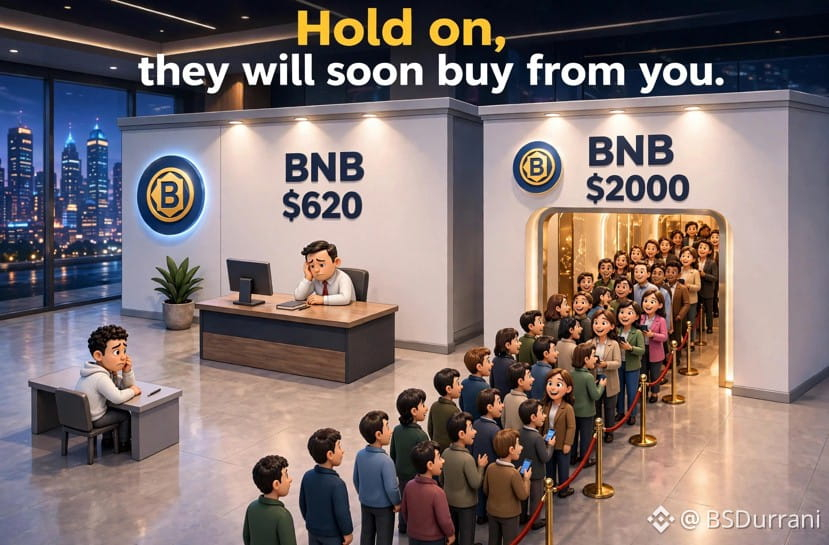
bnb is junk coin Stay away, it will go down to 15 usd.
5
2
858


·
--
Bullish
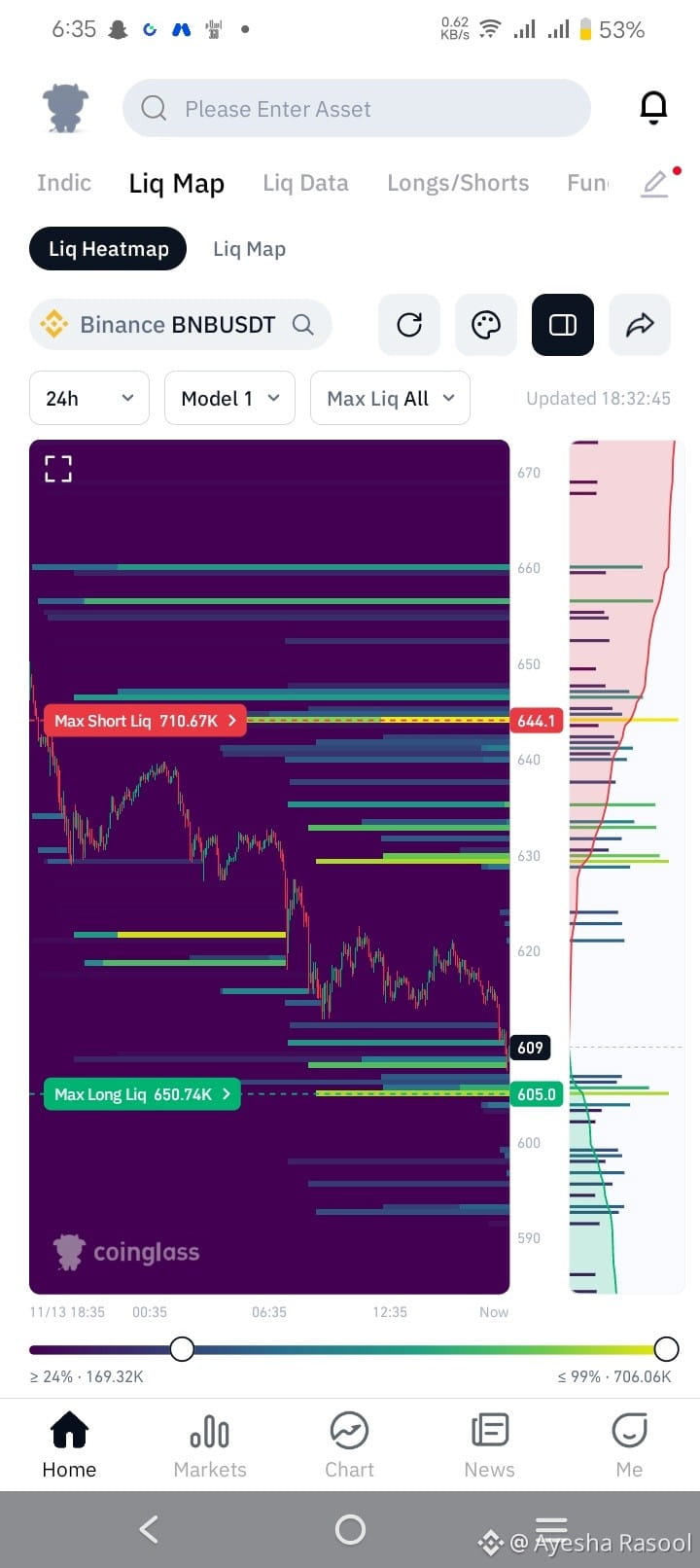
$BNB Liquidation Heatmap (24H) – Key Levels to Watch 👀
BNB is trading around $609, sitting just above a major long liquidation cluster.
📊 What the heatmap shows:
🔴 Max Short Liq: $644.1 (~710.67K)
A big pool of short liquidations sits above. If price pushes up here, shorts could get squeezed and fuel a sharp move.
🟢 Max Long Liq: $605.0 (~650.74K)
Heavy long liquidations are stacked just below current price. Only about $4 away, so a dip here could trigger a cascade of long liquidations.
⚠️ Other notable clusters:
$630–$632: bright liquidity zone, a likely resistance/magnet area
$620: moderate liquidity cluster
$600 and below: thinner liquidity, so a break of $605 could see a quick drop toward $590
🧠 My take:
Price is hovering right above the max long liq level. Price tends to be drawn toward liquidity zones, so a sweep of $605 is possible before any bounce. Bulls need to hold $605, while a reclaim of $630 would open the way toward $644.
📌 Levels:
Support: $605 / $590
Resistance: $620 / $630 / $644
Always manage your risk and use stop losses. Liquidation maps show where liquidity is, not guaranteed direction.
#BNB #BNB_Market_Update #Liquidations #CryptoTrading.
364


·
--
Bullish
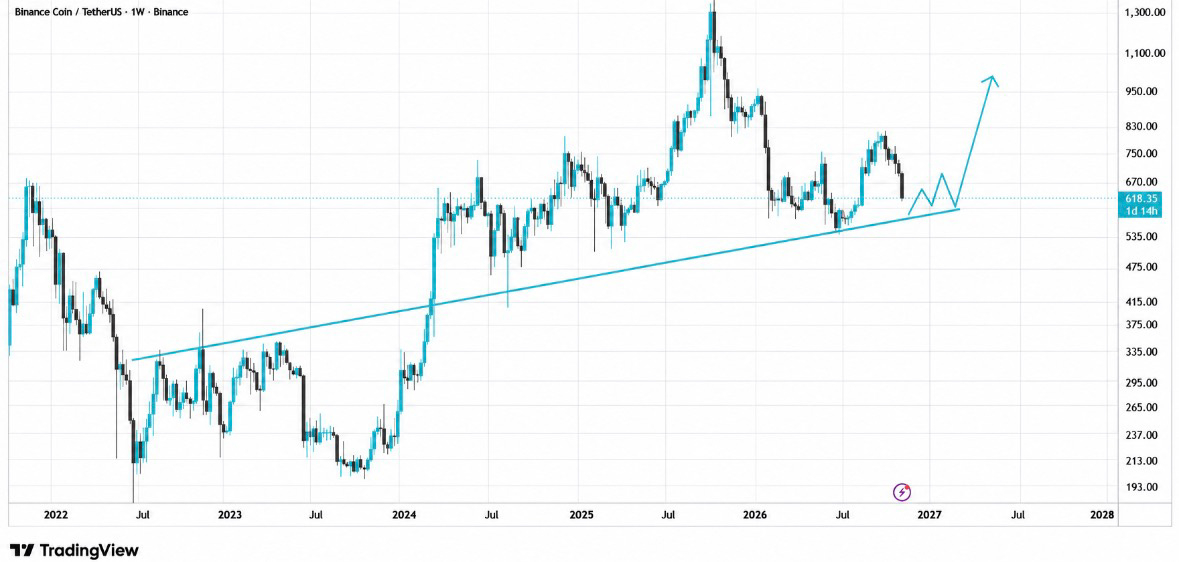
$BNB is approaching a key support zone around $600.
The long-term ascending trendline is still intact.
If buyers defend this level, a move towards $750 and $950 could follow.
Watching this setup closely.
#BNB #WhatWillDriveCryptoandStocks’NextRebound?
$BNB is approaching a key support zone around $600.
The long-term ascending trendline is still intact.
If buyers defend this level, a move towards $750 and $950 could follow.
Watching this setup closely.
#BNB #WhatWillDriveCryptoandStocks’NextRebound?
The long-term ascending trendline is still intact.
If buyers defend this level, a move towards $750 and $950 could follow.
Watching this setup closely.
#BNB #WhatWillDriveCryptoandStocks’NextRebound?
Elon Jamess:
The bigger structure looks decent for now
5
12
956

·
--
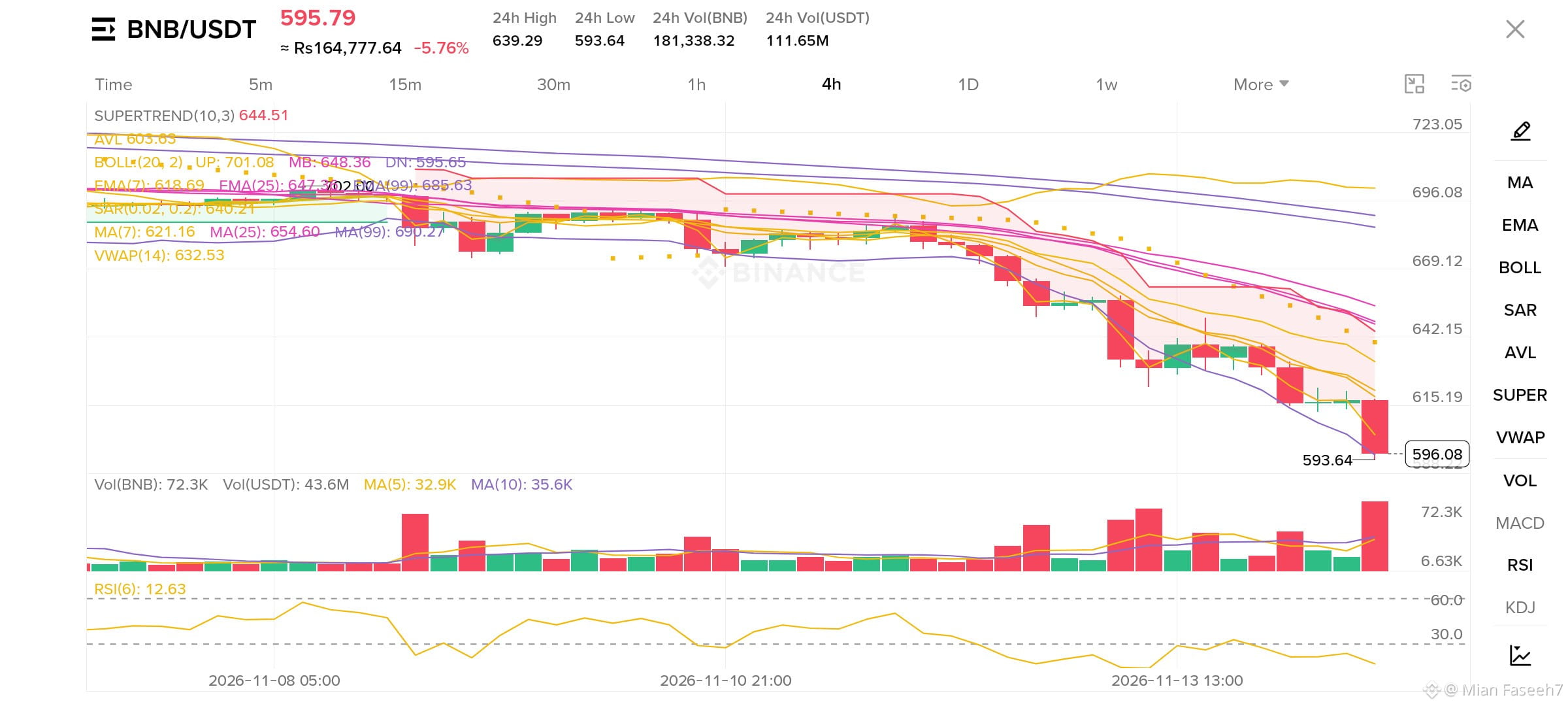
I never thought I would see $BNB at 595 again, but here we are.
{spot}(BNBUSDT)
When $BNB was at 639, everyone was talking about 700. Now it has dropped to 598.12, down -4.95% in a day, and the same people are quiet.
What I noticed is, it made a low at 593.64 and is still trying to hold just above it. That level is now everything. If it breaks, sellers will get more confident. If it holds, this could be the panic bottom everyone talks about later.
In my view:
593.64 is the support to watch. As long as price stays above it, a bounce back to 639 and then 648 is possible.
RSI is at 12.63, which is extremely oversold. This kind of RSI does not mean buy blindly, but it means panic selling is at its peak.
I am not buying in a hurry, I am watching the 593.64 close first.
Are you holding $BNB right now, or are you waiting for a lower entry?
Follow for daily honest market updates.
If this analysis helped you, a small Tip is appreciated 🙏
#BNB #Binance #Crypto
I never thought I would see $BNB at 595 again, but here we are.
When $BNB was at 639, everyone was talking about 700. Now it has dropped to 598.12, down -4.95% in a day, and the same people are quiet.
What I noticed is, it made a low at 593.64 and is still trying to hold just above it. That level is now everything. If it breaks, sellers will get more confident. If it holds, this could be the panic bottom everyone talks about later.
In my view:
593.64 is the support to watch. As long as price stays above it, a bounce back to 639 and then 648 is possible.
RSI is at 12.63, which is extremely oversold. This kind of RSI does not mean buy blindly, but it means panic selling is at its peak.
I am not buying in a hurry, I am watching the 593.64 close first.
Are you holding $BNB right now, or are you waiting for a lower entry?
Follow for daily honest market updates.
If this analysis helped you, a small Tip is appreciated 🙏
#BNB #Binance #Crypto
Saiful Islam Sagar 57:
Bnp on fire
2
1
700

·
--

Article
BNB (BNB): Market Update – November 14, 2026BNB $BNB is currently facing selling pressure in the cryptocurrency market. Today, November 14, 2026, the coin is showing a negative price movement.
According to recent market data, BNB is trading around $615–617, with a decline of approximately 2.5% to 3.7% over the last 24 hours. Its market capitalization is around $81 billion.
Why Is BNB Down Today?
The overall cryptocurrency market is experiencing weakness. Bitcoin has also declined, and negative market sentiment is affecting several major cryptocurrencies, including BNB.
BNB Ecosystem
BNB remains an important cryptocurrency in the BNB Chain ecosystem. It is used for transaction fees and supports decentralized applications, blockchain projects, and other Web3 services.
BNB also has a token burn mechanism that gradually reduces its supply.
Market Outlook
BNB is currently showing bearish movement. Traders are watching important support levels and overall market activity to understand its next direction.
A recovery in buying interest could help improve market sentiment, while continued selling pressure may create further challenges.
Conclusion
Despite the current price decline, BNB remains an important cryptocurrency with an established blockchain ecosystem. Its future performance will depend on market demand and overall crypto market conditions.
Disclaimer: This article is for educational purposes only. Always do your own research.
#bnb #binance #binancesquare #cryptonews #binancenews
{spot}(BNBUSDT)
BNB (BNB): Market Update – November 14, 2026
BNB $BNB is currently facing selling pressure in the cryptocurrency market. Today, November 14, 2026, the coin is showing a negative price movement.
According to recent market data, BNB is trading around $615–617, with a decline of approximately 2.5% to 3.7% over the last 24 hours. Its market capitalization is around $81 billion.
Why Is BNB Down Today?
The overall cryptocurrency market is experiencing weakness. Bitcoin has also declined, and negative market sentiment is affecting several major cryptocurrencies, including BNB.
BNB Ecosystem
BNB remains an important cryptocurrency in the BNB Chain ecosystem. It is used for transaction fees and supports decentralized applications, blockchain projects, and other Web3 services.
BNB also has a token burn mechanism that gradually reduces its supply.
Market Outlook
BNB is currently showing bearish movement. Traders are watching important support levels and overall market activity to understand its next direction.
A recovery in buying interest could help improve market sentiment, while continued selling pressure may create further challenges.
Conclusion
Despite the current price decline, BNB remains an important cryptocurrency with an established blockchain ecosystem. Its future performance will depend on market demand and overall crypto market conditions.
Disclaimer: This article is for educational purposes only. Always do your own research.
#bnb #binance #binancesquare #cryptonews #binancenews
134
·
--
Bearish
*Title:*
BNB Drops Below $650 - Lowest Since August! What Next?
*Post:*
BNB is trading around *$625 - $630* today, down *6-7% in 24H* and almost *-9% in 7 days* 📉
This is the lowest level since August 20.
*Why is BNB Down?*
1. *Binance Hack Aftermath:* Binance has now *completed the $6.34 Billion hack coverage* from 29 Oct. They paid users from SAFU Fund + Treasury. Good news, but market confidence is still shaky.
2. *Proof of Reserves:* Binance published new Proof of Reserves for 198 tokens, showing *100%+ backing*. But independent verification is still pending.
3. *Whole Market Down:* Bitcoin also fell below $70,000. So this is not only BNB, full market is in red. 1bced8f37cd1
*Technical View:*
BNB is trading below all major moving averages. RSI is at *27.71 - Oversold zone*. That means sellers are tired, a small bounce is possible.
*Key Levels:*
Support: $613 - $622
Resistance: $650 - $655
If $613 breaks, next target is $591. If $655 breaks, recovery starts.
*My Take:*
Panic sell mat karo. Oversold me panic wale phas te hain. Smart traders ab DCA aur Hold ki planning kar rahe hain.
Are you Buying, Holding or Selling BNB at $630?
Comment below 👇
#BNB #Binance #CryptoNewss $BNB
{future}(BNBUSDT)
*Title:*
BNB Drops Below $650 - Lowest Since August! What Next?
*Post:*
BNB is trading around *$625 - $630* today, down *6-7% in 24H* and almost *-9% in 7 days* 📉
This is the lowest level since August 20.
*Why is BNB Down?*
1. *Binance Hack Aftermath:* Binance has now *completed the $6.34 Billion hack coverage* from 29 Oct. They paid users from SAFU Fund + Treasury. Good news, but market confidence is still shaky.
2. *Proof of Reserves:* Binance published new Proof of Reserves for 198 tokens, showing *100%+ backing*. But independent verification is still pending.
3. *Whole Market Down:* Bitcoin also fell below $70,000. So this is not only BNB, full market is in red. 1bced8f37cd1
*Technical View:*
BNB is trading below all major moving averages. RSI is at *27.71 - Oversold zone*. That means sellers are tired, a small bounce is possible.
*Key Levels:*
Support: $613 - $622
Resistance: $650 - $655
If $613 breaks, next target is $591. If $655 breaks, recovery starts.
*My Take:*
Panic sell mat karo. Oversold me panic wale phas te hain. Smart traders ab DCA aur Hold ki planning kar rahe hain.
Are you Buying, Holding or Selling BNB at $630?
Comment below 👇
#BNB #Binance #CryptoNewss $BNB

225


·
--
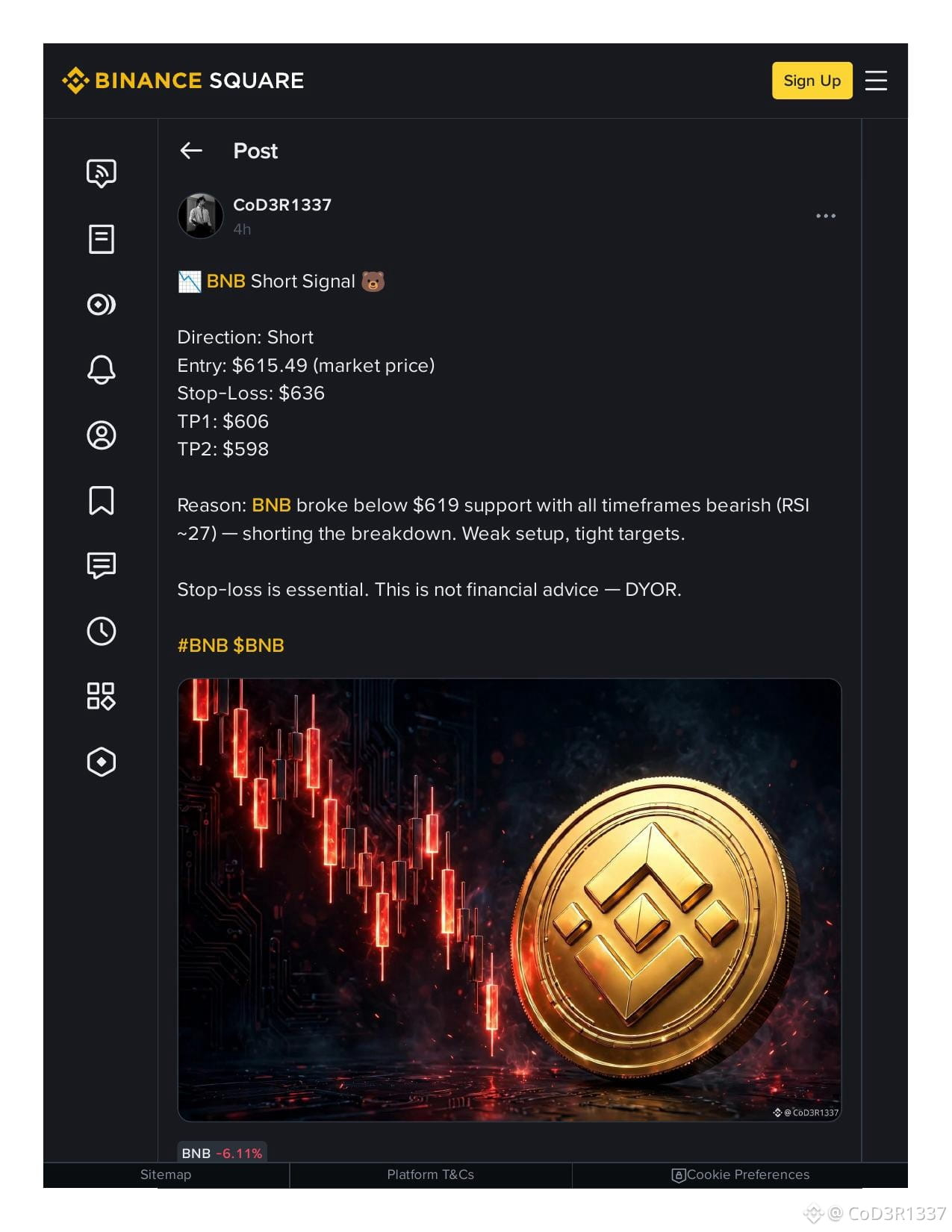
📉 BNB Short Signal 🐻
Direction: Short
Entry: $615.49 (market price)
Stop-Loss: $636
TP1: $606
TP2: $598
Reason: BNB broke below $619 support with all timeframes bearish (RSI ~27) — shorting the breakdown. Weak setup, tight targets.
Stop-loss is essential. This is not financial advice — DYOR.
#BNB $BNB
Direction: Short
Entry: $615.49 (market price)
Stop-Loss: $636
TP1: $606
TP2: $598
Reason: BNB broke below $619 support with all timeframes bearish (RSI ~27) — shorting the breakdown. Weak setup, tight targets.
Stop-loss is essential. This is not financial advice — DYOR.
#BNB $BNB

69
·
--
🎯 TP1 HIT! 🐻 BNB Short
Entry: $615.49 → TP1: $606 (+1.54%)
BNB slid to $605 and hit our first target — the breakdown call played out. TP2 at $598 still open.
Original signal: https://app.binance.com/uni-qr/cpos/388122711739829?r=D516LQKC&l=en
#BNB $BNB
🎯 TP1 HIT! 🐻 BNB Short
Entry: $615.49 → TP1: $606 (+1.54%)
BNB slid to $605 and hit our first target — the breakdown call played out. TP2 at $598 still open.
Original signal: https://app.binance.com/uni-qr/cpos/388122711739829?r=D516LQKC&l=en
#BNB $BNB
Entry: $615.49 → TP1: $606 (+1.54%)
BNB slid to $605 and hit our first target — the breakdown call played out. TP2 at $598 still open.
Original signal: https://app.binance.com/uni-qr/cpos/388122711739829?r=D516LQKC&l=en
#BNB $BNB
31

·
--
Bearish
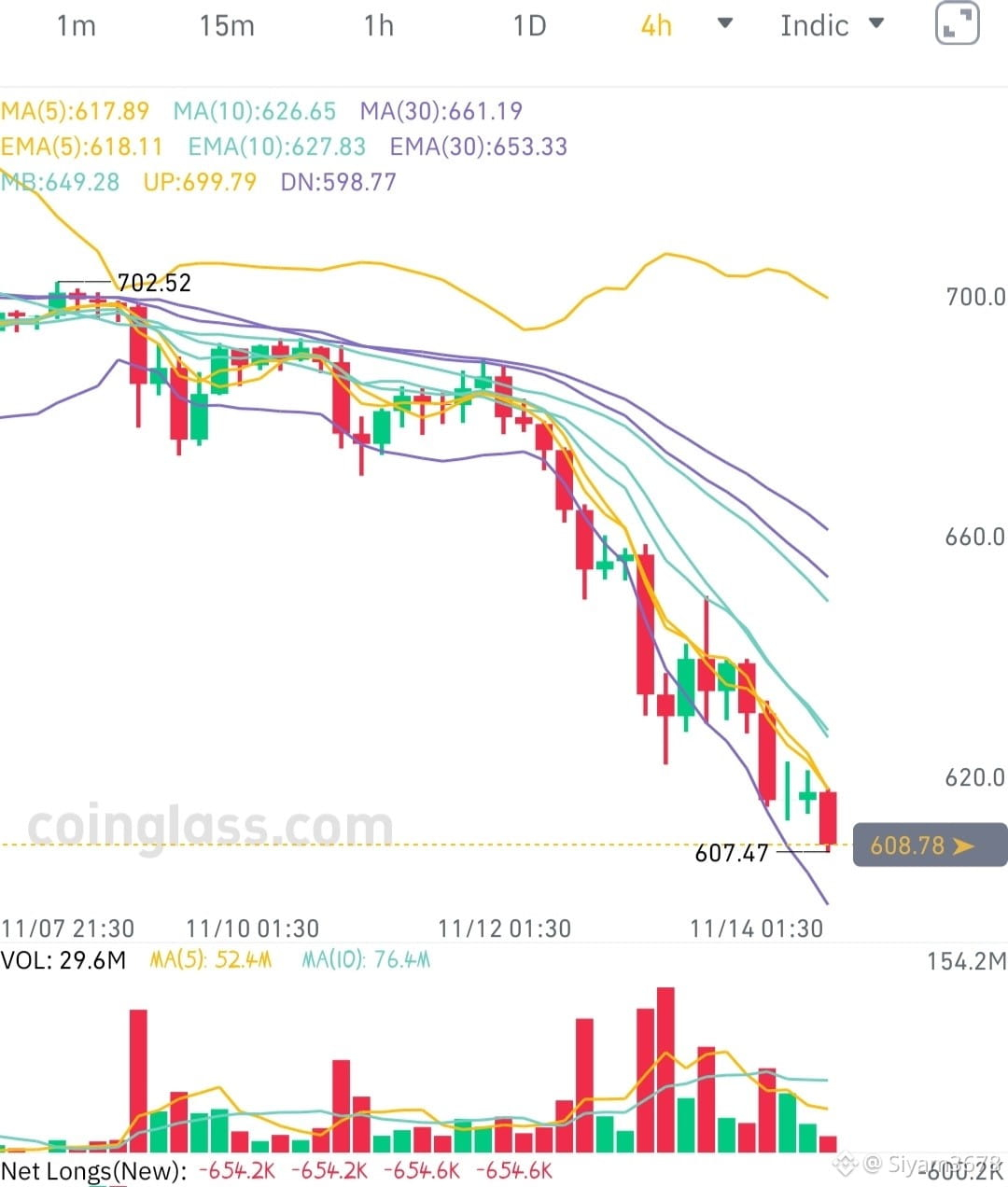
🔴 $BNB BNB's staircase just turned into a slide: price closed on the 607.47 session low under every mean — EMA(7)/25/99 at 621.94/648.58/686.20 and the Coinglass MA5-MA30 stack at 617.89-661.19 — with Supertrend red at 648.19 and the Bollinger midline at 649.28 rolling over above. The tape shows no capitulation tell yet: net new longs at -654.6K keep liquidating while +524.3K of net shorts press the breakdown, and RSI(6) at 16.83 has not produced a single green reversal candle, so sell 607.5-609.5 and let the measured extension below 600 do the work.
Trade Setup
Entry: 607.5 - 609.5
Stop-Loss: 628.5
Targets: 568 - 548 - 528
Trade smart, protect your capital, and always manage your own risk. Personal analysis only not financial advice.
#BNB #BNBUSDT #CryptoSignals #BinanceSquare
{future}(BNBUSDT)
🔴 $BNB BNB's staircase just turned into a slide: price closed on the 607.47 session low under every mean — EMA(7)/25/99 at 621.94/648.58/686.20 and the Coinglass MA5-MA30 stack at 617.89-661.19 — with Supertrend red at 648.19 and the Bollinger midline at 649.28 rolling over above. The tape shows no capitulation tell yet: net new longs at -654.6K keep liquidating while +524.3K of net shorts press the breakdown, and RSI(6) at 16.83 has not produced a single green reversal candle, so sell 607.5-609.5 and let the measured extension below 600 do the work.
Trade Setup
Entry: 607.5 - 609.5
Stop-Loss: 628.5
Targets: 568 - 548 - 528
Trade smart, protect your capital, and always manage your own risk. Personal analysis only not financial advice.
#BNB #BNBUSDT #CryptoSignals #BinanceSquare
Trade Setup
Entry: 607.5 - 609.5
Stop-Loss: 628.5
Targets: 568 - 548 - 528
Trade smart, protect your capital, and always manage your own risk. Personal analysis only not financial advice.
#BNB #BNBUSDT #CryptoSignals #BinanceSquare
1
78

·
--
Article
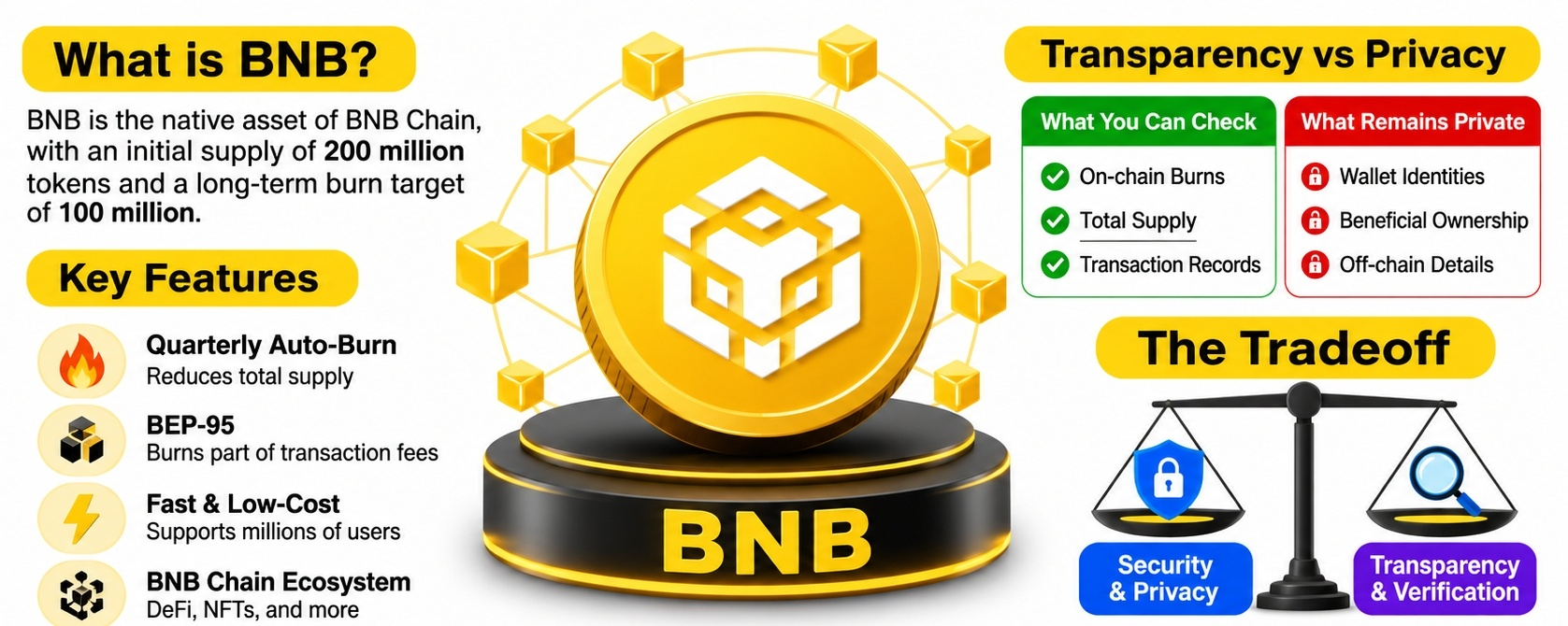
BNB is the native asset of BNB Chain, with an initial supply of 200 millionBNB is the native asset of BNB Chain, with an initial supply of 200 million tokens and a long-term burn target of 100 million. Its quarterly Auto-Burn transactions are publicly verifiable, but the identities behind individual wallet balances remain private. That's not an oversight. It's a stated choice.
BNB's model prioritizes transparent protocol activity without requiring holders to expose their identities. This reduces personal exposure and potential targeting, but it also limits what outsiders can establish about beneficial ownership and off-chain custody.
Holders can verify BNB burns directly on-chain, including transaction records and the remaining supply. The 37th quarterly burn destroyed 1,646,196.44 BNB in October 2026. BEP-95 also burns part of transaction fees continuously.
However, there is no reserve-backed structure or independent accounting firm providing monthly reserve attestations for BNB itself. On-chain supply is verifiable, but off-chain ownership and custodial liabilities are not continuously visible.
Compare this with USDC. Circle publishes weekly reserve disclosures and monthly third-party assurance from Deloitte. That means more exposure, in exchange for greater scrutiny of reserve composition. However, those attestations are point-in-time examinations, not continuous audits.
Neither approach removes counterparty risk. BNB relies on public blockchain records and its validator system, while USDC relies on disclosed reserves, custodians and financial institutions.
Which risk worries you more — limited visibility into off-chain control, or greater dependence on disclosed financial
institutions? #BNB $BNB
BNB is the native asset of BNB Chain, with an initial supply of 200 million
BNB is the native asset of BNB Chain, with an initial supply of 200 million tokens and a long-term burn target of 100 million. Its quarterly Auto-Burn transactions are publicly verifiable, but the identities behind individual wallet balances remain private. That's not an oversight. It's a stated choice.
BNB's model prioritizes transparent protocol activity without requiring holders to expose their identities. This reduces personal exposure and potential targeting, but it also limits what outsiders can establish about beneficial ownership and off-chain custody.
Holders can verify BNB burns directly on-chain, including transaction records and the remaining supply. The 37th quarterly burn destroyed 1,646,196.44 BNB in October 2026. BEP-95 also burns part of transaction fees continuously.
However, there is no reserve-backed structure or independent accounting firm providing monthly reserve attestations for BNB itself. On-chain supply is verifiable, but off-chain ownership and custodial liabilities are not continuously visible.
Compare this with USDC. Circle publishes weekly reserve disclosures and monthly third-party assurance from Deloitte. That means more exposure, in exchange for greater scrutiny of reserve composition. However, those attestations are point-in-time examinations, not continuous audits.
Neither approach removes counterparty risk. BNB relies on public blockchain records and its validator system, while USDC relies on disclosed reserves, custodians and financial institutions.
Which risk worries you more — limited visibility into off-chain control, or greater dependence on disclosed financial
institutions? #BNB $BNB
76

·
--
Bearish
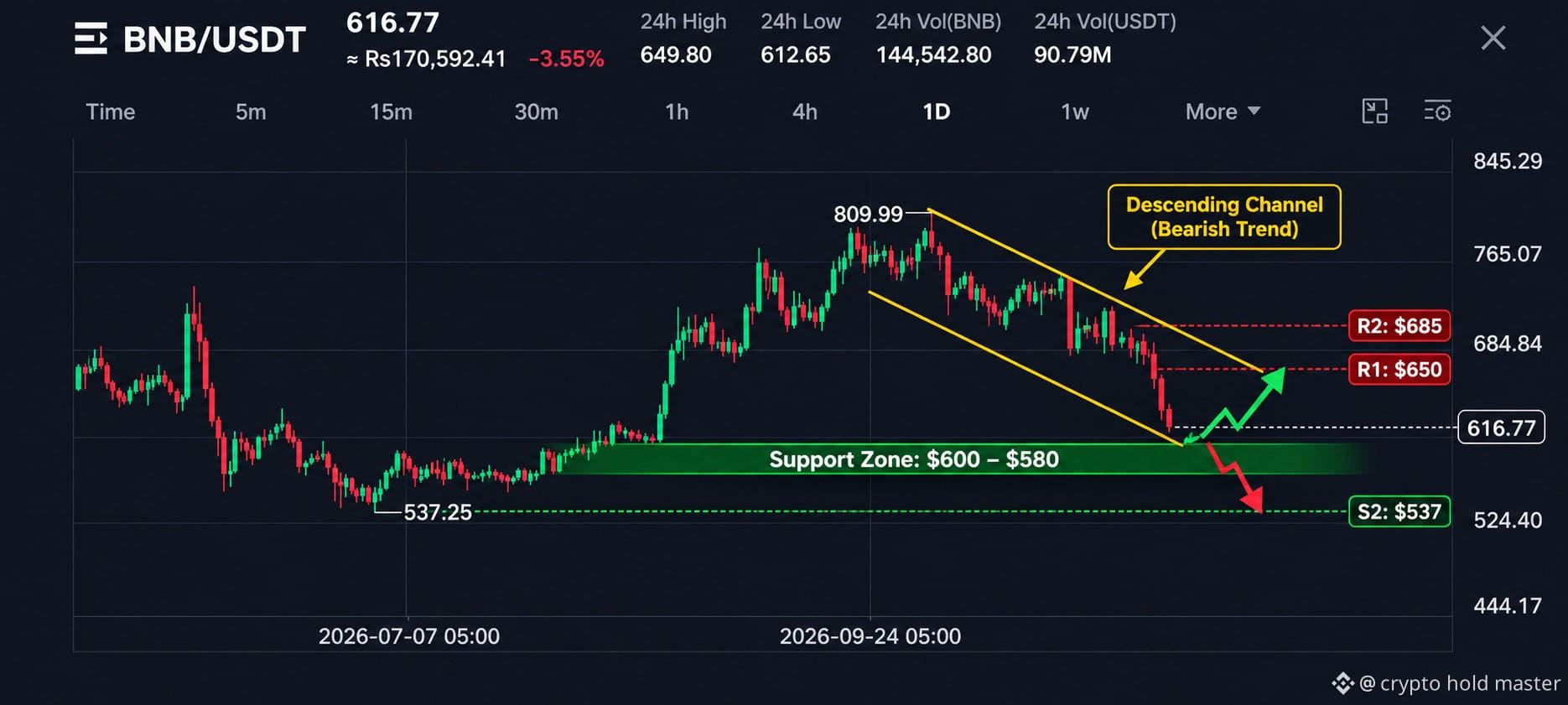
$BNB is still under selling pressure, and the daily chart is showing clear weakness. 👀
$BNB is trading around $616.77, down 3.55%. Sellers have pushed the price lower after rejection from the $800 area, and the recent candles show that buyers are struggling to regain control.
Key levels I'm watching:
Immediate support: $612–$600
Major support: $537
Resistance: $650
Stronger resistance: $685
If $BNB loses the $600 area, further downside toward $537 could come into focus. A recovery above $650 would be the first sign of possible relief.
Will #BNB find support here, or are we heading toward $537?
{spot}(BNBUSDT)
$BNB is still under selling pressure, and the daily chart is showing clear weakness. 👀
$BNB is trading around $616.77, down 3.55%. Sellers have pushed the price lower after rejection from the $800 area, and the recent candles show that buyers are struggling to regain control.
Key levels I'm watching:
Immediate support: $612–$600
Major support: $537
Resistance: $650
Stronger resistance: $685
If $BNB loses the $600 area, further downside toward $537 could come into focus. A recovery above $650 would be the first sign of possible relief.
Will #BNB find support here, or are we heading toward $537?
2
13

·
--

Article
Final Takeaway for TradersSmart positioning comes down to reading all three charts together:
1. Check BTC/USDT for overall market direction and macro risk appetite.
2. Monitor USDT volume and inflows to confirm whether real liquidity is backing a move.
3. Use BNB/BTC to decide whether holding BNB offers stronger relative strength than holdingBTC alone.
Disclaimer: This article is for informational and educational purposes only and does not constitute financial advice. Always manage your risk and do your own research (DYOR).
👇 How are you positioning your portfolio right now?
1️⃣ Holding $USDT and waiting for deeper support levels
2️⃣ Accumulating $BNB on dips for ecosystem yield
3️⃣ Staying focused strictly on $BTC until macro sentiment clears
Drop your analysis in the comments! 📊💬
$BNB BTCUSDT
#BinanceSquare #CryptoAnalysis #bnb #Bitcoin #USDT #tradingStrategy #CryptoMarket #TechnicalAnalysis #Web3
Final Takeaway for Traders
Smart positioning comes down to reading all three charts together:
1. Check BTC/USDT for overall market direction and macro risk appetite.
2. Monitor USDT volume and inflows to confirm whether real liquidity is backing a move.
3. Use BNB/BTC to decide whether holding BNB offers stronger relative strength than holdingBTC alone.
Disclaimer: This article is for informational and educational purposes only and does not constitute financial advice. Always manage your risk and do your own research (DYOR).
👇 How are you positioning your portfolio right now?
1️⃣ Holding $USDT and waiting for deeper support levels
2️⃣ Accumulating $BNB on dips for ecosystem yield
3️⃣ Staying focused strictly on $BTC until macro sentiment clears
Drop your analysis in the comments! 📊💬
$BNB BTCUSDT
#BinanceSquare #CryptoAnalysis #bnb #Bitcoin #USDT #tradingStrategy #CryptoMarket #TechnicalAnalysis #Web3
54

$BNB , $BTC , and $ETH have all recorded long liquidations, showing pressure on leveraged buyers.
Trade Signals:
🔹 BNB
Buy Zone: $605–$612
Targets: $620 / $628
Stop Loss: $599
🔹 BTC
Buy Zone: $66,000–$66,500
Targets: $68,000 / $69,000
Stop Loss: $65,500
🔹 ETH
Buy Zone: $1,865–$1,885
Targets: $1,930 / $1,970
Stop Loss: $1,845
My View: Wait for buying-volume confirmation before entering. No blind trades. Protect your capital.
Which coin will recover first?
#BNB #BTC #ETH #BinanceSquareTalks
BNB: Will BNB reach $620? 🚀
BTC: Will BTC hit $68K? 📈
ETH: Will ETH cross $1,900? 💪
???
19 hr(s) left
1
688

·
--
$BNB | BNB MARKET WATCH 🔍
{future}(BNBUSDT)
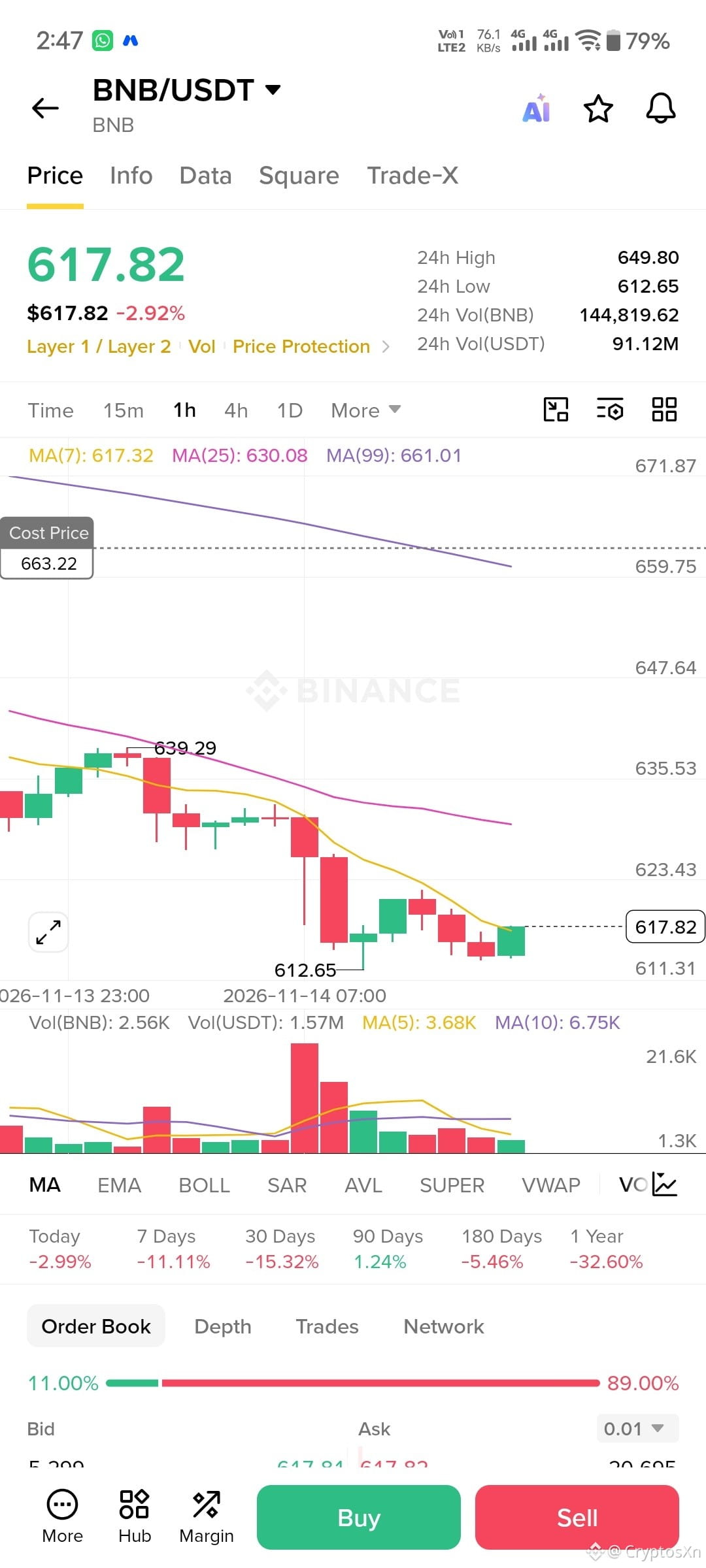
BNB is facing bearish pressure on the 1H chart, trading around $617.82 in the screenshot.
Recent candles show continued downward movement. Buyers have yet to show a convincing recovery, so volume and candle closes remain important.
Market Focus: Will buying activity increase or will selling pressure continue?
#bnb #BinanceCoin #CryptoAnalysis #BinanceSquare
$BNB | BNB MARKET WATCH 🔍
BNB is facing bearish pressure on the 1H chart, trading around $617.82 in the screenshot.
Recent candles show continued downward movement. Buyers have yet to show a convincing recovery, so volume and candle closes remain important.
Market Focus: Will buying activity increase or will selling pressure continue?
#bnb #BinanceCoin #CryptoAnalysis #BinanceSquare
Mujib59:
Hello I Followed you please follow me back
2
1
76

·
--
Bearish
🚨 $BNB Market Analysis | November 14, 2026
💰 Current Price: $617.13
📉 24H Change: -2.38%
🔴 Support: $615 – $601
🟢 Resistance: $658 – $661
BNB's 4H and Daily trends remain bearish. A breakdown below $615 could trigger further selling pressure. On the other hand, a recovery above $661 could create an opportunity for a bullish reversal.
Market Sentiment: Bearish 📉
$BNB
{future}(BNBUSDT)
#BNB #BinanceCoin #cryptotrading
🚨 $BNB Market Analysis | November 14, 2026
💰 Current Price: $617.13
📉 24H Change: -2.38%
🔴 Support: $615 – $601
🟢 Resistance: $658 – $661
BNB's 4H and Daily trends remain bearish. A breakdown below $615 could trigger further selling pressure. On the other hand, a recovery above $661 could create an opportunity for a bullish reversal.
Market Sentiment: Bearish 📉
$BNB
#BNB #BinanceCoin #cryptotrading
127

·
--
🚨 $BNB LIQUIDITY DIVERGENCE: HOW STRUCTURAL DEFENSES SHAPE SMART MONEY ACCUMULATION 🦈
As a leading spot and derivatives venue reinforces its systemic architecture following recent threat vectors, institutional order flow tells a compelling structural story. Order books are stabilizing as smart money absorbs liquidity sweeps around high-timeframe demand zones. 📊
Market resilience through infrastructural upgrades often precedes a volatility expansion phase as trapped shorts are forced to cover their positions. ⚡
💡 Are you positioning alongside institutional accumulation or waiting for a confirmed range reclaim? 👇
⚠️ Not financial advice. Always manage your risk. 🛡️
🏷️ #BNB #SmartMoney #OrderFlow #Crypto #MarketStructure
🔥 💎

🚨 $BNB FORTIFYING INFRASTRUCTURE AFTER UNPRECEDENTED DIGITAL SIEGE! 🛡️
Infrastructure hardening is the ultimate stress test for market heavyweights. When a top-tier exchange upgrades its armor after facing a historic digital breach, liquidity providers take note of the structural resilience. 📊
Institutional capital demands impenetrable fortresses before committing heavy multi-million dollar blocks. These aggressive security overhauls remove lingering tail-risk and restore absolute confidence across spot and derivatives order books. 💡
Are you factoring ecosystem security into your long-term thesis, or purely trading the charts? 👇
⚠️ Not financial advice. Always manage your risk. 🛡️
🏷️ #BNB #CryptoSecurity #MarketInsights #Infrastructure #Trading
🔥 💎
4

·
--
🦈 $BNB NEARING A CRITICAL LIQUIDITY SWEEP BEFORE THE NEXT EXPANSIVE IMPULSE ⚡
Institutional order flow on $BNB is currently carving out a classic structural sweep into major discount arrays. When retail sentiment dips into anxious consolidation across correlated majors like $BTC and $SOL , smart money quietly absorbs residual inventory. 📊
This localized compression phase typically precedes an aggressive liquidation of late shorts trapped above institutional resistance zones. Price action is respecting higher-timeframe demand, setting the stage for a rapid repricing toward premium liquidity pools. 💡
Are you positioned for this structural expansion, or waiting for confirmation above range highs? 💬
⚠️ Not financial advice. Always manage your risk. 🛡️
🏷️ #BNB #SmartMoney #MarketStructure #Crypto
🎯 🦈
8
Log in to explore more content
Join global crypto users on Binance Square
⚡️ Get latest and useful information about crypto.
💬 Trusted by the world’s largest crypto exchange.
👍 Discover real insights from verified creators.
Email / Phone number
Trending Topics
1
#WhoWillSucceedJensenHuangatNvidia?
81,433 views
1,115 Discussing
2
#WhatWillDriveCryptoandStocks’NextRebound?
431,655 views
3,015 Discussing
3
#BitcoinActiveSupplyInProfitDropsBelow45%
21,738 views
336 Discussing
4
#KavaSaysAbnormalActivityLimitedToKavaLend
8,507 views
170 Discussing
5
#USSpotXRPETFsSeeLargestWeeklyOutflowIn8Months
7,720 views
161 Discussing
6
#USPPIMissMayEaseBTCPressure
206,752 views
2,041 Discussing
7
#WORPTLetsTouristsConvertCryptoToThaiBaht
2,550 views
50 Discussing
8
#TONStrategyReports$23.97MQ3NetLoss
3,193 views
41 Discussing
9
#PolkadotCommunityApprovesNewStrategyWith97%Vote
18,626 views
244 Discussing
10
#dYdXPlansV9.9UpgradeToShiftUSDCToInjective
11,380 views
197 Discussing