
#zeroknowledge
zeroknowledge
151,939 views
1,767 Discussing
Hot
Latest

·
--
Bullish
Data is becoming increasingly important in the Web3 ecosystem, but having access to information isn't enough. Accuracy and verifiability are equally essential.
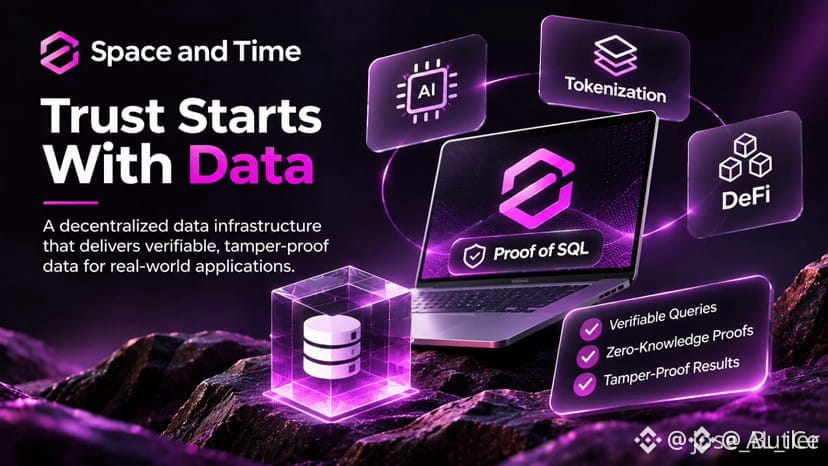
This is where @SpaceandTime stands out.
With its innovative Proof of SQL technology, Space and Time uses zero-knowledge cryptography to enable developers to verify database query results rather than blindly trusting the information they receive.
This technology could play a major role in powering blockchain applications, DeFi protocols, and AI-driven systems that rely on accurate and trustworthy data.
I believe the future of Web3 depends on transparent, verifiable, and reliable infrastructure.
Space and Time is working to make that future possible. 🚀
@SpaceandTime
#SXT #Web3 #Blockchain #ZeroKnowledge #AI #DeFi
2
·
--
Bullish
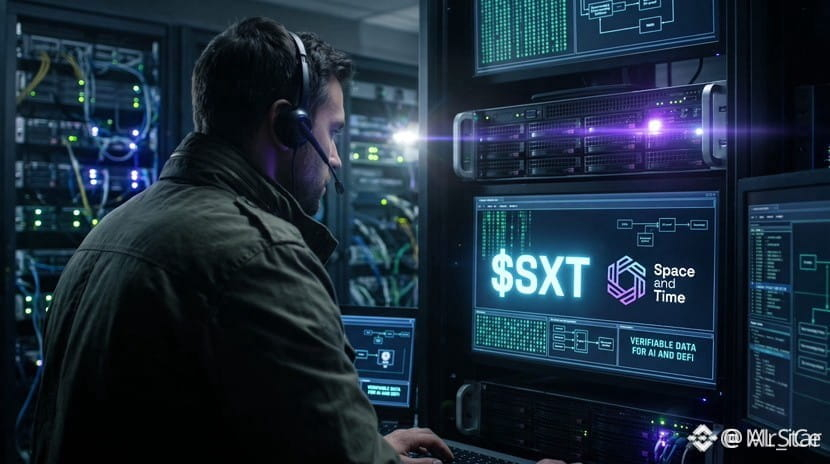
🚀 $SXT — BUILDING THE TRUST LAYER FOR AI, DEFI, AND TOKENIZATION!
The rapid growth of AI and digital asset tokenization is creating a major challenge for traditional data systems: trust and data integrity.
Every on-chain transaction and off-chain AI decision depends on accurate, reliable, and verifiable information. When institutional capital is involved, data transparency becomes more important than ever.
This is where Space and Time comes into the picture.
As an innovator in zero-knowledge technology, Space and Time is developing infrastructure that allows businesses and blockchain applications to verify complex data queries without blindly trusting centralized sources.
Here's what makes $SXT interesting:
Proof of SQL: Enables cryptographic verification of database queries.
AI Integration: Supports AI systems that require trustworthy and verifiable data.
DeFi Utility: Helps smart contracts access reliable information for automated financial operations.
Data Integrity: Connects off-chain databases with on-chain applications through verifiable computation.
Scalability: Designed to support the growing demand for trustworthy blockchain infrastructure.
As AI, DeFi, and tokenization continue to expand, the need for verifiable data could become increasingly important.
The bigger opportunity may not just be in the applications themselves, but in the infrastructure that makes them trustworthy.
👀 The question is: How will your project use $SXT to build a more transparent and reliable digital ecosystem?
Share your thoughts and trading analysis below!
#SXT #SpaceAndTime#AI #Blockchain #DeFi #ZeroKnowledge #Crypto
48
·
--
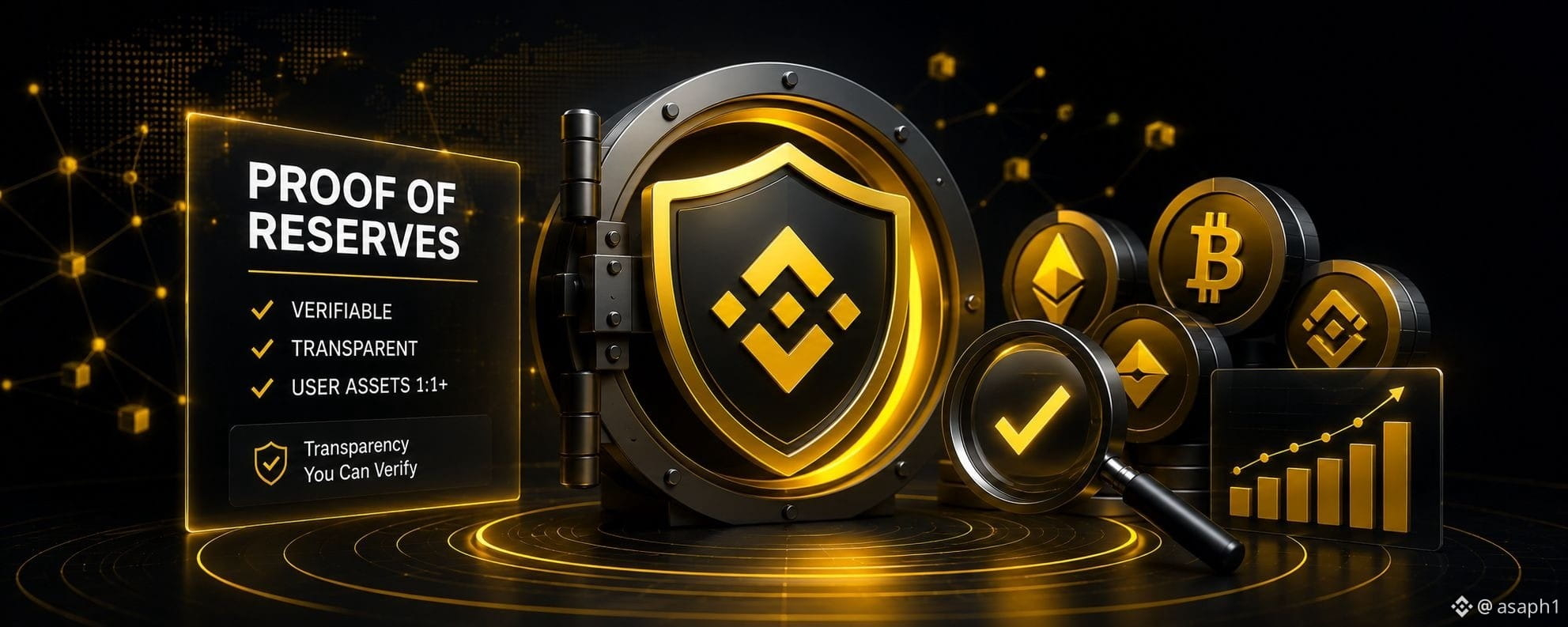
🚨 $BNB TOTAL SHOCK: BINANCE LETS YOU VERIFY YOUR FUNDS YOURSELF
To me, this is Binance playing its strongest card after the biggest hack in crypto history: $6,300 million vanished from its hot wallets on October 29, and today it’s responding with a proof of reserves using zero-knowledge cryptography that any user can verify for themselves.
Look at the detail nobody is noticing:
→ BTC is 100.05% backed: 688,283 BTC held against 687,912 BTC in user balances, just 371 BTC of cushion.
→ The snapshot is from November 12 and covers 198 coins: ETH 100.02%, BNB 100.39%, USDT 104.34%, and SOL 105.86%.
→ On November 13, Binance replenished more than $6,340 million with its own funds, and withdrawals are returning in phases, with the last one scheduled for next week.
Do you trust Binance’s proof of reserves, or would you rather keep your crypto off the exchange? 👇
$BNB $BTC $ETH
#Binance #PruebaDeReservas #ZeroKnowledge
192

🔐 Can blockchain verify something without revealing all the details?
That's the fascinating idea behind Zero-Knowledge Proofs (ZK).
Imagine proving that a transaction is valid without exposing every piece of information behind it.
ZK technology could help blockchains achieve:
✅ Better privacy
✅ More scalable transactions
✅ Efficient verification
✅ New possibilities for digital identity
Some projects exploring this technology:
🔹 $ZK — zkSync
🔹 $STRK — Starknet
🔹 $MINA — Mina Protocol
But adoption isn't automatic. Technical complexity, security audits and real-world demand will determine how far ZK technology goes.
💬 What's more important for the future of blockchain: privacy, scalability or decentralisation?
Pick one and tell us why! 👇
#ZeroKnowledge #ZKProofs #blockchain #crypto #Web3
756

Meta AI has forecasted the top 3 Zero-Knowledge (ZK) cryptos heading into 2027: zkSync ($ZK), Starknet ($STRK), and Zcash ($ZEC).
ZK technology is rapidly evolving from a simple scaling tool into core infrastructure for privacy, institutional adoption, and high-speed applications. Driven by technical progress and real-world traction, these projects are positioning themselves to lead the next major market narrative.
Are you bullish on ZK tech? 👇
#ZeroKnowledge #CryptoNews #Layer2
Meta AI has forecasted the top 3 Zero-Knowledge (ZK) cryptos heading into 2027: zkSync ($ZK ), Starknet ($STRK ), and Zcash ($ZEC ).
ZK technology is rapidly evolving from a simple scaling tool into core infrastructure for privacy, institutional adoption, and high-speed applications. Driven by technical progress and real-world traction, these projects are positioning themselves to lead the next major market narrative.
Are you bullish on ZK tech? 👇
#ZeroKnowledge #CryptoNews #Layer2
1
131

Article
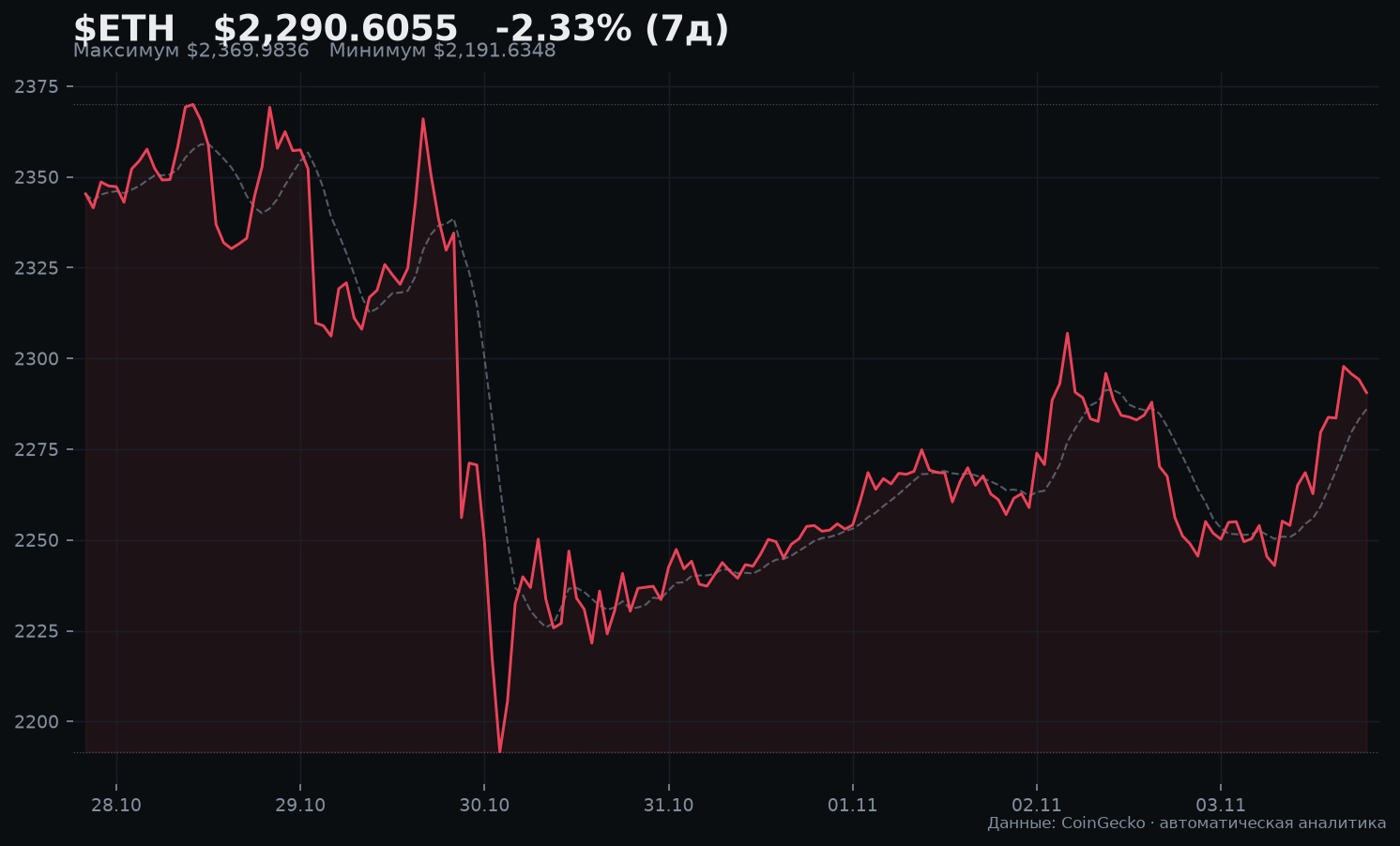
Aztec Tierra V6: How Privacy on Ethereum Is Changing Web3 ArchitectureEthereum is trading at $2,291, up 1.80% over the past 24 hours—and while the market is digesting the macro backdrop, an event at the protocol infrastructure level could reshape the Layer 2 competitive landscape for the next two to three years. The Aztec Foundation has deployed the Tierra V6 upgrade, a major overhaul of its zero-knowledge network that addresses several documented security vulnerabilities and, according to the developers, doubles proof generation speeds for private transactions. This is no ordinary marketing release: it’s a technical turning point that could determine whether private blockchains find a path to institutional adoption.
Aztec Tierra V6: How Privacy on Ethereum Is Changing Web3 Architecture
Ethereum is trading at $2,291, up 1.80% over the past 24 hours—and while the market is digesting the macro backdrop, an event at the protocol infrastructure level could reshape the Layer 2 competitive landscape for the next two to three years. The Aztec Foundation has deployed the Tierra V6 upgrade, a major overhaul of its zero-knowledge network that addresses several documented security vulnerabilities and, according to the developers, doubles proof generation speeds for private transactions. This is no ordinary marketing release: it’s a technical turning point that could determine whether private blockchains find a path to institutional adoption.
23
Will Zero-Knowledge Proofs (ZKPs) Become the Standard for Web3 Privacy and Scalability? 🛡️⚡
As decentralized applications scale, balancing public transparency with user privacy remains a major challenge. Can Zero-Knowledge Proofs revolutionize Web3 by proving transaction validity without revealing sensitive data?
Zero-Knowledge Proofs allow one party to mathematically prove to another that a statement is true without disclosing any underlying information. In crypto, ZK-rollups use this technology to aggregate thousands of transactions off-chain and verify them on-chain using a single cryptographic proof, drastically increasing throughput while maintaining top-tier security and privacy.
ZK-technology provides the essential framework for high-speed, privacy-preserving blockchain transactions, opening the door for widespread institutional and enterprise adoption.
$ZK $MINA #ZeroKnowledge #ZKRollups #CryptoPrivacy #CoinVahini
19

·
--
Bullish
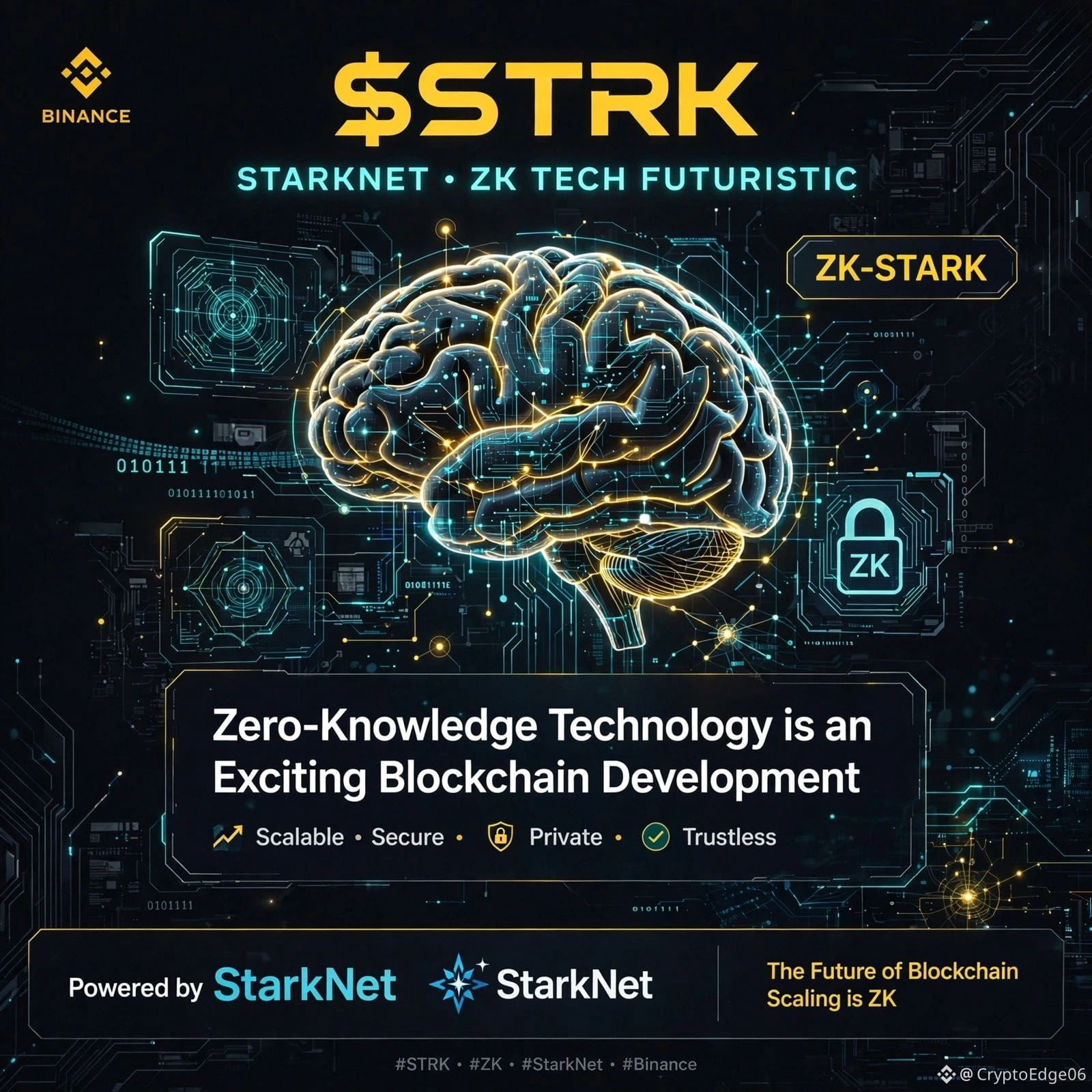
$STRK — Zero-knowledge technology is an exciting blockchain development! 🧠
$STRK — Zero-knowledge technology is an exciting blockchain development! 🧠
StarkNet ZK tech is the future - Scalable, Secure, Private & Trustless.
ZK-STARK technology is revolutionizing blockchain scaling.
The Future of Blockchain Scaling is ZK
#STRK #ZK #STARKNET #ZeroKnowledge #Binance
$STRK — Zero-knowledge technology is an exciting blockchain development! 🧠
$STRK — Zero-knowledge technology is an exciting blockchain development! 🧠
StarkNet ZK tech is the future - Scalable, Secure, Private & Trustless.
ZK-STARK technology is revolutionizing blockchain scaling.
The Future of Blockchain Scaling is ZK
#STRK #ZK #STARKNET #ZeroKnowledge #Binance
$STRK — Zero-knowledge technology is an exciting blockchain development! 🧠
StarkNet ZK tech is the future - Scalable, Secure, Private & Trustless.
ZK-STARK technology is revolutionizing blockchain scaling.
The Future of Blockchain Scaling is ZK
#STRK #ZK #STARKNET #ZeroKnowledge #Binance
56
Article
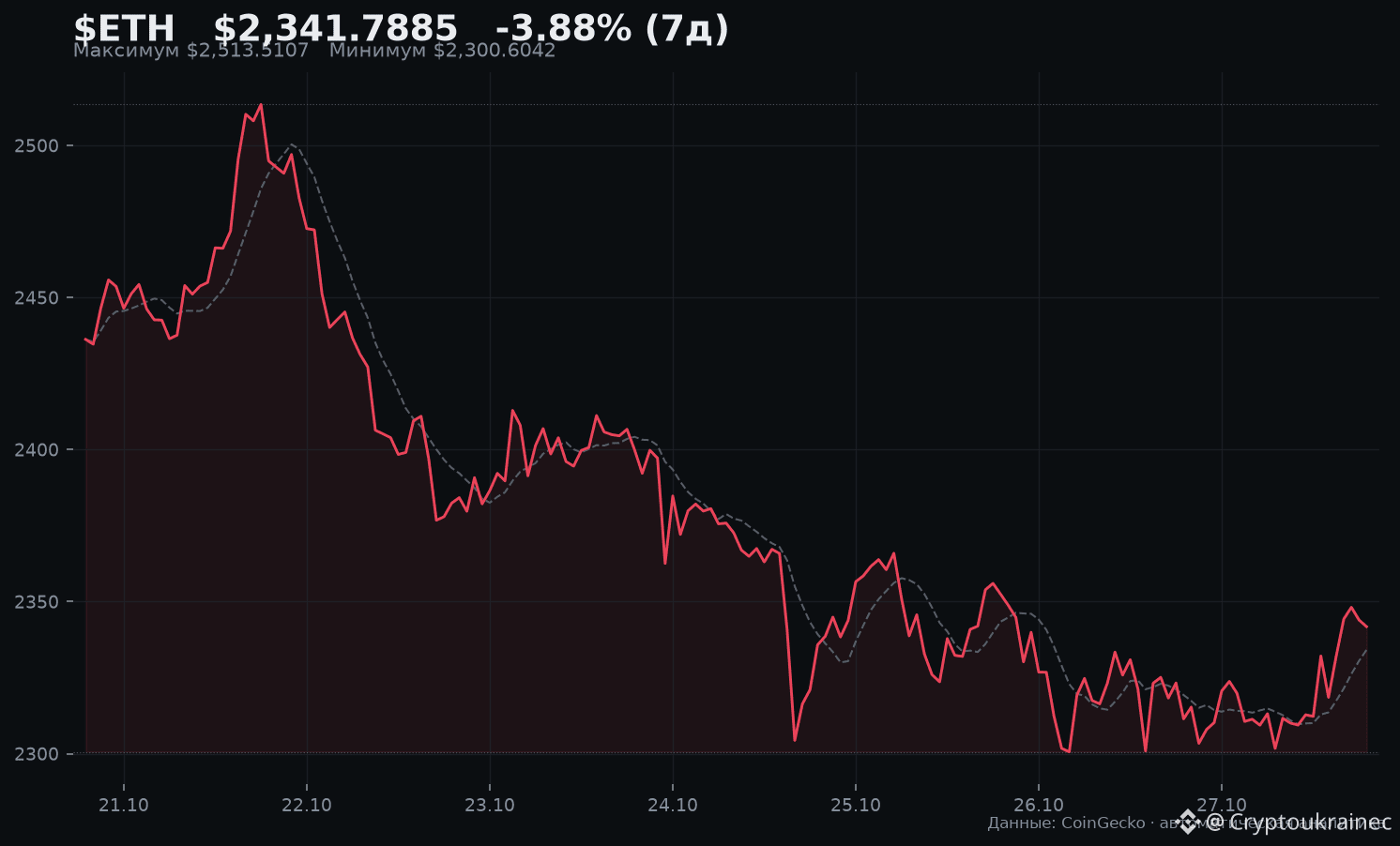
ETH and the Mathematical Paradox: How OpenAI’s Theorem Affects Trust in BlockchainThis morning, the cryptocurrency community found itself at the center of a discussion that may seem, at first glance, far removed from trading, but in fact touches on one of the fundamental principles underlying trust in blockchain infrastructure. An OpenAI research group published a paper claiming that the ETH hypothesis—a mathematical assumption underpinning hundreds of academic papers in theoretical computer science and cryptography—is false. The cryptography community and Crypto Twitter reacted immediately, and their responses were divided. In this context, ETH does not refer to the Ethereum token, but to the Exponential Time Hypothesis, a key postulate in computational complexity. But the coincidence of abbreviations immediately sparked a wave of interpretations, misreadings, and speculation about the asset, which is trading today at $2,342.39 (+1.27% over 24 hours).
ETH and the Mathematical Paradox: How OpenAI’s Theorem Affects Trust in Blockchain
This morning, the cryptocurrency community found itself at the center of a discussion that may seem, at first glance, far removed from trading, but in fact touches on one of the fundamental principles underlying trust in blockchain infrastructure. An OpenAI research group published a paper claiming that the ETH hypothesis—a mathematical assumption underpinning hundreds of academic papers in theoretical computer science and cryptography—is false. The cryptography community and Crypto Twitter reacted immediately, and their responses were divided. In this context, ETH does not refer to the Ethereum token, but to the Exponential Time Hypothesis, a key postulate in computational complexity. But the coincidence of abbreviations immediately sparked a wave of interpretations, misreadings, and speculation about the asset, which is trading today at $2,342.39 (+1.27% over 24 hours).
24

·
--
Have you ever wondered how a blockchain can stay the size of a few tweets while processing millions of transactions? Enter Mina Protocol, widely known as the world’s lightest blockchain.
While traditional networks like Bitcoin and Ethereum require hundreds of gigabytes to store transaction history, Mina maintains a fixed size of just about 22 kilobytes. That is smaller than a single smartphone photo!
How does Mina achieve this impossible feat? The secret lies in Zero-Knowledge Proofs, specifically recursive zk-SNARKs. Instead of forcing every user to verify the entire chain history from day one, Mina generates a tiny cryptographic proof that proves the validity of the network. This means anyone, even on a basic smartphone or internet browser, can run a full node and verify the blockchain instantly without sacrificing security or relying on centralized intermediaries.
Why is this important right now? As Zero-Knowledge technology becomes a dominant force in crypto scalability and privacy, Mina is positioned right at the center of innovation. Its programmable zero-knowledge smart contracts, called zkApps, allow developers to connect real-world data to Web3 without compromising user privacy. Imagine proving your income to a lending app or verifying your identity online without ever sharing your private documents. That is the real-world utility Mina enables.
With key network upgrades enhancing smart contract functionality and boosting developer activity, Mina is shifting from theoretical potential to practical application. Its emphasis on true decentralization, accessibility, and user privacy gives it a distinct narrative in a market often dominated by resource-heavy Layer 1 networks.
As privacy regulations tighten and user demand for data control grows, projects built on zero-knowledge architecture like Mina will likely play a critical role in bridging Web2 privacy with Web3 efficiency.
Is the world's lightest blockchain heavy enough to lead the next ZK revolution? Let me know your thoughts in the comments!
#MinaProtocol #CryptoInsights #ZeroKnowledge
1
266
·
--
Midnight: What if you could prove the truth without revealing your secrets?Imagine wanting to get a bank loan, prove that you are eligible for a particular service, or confirm that you have enough funds to make a financial transaction.
In traditional systems, you may have to reveal far more information than the process requires: your personal data, account details, financial records, and perhaps information you don’t want anyone to know.
Midnight: What if you could prove the truth without revealing your secrets?
Imagine wanting to get a bank loan, prove that you are eligible for a particular service, or confirm that you have enough funds to make a financial transaction.
In traditional systems, you may have to reveal far more information than the process requires: your personal data, account details, financial records, and perhaps information you don’t want anyone to know.
In traditional systems, you may have to reveal far more information than the process requires: your personal data, account details, financial records, and perhaps information you don’t want anyone to know.
62

·
--
🚀 $NIGHT UNVEILS ZK PRIVACY ENGINE THAT REDEFINES BLOCKCHAIN CONFIDENTIALITY! 🟢
Midnight’s zero‑knowledge proof engine lets apps confirm facts without spilling the beans, turning privacy into a programmable layer 📊.
Imagine a lender instantly validating income eligibility while the borrower’s bank details stay locked behind a cryptographic veil – that’s the sweet spot where transparency meets secrecy 🦈.
Smart money is already eyeing this toolkit; developers who can spin real‑world use cases will lock in the liquidity wave 🌊 before the next compliance sprint 💡.
💬 Are you ready to build the next privacy‑first dApp on $NIGHT ? 👇
⚠️ Not financial advice. Always manage your risk. 🛡️
🏷️ #NIGHT #PrivacyProtocol #ZeroKnowledge #Crypto
🔥 💎
32

·
--
AI + Crypto: Why ZK Coprocessors Are the Missing Infrastructure Layer
Most AI-meets-crypto narratives focus on token incentives for compute. That misses the deeper architectural problem: how does a smart contract verify that an AI model ran correctly?
You can pay a GPU node with $ETH, but payment does not prove correctness. A malicious or faulty node can return wrong outputs — and the chain has no way to tell.
Enter ZK coprocessors. They generate zero-knowledge proofs attesting that a specific model inference executed correctly on a specific input. The proof is small, fast to verify on-chain, and cryptographically binding. No trust assumption needed — just math.
This unlocks a category that doesn't exist yet at scale: verifiable AI applications. Think on-chain risk engines for DeFi that can't be gamed, autonomous agents with auditable decision logs, or oracle networks where model output carries its own proof of correctness.
$SOL and $ETH L2 ecosystems are both racing to host zkVM-native AI pipelines. $BNB Chain's vertically integrated stack makes it a natural proving ground — EVM compatibility plus fast finality reduces the latency cost of proof verification.
The bottleneck today is proof generation speed and cost — but hardware acceleration curves look like early GPU scaling. The teams solving this won't announce it loudly. Watch testnet deployment addresses and zkVM benchmarks, not price charts.
Verifiable AI inference is the foundation, not a feature.
#AIAndCrypto #ZeroKnowledge #DeFi #CryptoInfrastructure
AI + Crypto: Why ZK Coprocessors Are the Missing Infrastructure Layer
Most AI-meets-crypto narratives focus on token incentives for compute. That misses the deeper architectural problem: how does a smart contract verify that an AI model ran correctly?
You can pay a GPU node with $ETH , but payment does not prove correctness. A malicious or faulty node can return wrong outputs — and the chain has no way to tell.
Enter ZK coprocessors. They generate zero-knowledge proofs attesting that a specific model inference executed correctly on a specific input. The proof is small, fast to verify on-chain, and cryptographically binding. No trust assumption needed — just math.
This unlocks a category that doesn't exist yet at scale: verifiable AI applications. Think on-chain risk engines for DeFi that can't be gamed, autonomous agents with auditable decision logs, or oracle networks where model output carries its own proof of correctness.
$SOL and $ETH L2 ecosystems are both racing to host zkVM-native AI pipelines. $BNB Chain's vertically integrated stack makes it a natural proving ground — EVM compatibility plus fast finality reduces the latency cost of proof verification.
The bottleneck today is proof generation speed and cost — but hardware acceleration curves look like early GPU scaling. The teams solving this won't announce it loudly. Watch testnet deployment addresses and zkVM benchmarks, not price charts.
Verifiable AI inference is the foundation, not a feature.
#AIAndCrypto #ZeroKnowledge #DeFi #CryptoInfrastructure
56
·
--
ZK Proofs Are Becoming the Trust Layer for AI+Crypto Infrastructure
Zero-knowledge proofs started as a privacy tool. They are quietly becoming something bigger: the verification backbone for AI-integrated blockchain systems.
Here is the core problem: AI inference is a black box. An on-chain protocol cannot natively verify that a model ran correctly, used the right weights, or produced an unmanipulated output. Smart contracts trust deterministic code — AI is probabilistic and off-chain by default.
ZK proofs solve this by generating a cryptographic proof that a specific computation was executed faithfully, without revealing the underlying model or inputs. On-chain verifiers can then accept or reject the proof in a single transaction.
What this unlocks is significant:
— AI agents that can execute $ETH smart contract calls with verifiable, auditable reasoning
— On-chain lending protocols that use ZK-verified credit models without exposing borrower data
— $BNB Chain DeFi strategies that incorporate ML signals trustlessly
— Cross-chain messaging gated by ZK-verified AI routing decisions
— Subnets that enforce compliance logic via ZK model attestations instead of manual KYC
The practical barrier today is compute cost. Generating a ZK proof for a large model inference is expensive. But hardware acceleration and recursive proof systems are compressing that cost curve faster than most expect.
Infrastructure cycles in crypto always precede narrative cycles. ZK compute is building the rails now.
The chains that integrate verifiable AI infrastructure early will have a structural moat in the next application wave. $BTC holders should watch this space closely — capital will flow toward ecosystems with verifiable AI primitives.
#ZeroKnowledge #AIcrypto #DeFi #CryptoInfrastructure #Web3AI
20
·
--
Zero-Knowledge Proofs Are the Trust Layer AI Agents Need
One of the most underappreciated infrastructure stories in crypto right now is the convergence of ZK proofs and autonomous AI agents.
Here's the problem: as AI agents gain the ability to execute on-chain transactions, manage wallets, and interact with smart contracts, how does any counterparty verify that an agent behaved as intended — without re-running every step?
ZK proofs solve this cleanly. A verifiable proof can attest that an agent followed its declared logic without revealing the underlying model weights, inputs, or strategy. This is cryptographic accountability for autonomous systems.
The implications compound quickly:
• Smart contracts can condition execution on verified agent behavior
• On-chain protocols can enforce agent policies at the settlement layer
• Users retain privacy while counterparties gain provable assurance
This is not a 2030 thesis. ZK prover throughput is improving rapidly, and chains optimized for proof verification are already building toward this stack. $ETH L2s lead the charge, $BNB Chain's parallel execution positions it as a strong agent-native settlement candidate, and $SOL's high throughput makes it a natural fit for latency-sensitive agent workflows.
Verifiable AI is not just a research concept. It's the missing trust primitive that makes on-chain autonomous agents viable at scale.
The chains that build the best ZK-native agent infrastructure today will host the highest-value applications tomorrow.
#ZeroKnowledge #AIAgents #CryptoInfrastructure #Web3AI #BinanceSquare
Zero-Knowledge Proofs Are the Trust Layer AI Agents Need
One of the most underappreciated infrastructure stories in crypto right now is the convergence of ZK proofs and autonomous AI agents.
Here's the problem: as AI agents gain the ability to execute on-chain transactions, manage wallets, and interact with smart contracts, how does any counterparty verify that an agent behaved as intended — without re-running every step?
ZK proofs solve this cleanly. A verifiable proof can attest that an agent followed its declared logic without revealing the underlying model weights, inputs, or strategy. This is cryptographic accountability for autonomous systems.
The implications compound quickly:
• Smart contracts can condition execution on verified agent behavior
• On-chain protocols can enforce agent policies at the settlement layer
• Users retain privacy while counterparties gain provable assurance
This is not a 2030 thesis. ZK prover throughput is improving rapidly, and chains optimized for proof verification are already building toward this stack. $ETH L2s lead the charge, $BNB Chain's parallel execution positions it as a strong agent-native settlement candidate, and $SOL 's high throughput makes it a natural fit for latency-sensitive agent workflows.
Verifiable AI is not just a research concept. It's the missing trust primitive that makes on-chain autonomous agents viable at scale.
The chains that build the best ZK-native agent infrastructure today will host the highest-value applications tomorrow.
#ZeroKnowledge #AIAgents #CryptoInfrastructure #Web3AI #BinanceSquare
36

·
--
Bullish
Is the Privacy Coin comeback here? Why $ZEC is on the whales’ radar 🕵️♂️⚡
As the market looks for compelling narratives, privacy and scalability are once again taking center stage in crypto. Zcash is no longer the protocol it once was: its recent, historic move toward the Zcash Dev Fund (ZFFF) and progress toward the Proof of Stake (PoS) consensus mechanism are completely changing the ecosystem’s issuance and governance rules. 🛡️
With growing global regulatory pressure on self-custody, protocols that protect financial sovereignty using advanced Zero-Knowledge technology (Zk-SNARKs) are gaining quiet but steady institutional traction. The price is consolidating in a crucial technical zone, and long-term investors know that Zcash’s programmed scarcity (capped at 21 million, just like Bitcoin) is a factor that cannot be ignored. 📉➡️📈
👇 What’s your strategy for privacy coins today? Do you think $ZEC will lead the next tech rally, or do you prefer traditional Layer 1 networks? Share your analysis in the comments!
#BinanceSquare #PrivacyCoins #ZcashCommunity #ZeroKnowledge
{spot}(ZECUSDT)
Is the Privacy Coin comeback here? Why $ZEC is on the whales’ radar 🕵️♂️⚡
As the market looks for compelling narratives, privacy and scalability are once again taking center stage in crypto. Zcash is no longer the protocol it once was: its recent, historic move toward the Zcash Dev Fund (ZFFF) and progress toward the Proof of Stake (PoS) consensus mechanism are completely changing the ecosystem’s issuance and governance rules. 🛡️
With growing global regulatory pressure on self-custody, protocols that protect financial sovereignty using advanced Zero-Knowledge technology (Zk-SNARKs) are gaining quiet but steady institutional traction. The price is consolidating in a crucial technical zone, and long-term investors know that Zcash’s programmed scarcity (capped at 21 million, just like Bitcoin) is a factor that cannot be ignored. 📉➡️📈
👇 What’s your strategy for privacy coins today? Do you think $ZEC will lead the next tech rally, or do you prefer traditional Layer 1 networks? Share your analysis in the comments!
#BinanceSquare #PrivacyCoins #ZcashCommunity #ZeroKnowledge
136
·
--
ZK Proofs Are Becoming the Trust Layer for On-Chain AI Agents
The convergence of AI and crypto is generating a lot of hype — but one specific primitive deserves serious attention: zero-knowledge proofs as a verifiability layer for autonomous AI agents.
Here is the core problem. When an AI agent executes a trade, signs a transaction, or manages a treasury on-chain, how do you know it followed its stated logic? Trust-me-bro attestations from off-chain models are not sufficient for DeFi protocols holding real capital.
ZK proof systems solve this by enabling verifiable computation. An agent can cryptographically prove it ran a specific model with specific inputs and produced an authorized output — without revealing proprietary model weights. The proof is verified on-chain before execution proceeds.
This has enormous implications:
— Autonomous yield strategies where the logic is provably correct, not just audited
— Agent-operated DAO treasuries with ZK-verified decision rails
— Permissioned DeFi where compliance logic runs in a ZK circuit, preserving privacy
— Cross-chain agent coordination verified before settlement
Ethereum's ZK rollup ecosystem ($ETH) is the most mature deployment ground today. $BNB Chain's opBNB and zkBNB infrastructure is also positioning for this compute layer. Bitcoin ($BTC) inscription-layer projects are beginning to experiment with ZK-verified state channels as well.
The teams building verifiable AI infrastructure — not just AI-flavored tokens — are laying the groundwork for the next trust primitive in DeFi.
Watch the ZK + agent intersection. It is early, it is real, and it is underpriced in narratives.
#ZeroKnowledge #AIandCrypto #DeFi #Web3Infrastructure #CryptoInvesting
ZK Proofs Are Becoming the Trust Layer for On-Chain AI Agents
The convergence of AI and crypto is generating a lot of hype — but one specific primitive deserves serious attention: zero-knowledge proofs as a verifiability layer for autonomous AI agents.
Here is the core problem. When an AI agent executes a trade, signs a transaction, or manages a treasury on-chain, how do you know it followed its stated logic? Trust-me-bro attestations from off-chain models are not sufficient for DeFi protocols holding real capital.
ZK proof systems solve this by enabling verifiable computation. An agent can cryptographically prove it ran a specific model with specific inputs and produced an authorized output — without revealing proprietary model weights. The proof is verified on-chain before execution proceeds.
This has enormous implications:
— Autonomous yield strategies where the logic is provably correct, not just audited
— Agent-operated DAO treasuries with ZK-verified decision rails
— Permissioned DeFi where compliance logic runs in a ZK circuit, preserving privacy
— Cross-chain agent coordination verified before settlement
Ethereum's ZK rollup ecosystem ($ETH ) is the most mature deployment ground today. $BNB Chain's opBNB and zkBNB infrastructure is also positioning for this compute layer. Bitcoin ($BTC ) inscription-layer projects are beginning to experiment with ZK-verified state channels as well.
The teams building verifiable AI infrastructure — not just AI-flavored tokens — are laying the groundwork for the next trust primitive in DeFi.
Watch the ZK + agent intersection. It is early, it is real, and it is underpriced in narratives.
#ZeroKnowledge #AIandCrypto #DeFi #Web3Infrastructure #CryptoInvesting
29
·
--
ZK Proofs Are About to Become AI's Most Important Primitive
The AI boom and crypto have been running on parallel tracks — but zero-knowledge proofs may be the bridge that makes them converge in a genuinely useful way.
Here's the core problem with AI at scale: you can't verify outputs. When a model returns a result, you have no cryptographic way to prove it ran the correct computation on the correct model weights without trusting the infrastructure provider. That's fine for consumer chatbots. It's a serious blocker for AI agents handling financial decisions, legal documents, or health data.
ZK proof systems solve exactly this. A zkML proof lets a model owner prove — without revealing weights — that a specific inference was run correctly. The output is cryptographically attested. No trust required beyond the math.
This matters enormously for on-chain AI agents. $ETH and $BNB are already the settlement layers for value. Add zkML attestation and those agents can now make verifiable decisions — not just probabilistic ones. $SOL's high-throughput environment makes it a natural candidate for cheap proof verification.
We're early. zkML proofs are still expensive to generate. But proof costs follow Moore's Law analogs — they compress fast. The teams building ZK-verified AI inference today are laying rails for the next infrastructure cycle.
Verifiable AI isn't a feature. It's a prerequisite for autonomous on-chain agents to hold real value.
#ZeroKnowledge #AIcrypto #zkML #DeFi #Web3
ZK Proofs Are About to Become AI's Most Important Primitive
The AI boom and crypto have been running on parallel tracks — but zero-knowledge proofs may be the bridge that makes them converge in a genuinely useful way.
Here's the core problem with AI at scale: you can't verify outputs. When a model returns a result, you have no cryptographic way to prove it ran the correct computation on the correct model weights without trusting the infrastructure provider. That's fine for consumer chatbots. It's a serious blocker for AI agents handling financial decisions, legal documents, or health data.
ZK proof systems solve exactly this. A zkML proof lets a model owner prove — without revealing weights — that a specific inference was run correctly. The output is cryptographically attested. No trust required beyond the math.
This matters enormously for on-chain AI agents. $ETH and $BNB are already the settlement layers for value. Add zkML attestation and those agents can now make verifiable decisions — not just probabilistic ones. $SOL 's high-throughput environment makes it a natural candidate for cheap proof verification.
We're early. zkML proofs are still expensive to generate. But proof costs follow Moore's Law analogs — they compress fast. The teams building ZK-verified AI inference today are laying rails for the next infrastructure cycle.
Verifiable AI isn't a feature. It's a prerequisite for autonomous on-chain agents to hold real value.
#ZeroKnowledge #AIcrypto #zkML #DeFi #Web3
57

#privacyrotation
🔐 PRIVACY & SECURITY: A DIFFERENT CRYPTO NARRATIVE IS BUILDING!
As blockchain adoption grows, demand for private transactions and secure infrastructure remains an important niche within the broader market.
💡 WHAT THIS MEANS FOR TRADERS:
Privacy-related assets can move sharply when market attention suddenly returns to the sector.
🔍 3 COINS TO WATCH:
🛡️ $ZEN — Horizen continues developing privacy and blockchain infrastructure.
{spot}(ZENUSDT)
🔒 $DUSK — Dusk focuses on privacy and regulated financial applications.
{spot}(DUSKUSDT)
🌑 $MINA — Mina uses a lightweight blockchain design built around zero-knowledge technology.
{spot}(MINAUSDT)
Could zero-knowledge narratives regain momentum?
#ZEN #DUSK #MINA #ZeroKnowledge
#privacyrotation
🔐 PRIVACY & SECURITY: A DIFFERENT CRYPTO NARRATIVE IS BUILDING!
As blockchain adoption grows, demand for private transactions and secure infrastructure remains an important niche within the broader market.
💡 WHAT THIS MEANS FOR TRADERS:
Privacy-related assets can move sharply when market attention suddenly returns to the sector.
🔍 3 COINS TO WATCH:
🛡️ $ZEN — Horizen continues developing privacy and blockchain infrastructure.
🔒 $DUSK — Dusk focuses on privacy and regulated financial applications.
🌑 $MINA — Mina uses a lightweight blockchain design built around zero-knowledge technology.
Could zero-knowledge narratives regain momentum?
#ZEN #DUSK #MINA #ZeroKnowledge

1
634
·
--
Zero-knowledge proofs are no longer just a privacy trick — they are becoming the backbone of verifiable AI on crypto rails.
Here is what is happening: AI inference is expensive to verify. When an AI model produces an output, you have no way to confirm the computation was honest without re-running the entire model yourself. That is fine for a chatbot. It is unacceptable for on-chain financial decisions, smart contract triggers, or decentralized oracles.
ZK proofs solve this. A prover runs the AI computation off-chain, generates a cryptographic proof that the inference was correct, and posts that proof on-chain for near-zero verification cost. The blockchain never needs to see the model — it only sees the math that guarantees the result is genuine.
Why does this matter for crypto markets now?
Protocols building ZK-native AI inference layers are quietly becoming infrastructure bets, not speculation plays. Every DeFi protocol that wants trustless automation — liquidations, rebalancing, risk scoring — eventually needs verifiable computation. $ETH and $BNB carry most of this settlement load today. $SOL is racing to close the gap with its own proving stack.
The convergence point: AI finds the signal. ZK proves the computation was honest. The chain executes. No trusted third party.
This is not a future narrative. Deployments are live. The question is which infrastructure layer captures the most value as verifiable AI scales from millions to billions of on-chain decisions per day.
#ZeroKnowledge #AIxCrypto #DeFi #Web3Infrastructure #CryptoInfrastructure
128
Log in to explore more content
Join global crypto users on Binance Square
⚡️ Get latest and useful information about crypto.
💬 Trusted by the world’s largest crypto exchange.
👍 Discover real insights from verified creators.
Email / Phone number
Trending Topics
1
#WhoWillSucceedJensenHuangatNvidia?
184,993 views
1,694 Discussing
2
#WhatWillDriveCryptoandStocks’NextRebound?
597,533 views
3,543 Discussing
3
#TradFiForBeginners
741,576 views
4,513 Discussing
4
#BitcoinActiveSupplyInProfitDropsBelow45%
82,831 views
752 Discussing
5
#KavaSaysAbnormalActivityLimitedToKavaLend
47,443 views
420 Discussing
6
#USSpotXRPETFsSeeLargestWeeklyOutflowIn8Months
35,261 views
361 Discussing
7
#USPPIMissMayEaseBTCPressure
315,072 views
2,293 Discussing
8
#WORPTLetsTouristsConvertCryptoToThaiBaht
11,126 views
104 Discussing
9
#TONStrategyReports$23.97MQ3NetLoss
10,972 views
44 Discussing
10
#PolkadotCommunityApprovesNewStrategyWith97%Vote
30,613 views
297 Discussing