
#meta
meta
804,930 views
4,973 Discussing
Hot
Latest

·
--
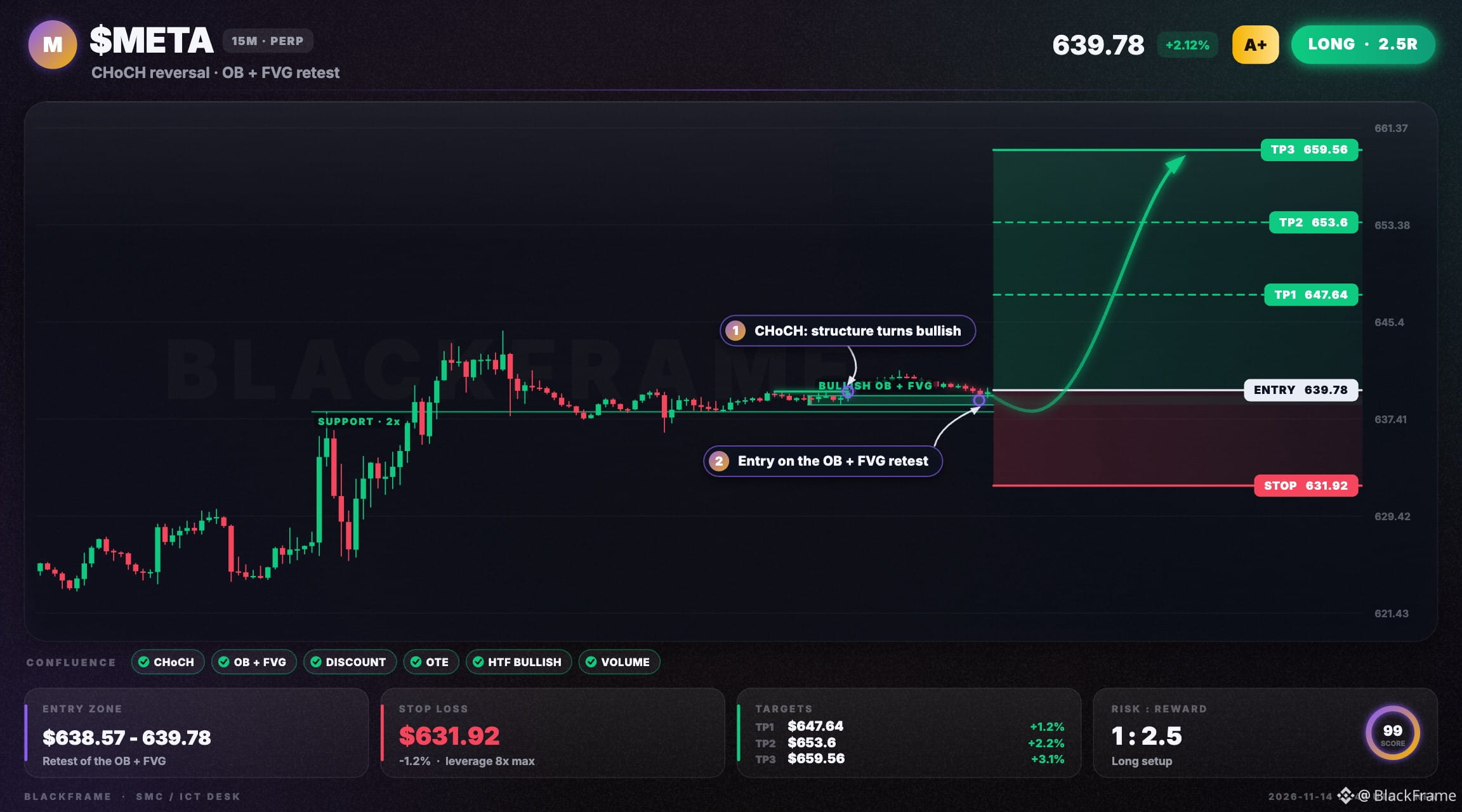
🚀 $META rides bullish CHoCH flip
LONG · 15M
Entry: $639.33 - $639.78
TP1: $647.64
TP2: $653.6
TP3: $659.56
SL: $631.92
CHoCH confirmed on the 15M aligns with an OB and FVG stacked in the $638.57-639.33 zone. Entry at $639.78 captures the OTE pocket discount with HTF bias bullish. Target at $659.56 and stop at $631.92.
#META #Futures · NFA
1
64

🌍 Welcome to Meta Earth — where purpose meets Web3 to uplift everyday life.
Every action you take helps you grow financially and as part of a global movement. Your journey begins with Unconditional Basic Income (UBI), freely given to support and empower you.
💰 What you can earn for free with Meta Earth:
• Daily UBI Income
• Monthly Airdrops
• Staking Rewards
• Referral Bonuses
• Daily Check-in Rewards
• Extra Ecosystem Airdrops
Meta Earth is about building hope, fueling growth, and celebrating progress. Your ME Pass is the key that unlocks it all.
Download your ME Pass and start earning today 🙏
Invitation code 👉 psr7z5h3
Referral link 👉
https://i.mec.me/?c=psr7z5h3
#MEC/USDT #meta
⚠️ Reminder: Admins will never DM you first or ask for your seed phrase.

62

Meta is quietly exploring prediction markets with points, bridging social tech with speculative forecasting. Meanwhile, regulatory and legal pressures intensify as the DOJ targets billions linked to exchange exploits and illicit schemes. These contrasting moves highlight a dual reality: big tech warming up to prediction mechanics while compliance and security remain under intense scrutiny. It is a clear reminder that innovation and strict enforcement are moving fast side by side. $BNB #CryptoNews #Regulation #Meta
Meta is quietly exploring prediction markets with points, bridging social tech with speculative forecasting. Meanwhile, regulatory and legal pressures intensify as the DOJ targets billions linked to exchange exploits and illicit schemes. These contrasting moves highlight a dual reality: big tech warming up to prediction mechanics while compliance and security remain under intense scrutiny. It is a clear reminder that innovation and strict enforcement are moving fast side by side. $BNB #CryptoNews #Regulation #Meta
1
39

·
--
Bullish
Meta Tests Its Own Prediction Market App Called Takes 👀
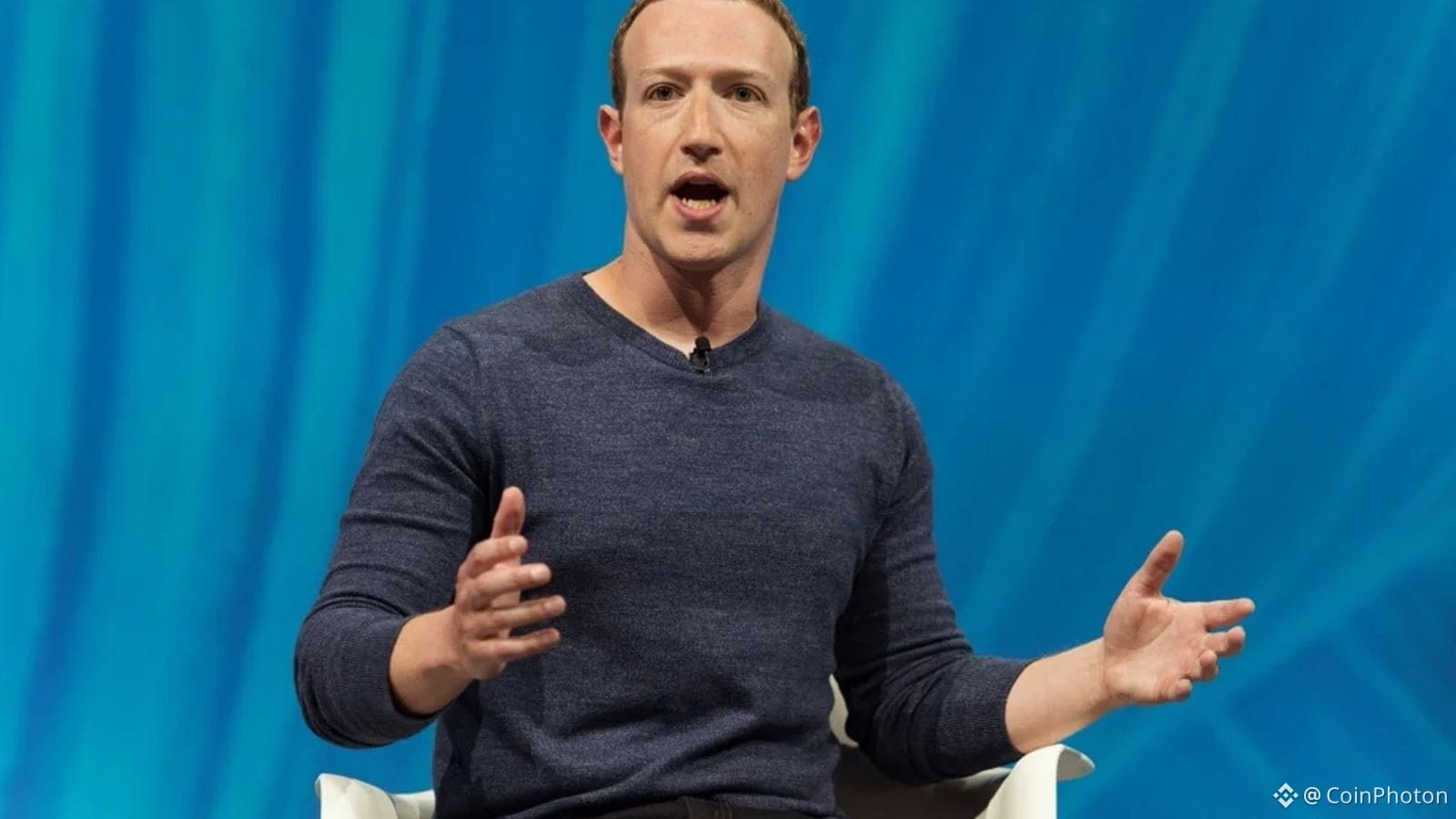
#Meta is reportedly testing a new prediction market app called Takes internally, allowing employees to predict real-world events using virtual points instead of actual money. Users earn points when their predictions are correct and lose points when they get things wrong. The app was previously known as Arena, and Mark Zuckerberg reportedly asked employees to develop it as a standalone platform.
I think this is an interesting move by Meta, especially with prediction markets gaining more attention lately. If the company eventually opens it to the public, it could become another way for users to engage with news, politics, sports, and other major events. The big question is whether Meta will eventually introduce real-money predictions or keep it purely points-based.
If you enjoy my content, feel free to follow me ❤️
#Binance
#crypto2026

1
325


·
--
🎯 Meta quietly tests a prediction market app called Takes
Meta has begun testing a prediction market app with its employees, The Wall Street Journal reported. The app, called Takes, lets users bet "cred" points instead of real money: correct calls earn cred and wrong ones lose it. It builds on a project first reported in June under the name Arena, when Mark Zuckerberg reportedly directed staff to build a standalone app. Meta declined to comment or give a timetable for a public release.
⭐ Big Tech edging into prediction markets comes as Kalshi and Polymarket fight state gambling lawsuits, a sign the sector is drawing mainstream attention.
#PredictionMarkets #Meta #Kalshi #Polymarket
2
335

·
--
#Meta
$META
is reportedly testing a prediction-market app for employees, giving staff a way to bet on internal outcomes as the company experiments with new tools for surfacing collective judgment. The test is still internal, but it hints at a broader push to use market-style signals inside the business — and where Meta takes it next could be the more interesting part.
{future}(METAUSDT)
#Meta
$META
is reportedly testing a prediction-market app for employees, giving staff a way to bet on internal outcomes as the company experiments with new tools for surfacing collective judgment. The test is still internal, but it hints at a broader push to use market-style signals inside the business — and where Meta takes it next could be the more interesting part.
21

> NEW META PREDICTION-MARKET APP LETS USERS WAGER 'CRED,' NOT MONEY: WSJ
> META PREDICTION-MARKET APP IS INTERNALLY CALLED 'TAKES,' SOURCES SAY: WSJ
> $META
#META
> NEW META PREDICTION-MARKET APP LETS USERS WAGER 'CRED,' NOT MONEY: WSJ
> META PREDICTION-MARKET APP IS INTERNALLY CALLED 'TAKES,' SOURCES SAY: WSJ
> $META
#META
> META PREDICTION-MARKET APP IS INTERNALLY CALLED 'TAKES,' SOURCES SAY: WSJ
> $META
#META
17

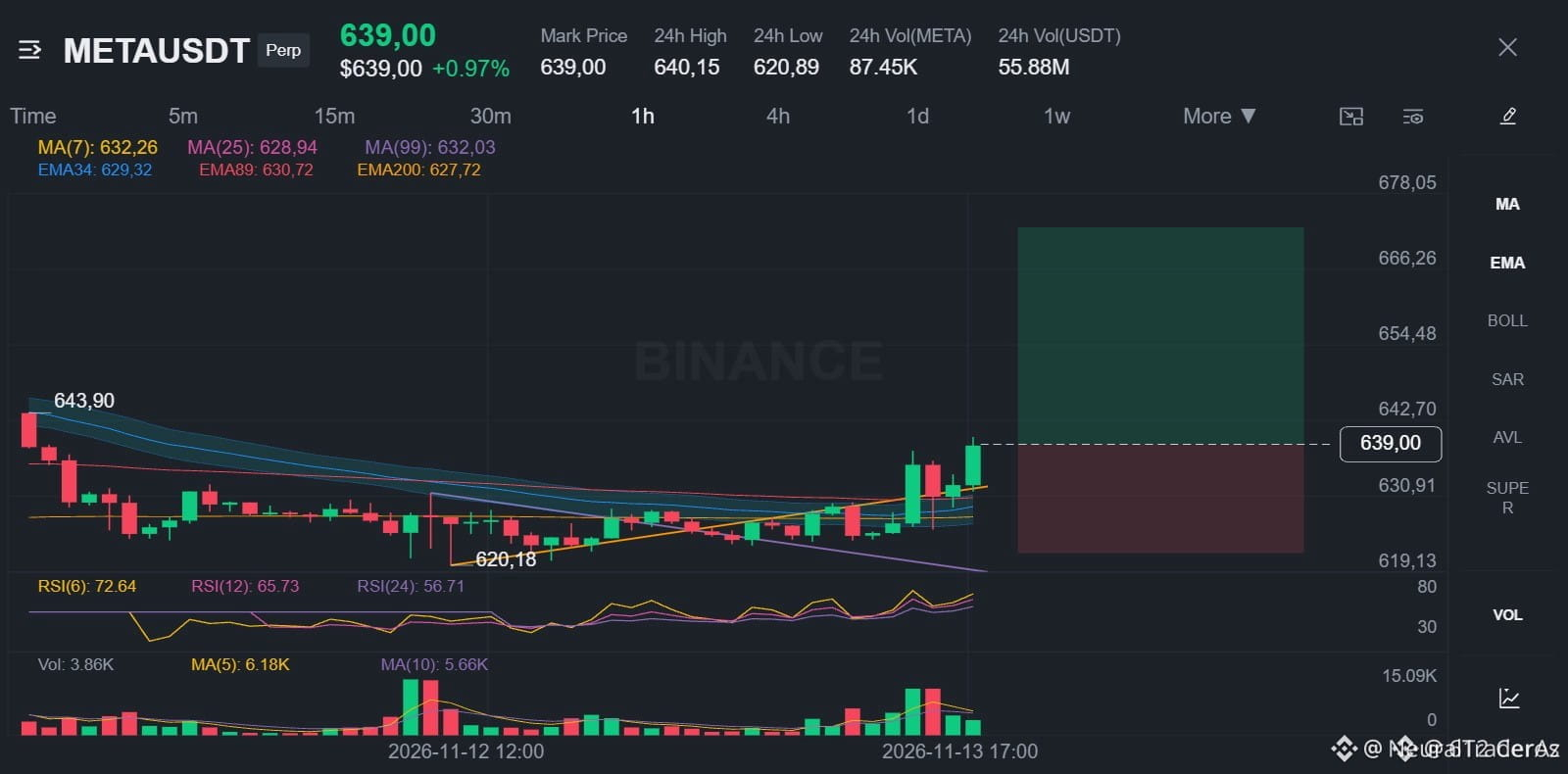
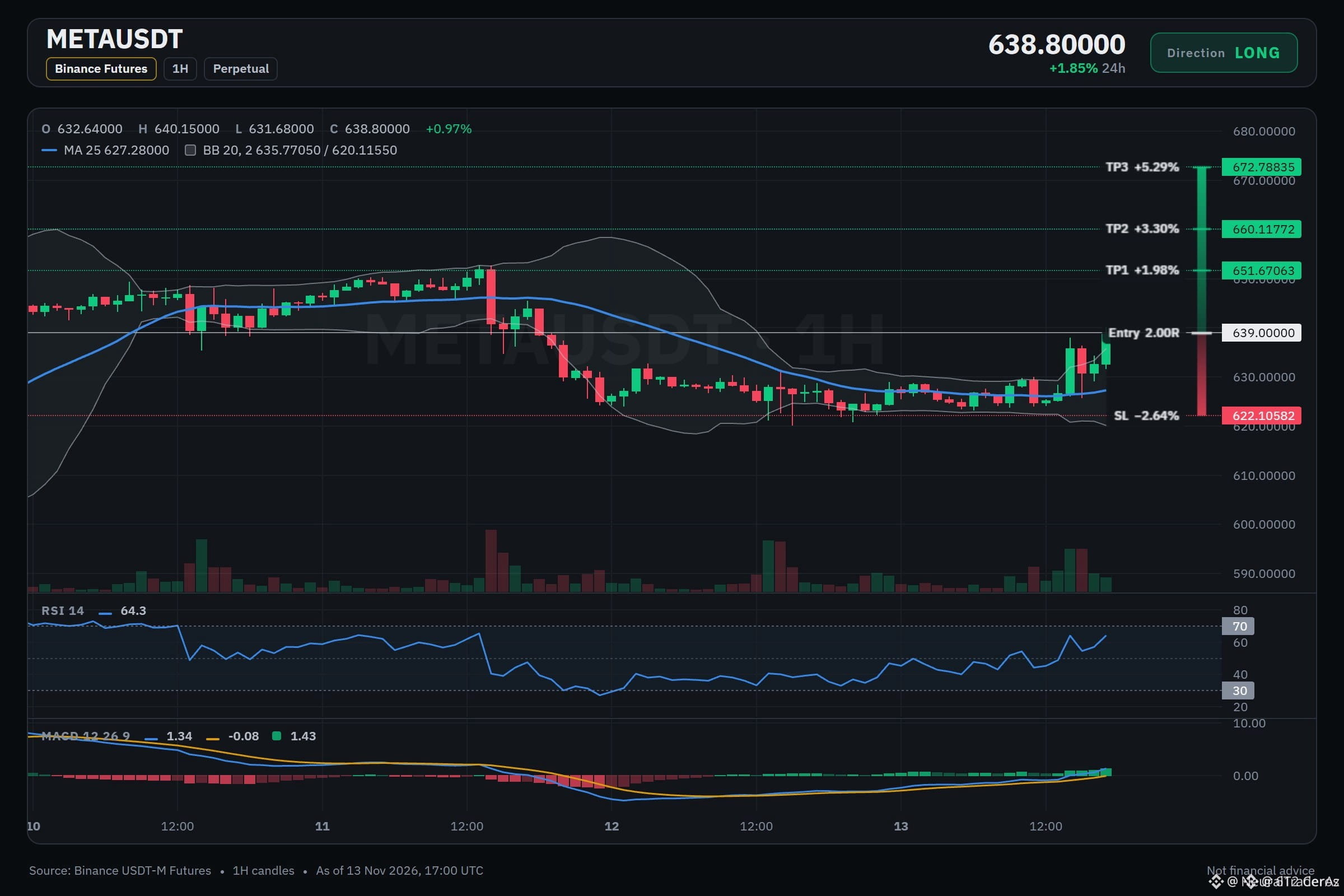
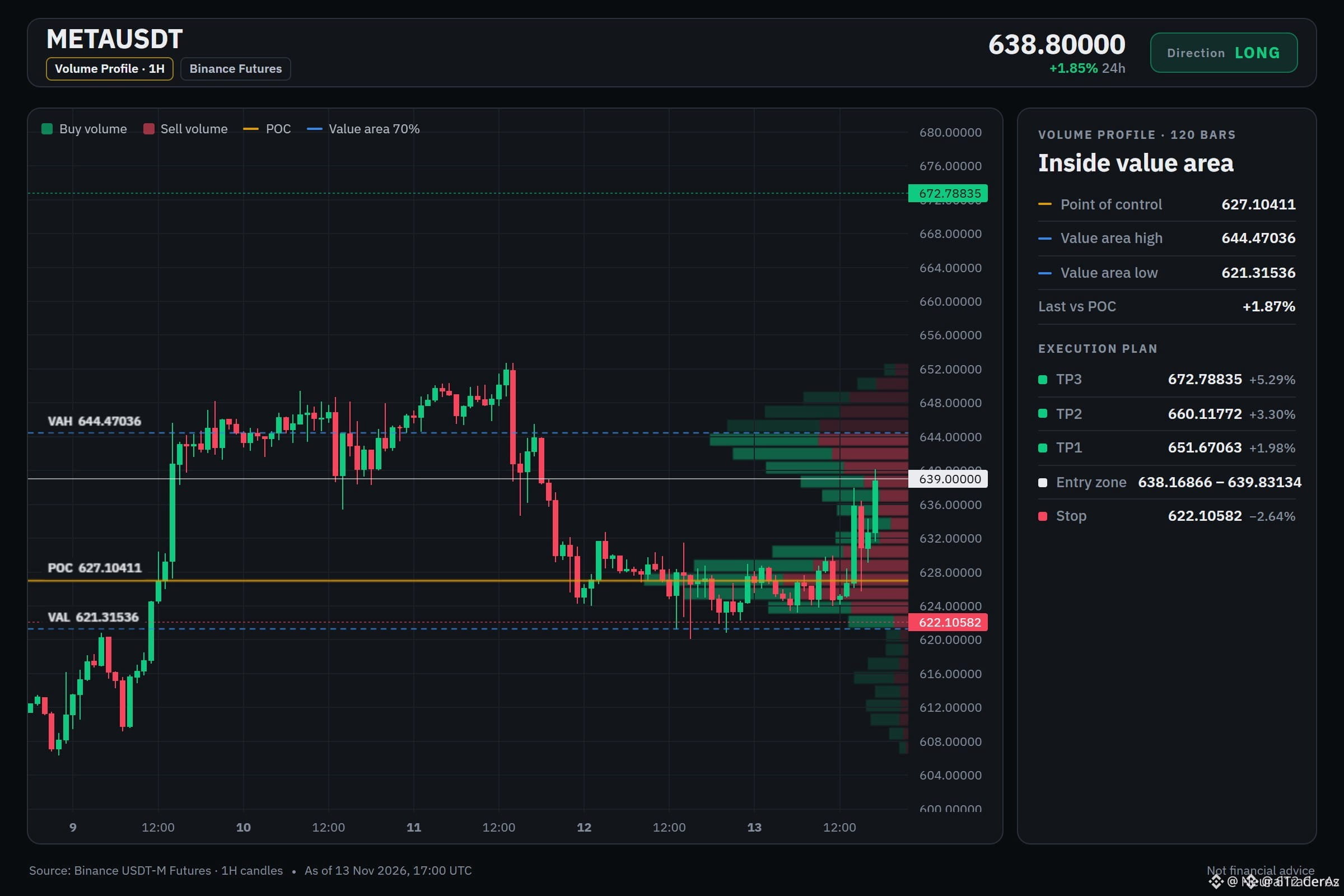
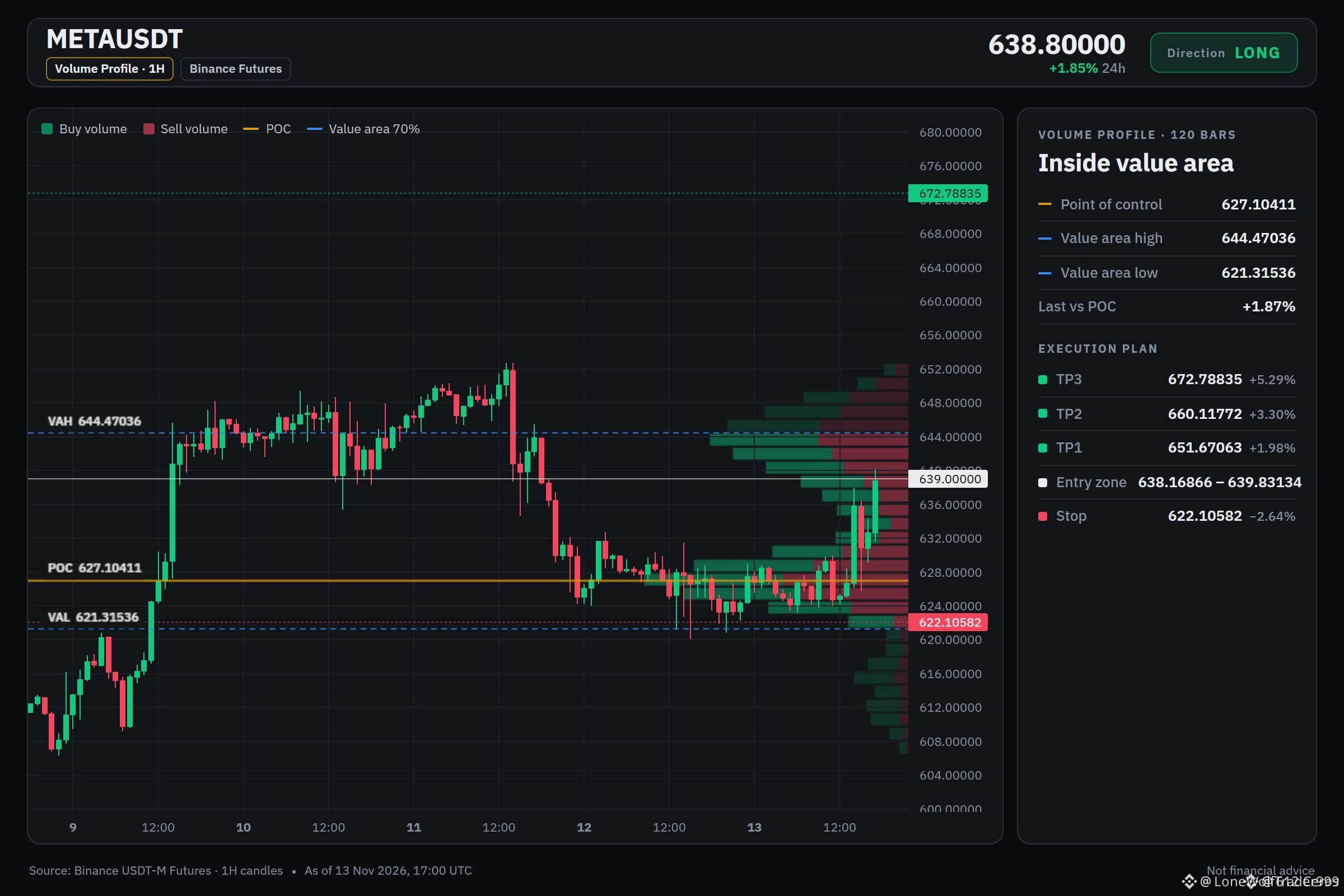
⚡ $META SHOWS STRUCTURAL CONTINUATION AS BULLISH EMA STACKS HOLD FIRM 📊
Entry: 638.17 - 639.83 ⚡
Target: 672.79 🚀
Stop Loss: 622.11 ⚠️
The hourly timeframe displays a robust bullish Exponential Moving Average stack, backed by an ADX reading of 29.4 confirming solid directional velocity. Order flow metrics confirm that institutional buyers are actively driving price action while seller participation remains suppressed. 💡
Moderate conviction dictates keeping position sizes controlled while monitoring structural reaction at key levels. 🔍 Are you scaling into this ongoing momentum continuation or waiting for a cleaner retracement? 👇
⚠️ Not financial advice. Always manage your risk. 🛡️
🏷️ #META #LongSetup #Momentum #Crypto
🔥 💎
5

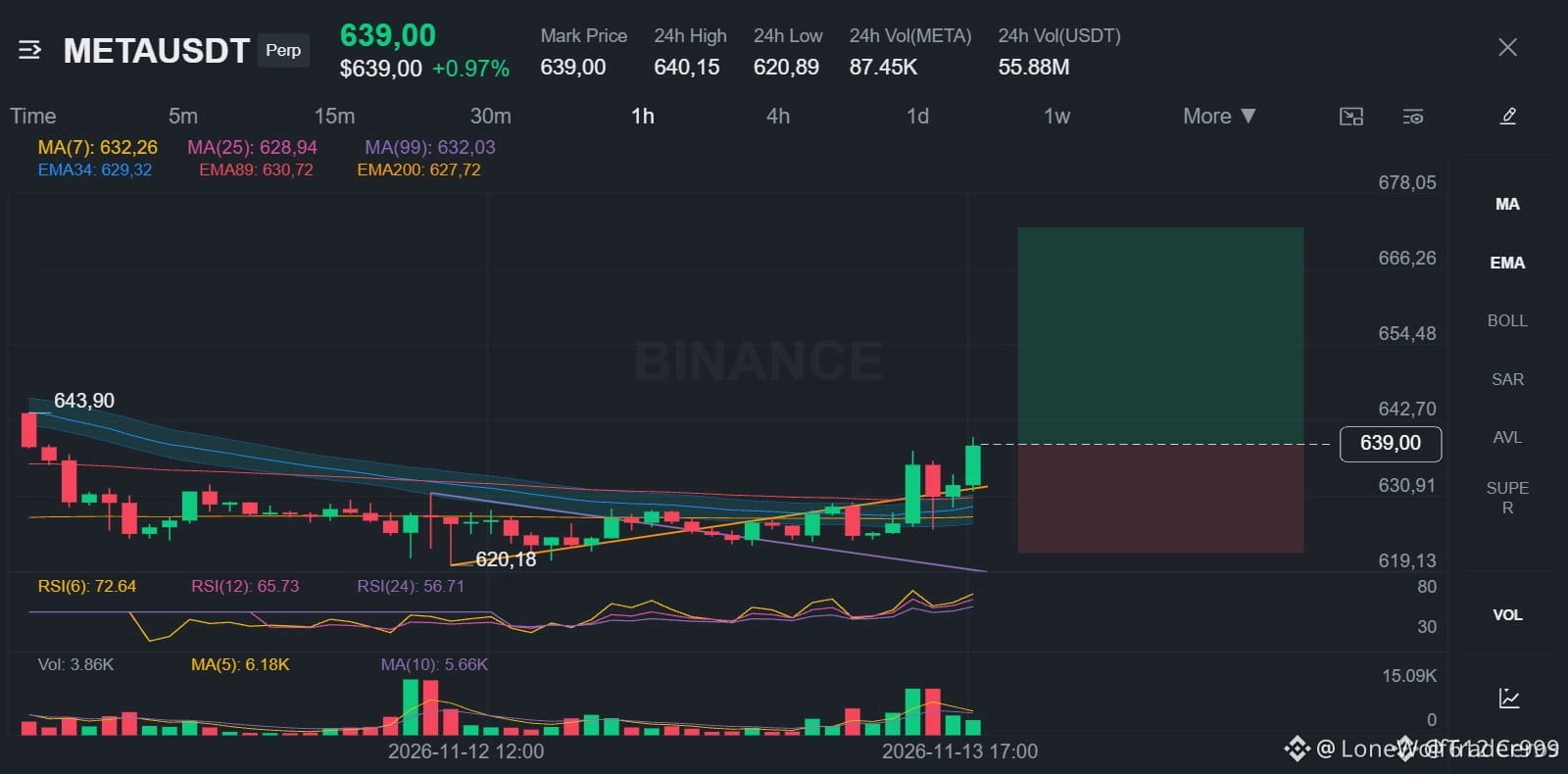
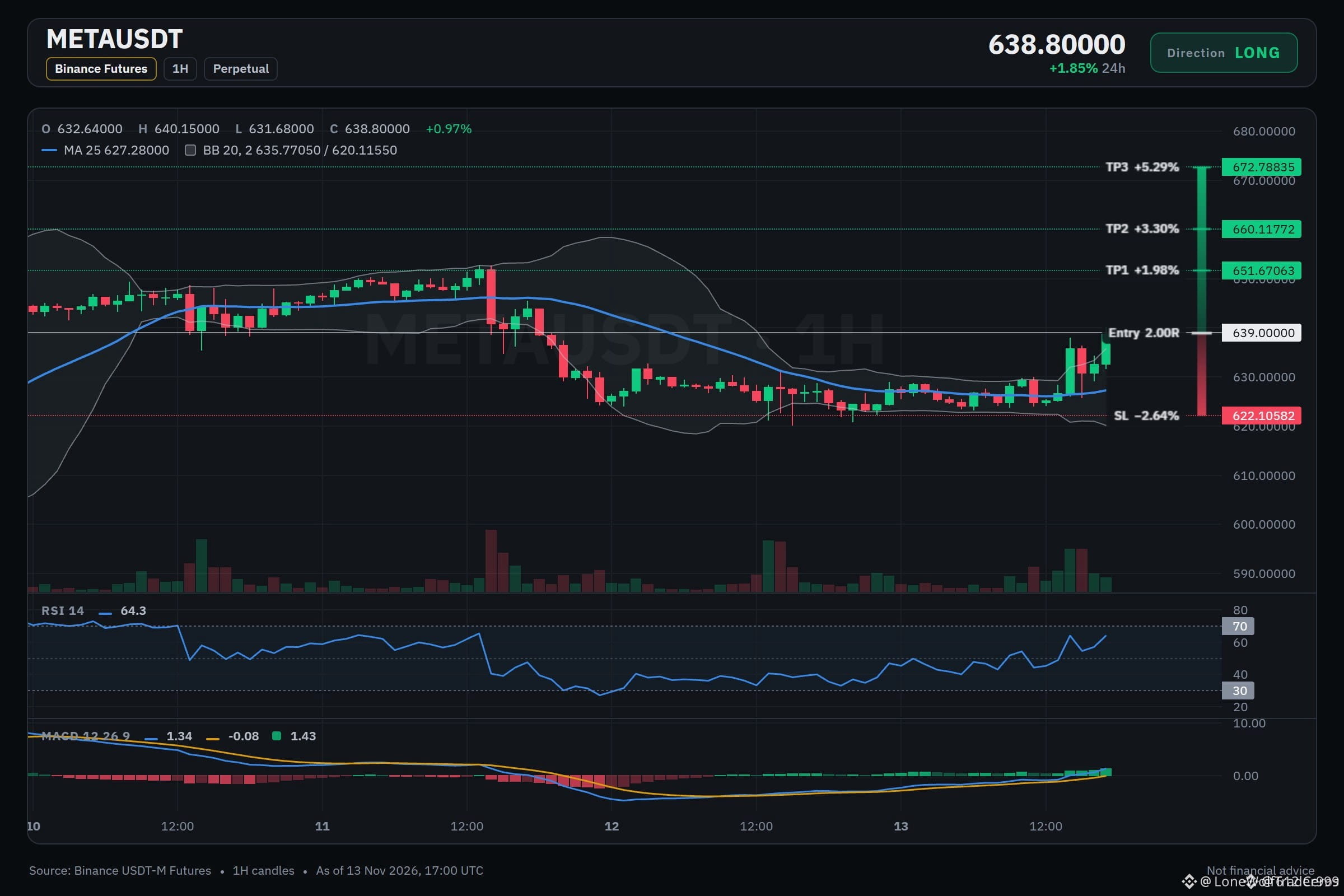
🟢 $META BULLS ARE STACKING AN IMMACULATE HOURLY EMA STACK FOR A CLEAN PUSH! 🚀
Entry: 638.17 - 639.83 ⚡
Target: 672.79 🚀
Stop Loss: 622.11 ⚠️
Buyers are firmly in the driver seat with an ADX reading of 29.4, as the directional indicator spread confirms aggressive supply absorption above the hourly EMA stack. 📊 Momentum remains steady with moderate conviction, leaving plenty of room for a clean scale towards the upper targets. ⚡
Keep position sizing disciplined while respecting the strict invalidation level below support. 💡 Are you scaling out at each resistance tier or holding for the full extension? 👇
⚠️ Not financial advice. Always manage your risk. 🛡️
🏷️ #META #LongSetup #Crypto #Breakout
🔥 💎
5

·
--
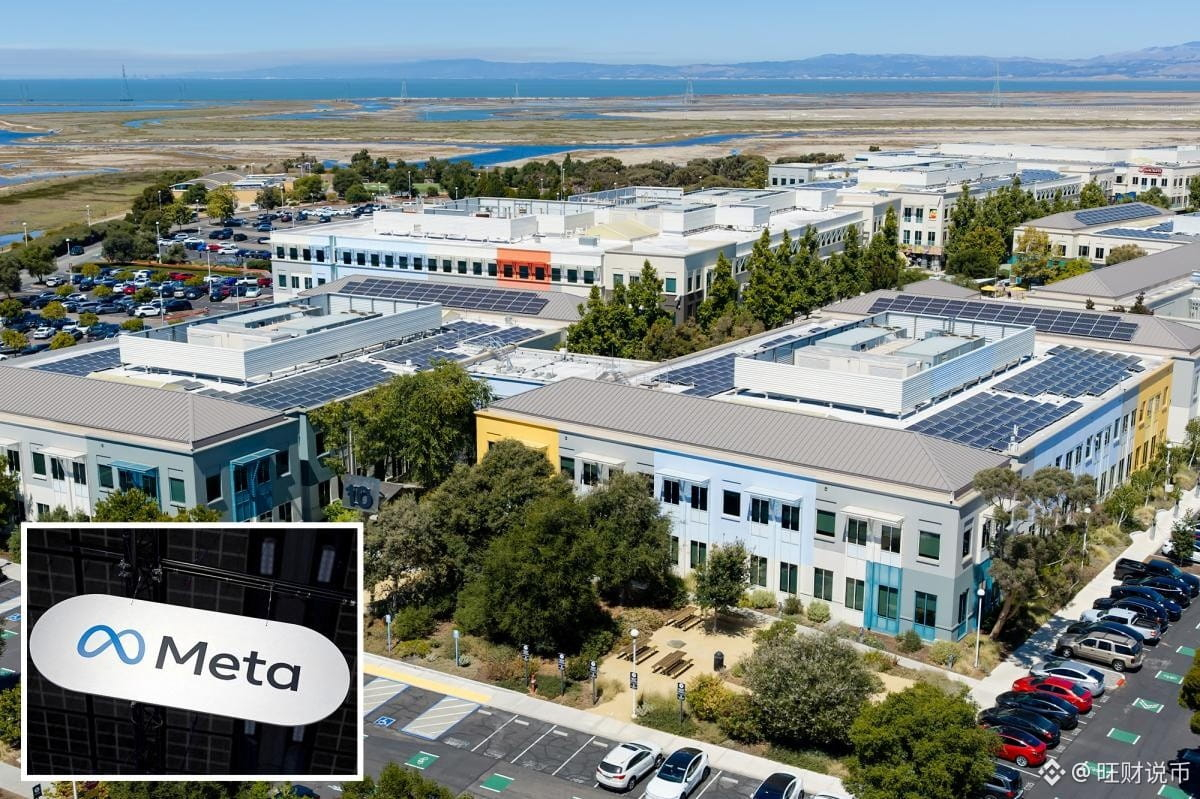
Meta quietly launches a prediction market—but won’t let users bet real money? The move goes deeper than you think 🎯
According to a November 13 report by The Wall Street Journal, Meta is internally testing a prediction market app called “Takes” 👇
• Users bet with “cred” (reputation points): get answers right and earn points; get them wrong and lose points. No real money involved.
• Test questions include: Will Cook become Nvidia’s next CEO?
• The project is being driven directly by Zuckerberg. It was previously called Arena, and there’s no public launch timeline yet.
🧠 My take:
1️⃣ Kalshi and Polymarket are facing gambling lawsuits from multiple states. Meta is starting with a points-based model to sidestep regulation, keeping its options open.
2️⃣ With billions of users across Facebook, Instagram, and Threads, Meta could completely unlock the growth potential of prediction markets if it starts directing users to Takes.
3️⃣ For crypto: prediction markets are one of the most mature PMF use cases on-chain. A big tech giant entering the space will educate the market—but also bring competition.
⚠️ Current market: BTC is around $67,000, and the Fear & Greed Index is at 13 (extreme fear). Money is moving into safe havens, so narrative-driven good news is unlikely to support prices in the short term.
Do you think Takes will eventually allow real-money betting? Share your thoughts in the comments 👇
$BTC $ETH #预测市场 #Meta #CryptoMarket
Personal opinion only; not investment advice.
9

·
--
Meta is getting into prediction markets, too.
The Wall Street Journal reported on November 13 that Meta employees have begun internally testing a prediction market app, internally named Takes. Employees bet using virtual points called cred (short for credibility): get a prediction right and earn points, get it wrong and lose points. No real money is involved, so it’s not the same as betting real cash on Kalshi or Polymarket. Meta declined to comment. The app isn’t available to the public, and it’s still unclear when—or whether—it will launch.
One question on Thursday was particularly interesting: Will Tim Cook become Nvidia’s next CEO? It landed right as rumors swirled about Jensen Huang stepping down and Nvidia changing leadership. This isn’t a spur-of-the-moment idea for Meta: The New York Times previously reported that Zuckerberg personally ordered a team to build a prediction market app over the summer, then code-named Arena. At an internal meeting this spring, he also said he wanted to work with product chief Chris Cox on as many as 50 new apps.
Three angles on this move:
First, distribution is Meta’s trump card. Prediction markets are one of the hottest sectors this year. Kalshi and Polymarket are competing for traffic and liquidity, while Meta has billions of users across Facebook, Instagram, and WhatsApp. If it plugs prediction markets into its social graph, its user-acquisition costs will be lower than anyone else’s. The fact that Takes currently uses points rather than real money is actually a smart move: U.S. states are still arguing over whether prediction markets count as gambling or financial derivatives. Meta can stake out a position with a points-based version and build up its product experience, then add real-money trading once licensing and regulatory rules are clearer. It can move forward without giving up its ability to pull back.
Second, don’t mistake this for the main course. Meta’s real spending focus is AI: On November 12, it issued €9 billion in senior notes (six tranches, maturing from 2031 to 2065, with coupons ranging from 4.300% to 6.400%). On October 21, it also disclosed plans to issue non-voting Class C shares (new shares that carry dividend rights but no voting rights). The charter takes effect on January 19, 2027, and investment banks estimate it could raise about $700 billion over the next few years, while Zuckerberg retains about 60.6% of the voting power. S&P had already revised Meta’s outlook to negative on October 30. A prediction market is just one piece on the board among 50 new apps; whether it succeeds or not won’t change the company’s fundamentals.
Third, the stock has just caught its breath. Meta closed Friday at $641.69, up 2.90%, making it one of only two Magnificent Seven stocks to finish higher that day. It gained 6.05% this week but is still down 2.79% year to date. However, it remains 17.71% below its 52-week high of $779.82 on September 24. Its relative strength index is 47.8, still in neutral territory (the relative strength index measures buying and selling momentum; below 30 is considered oversold, and above 70 overbought). The stock has just climbed back above its 200-day moving average (around $631), while its 50-day moving average of $679.85 remains overhead. Wall Street consensus is still Strong Buy, with an average price target of $850.10 from 57 firms—32.5% above the current price. But that optimism is based on AI monetization, not Takes.
There are also two risks to keep in mind. First, Takes may never be released publicly. The Wall Street Journal’s exact wording was that it’s unknown when—or whether—it will launch, so don’t treat it as an established business. Second, there’s the execution risk around AI: Infrastructure chief Santosh Janardhan is leaving in early 2027, just as Meta’s expansion of its computing capacity is going through a leadership change.
What to watch: whether Takes launches publicly and whether it adds real-money trading; Nvidia’s earnings on November 17, which may settle the other side of the Cook rumor; whether Meta holds above its 200-day moving average and can reclaim the $679.85 50-day moving average; and the Class C share charter taking effect on January 19, 2027, followed by the next quarterly earnings report on January 28.
In Zuckerberg’s list of 50 new apps, the prediction market is just the first card turned over.
#Meta #PredictionMarkets
$META $NVDA $QQQ
141

#MetaTakesOnPredictionMarkets
📱 META ENTERS THE PREDICTION MARKET WITH "TAKES" APP
Hey everyone, Meta has reportedly been testing an internal prediction app called Takes, where employees guess the outcomes of events using virtual "cred" points instead of real money — correct guesses earn points, while incorrect ones lose points. The project was previously called Arena and has been led by Zuckerberg since June, but Meta has not set a public launch date. The move comes just as Kalshi and Polymarket are being sued by several states over gambling — Meta is using virtual points to avoid legal trouble altogether.
Biggest perpetual movers today: $H 0,0199 dollars, $ICP 2,41 dollars, $SOL 75,61 dollars
#Meta #PredictionMarkets #Crypto

3
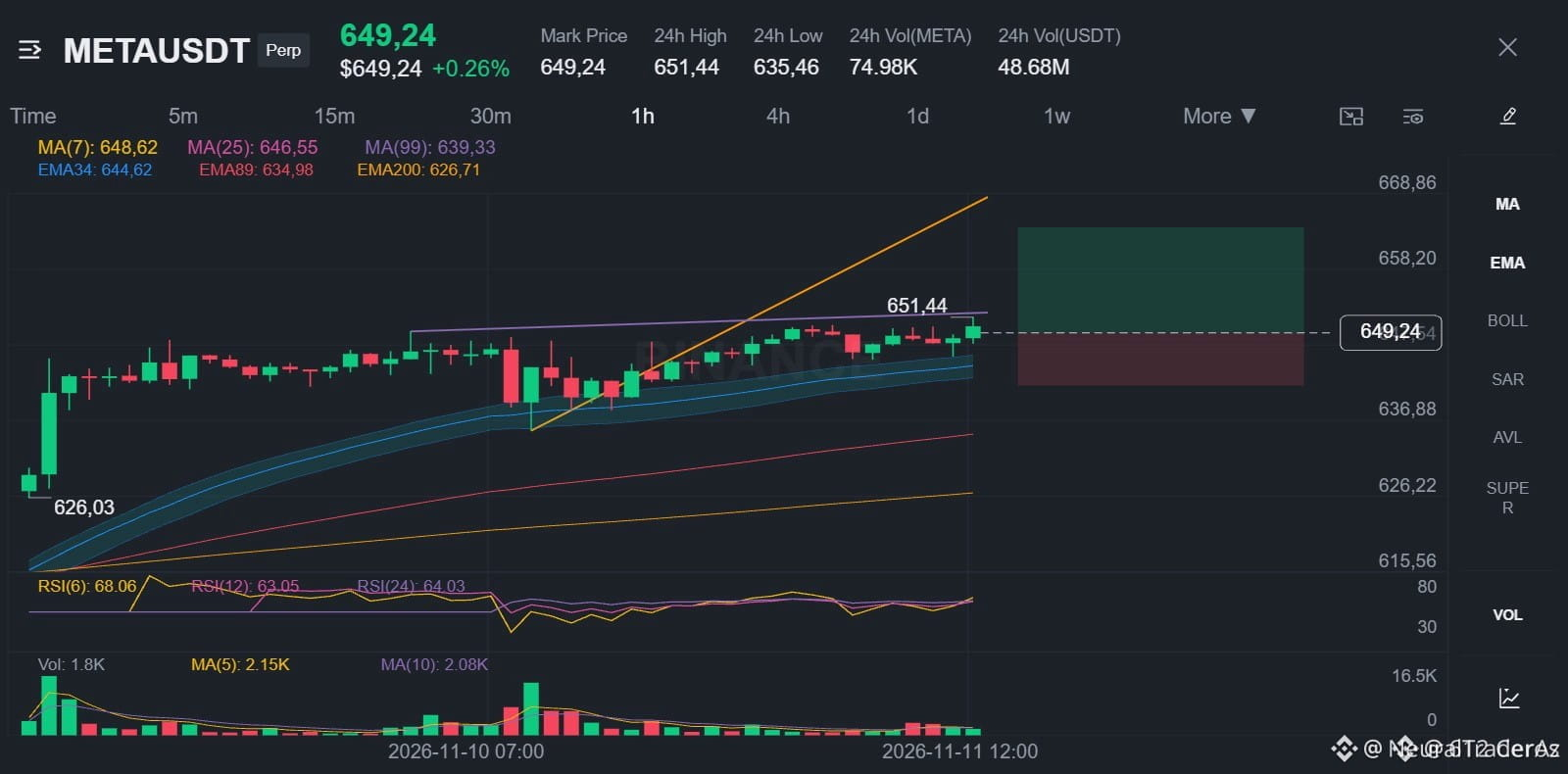
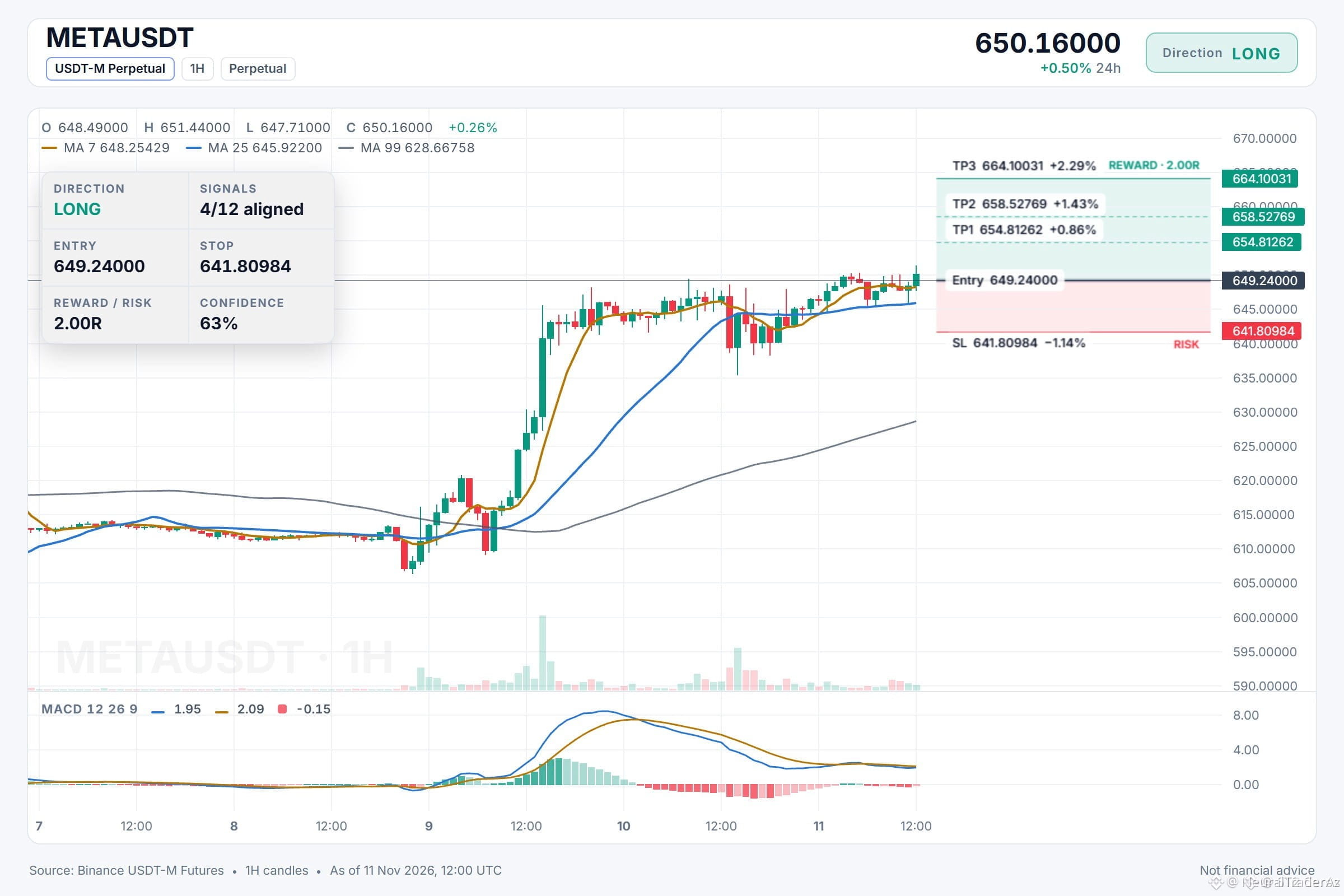
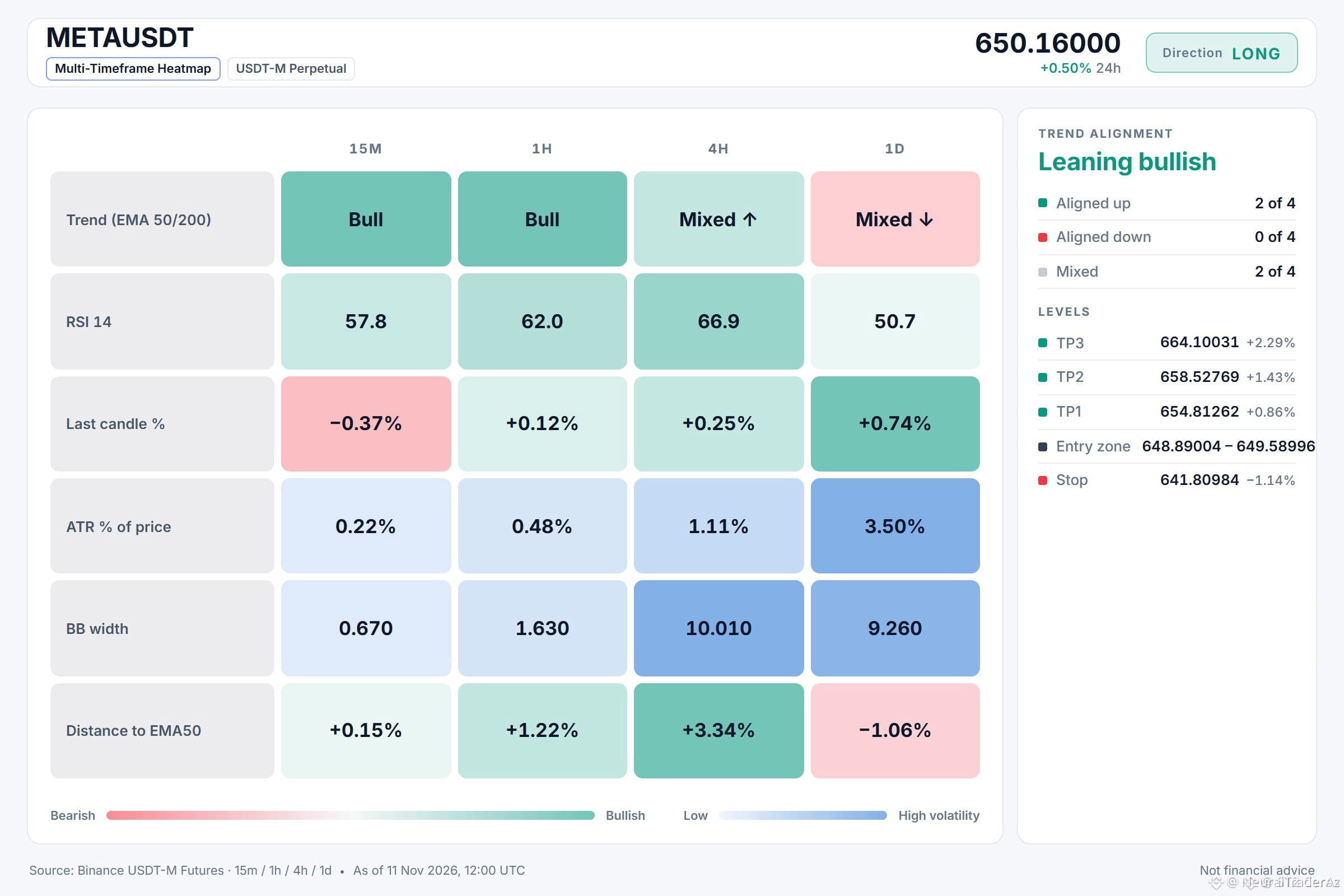
🦈 $META MAINTAINING A 1H BULLISH EMA STACK AWAITING EXPANSION ⚡
Entry: 648.89004 – 649.58996 ⚡
Target: 664.10031 🚀
Stop Loss: 641.80984 🛑
Institutional order flow on $META reflects steady accumulation as price defends the one-hour exponential moving average stack with disciplined structure. 📊
With the fifty and two-hundred period averages acting as dynamic support, momentum favors a controlled push toward higher liquidity pools. 💡
Keep sizing measured given the moderate conviction profile, and trail your risk methodically as initial targets unfold. 💬 Are you positioning for this continuation or waiting for a deeper retest? 👇
⚠️ Not financial advice. Always manage your risk. 🛡️
🏷️ #META #LongSetup #OrderFlow #SmartMoney
🔥 🦈
10

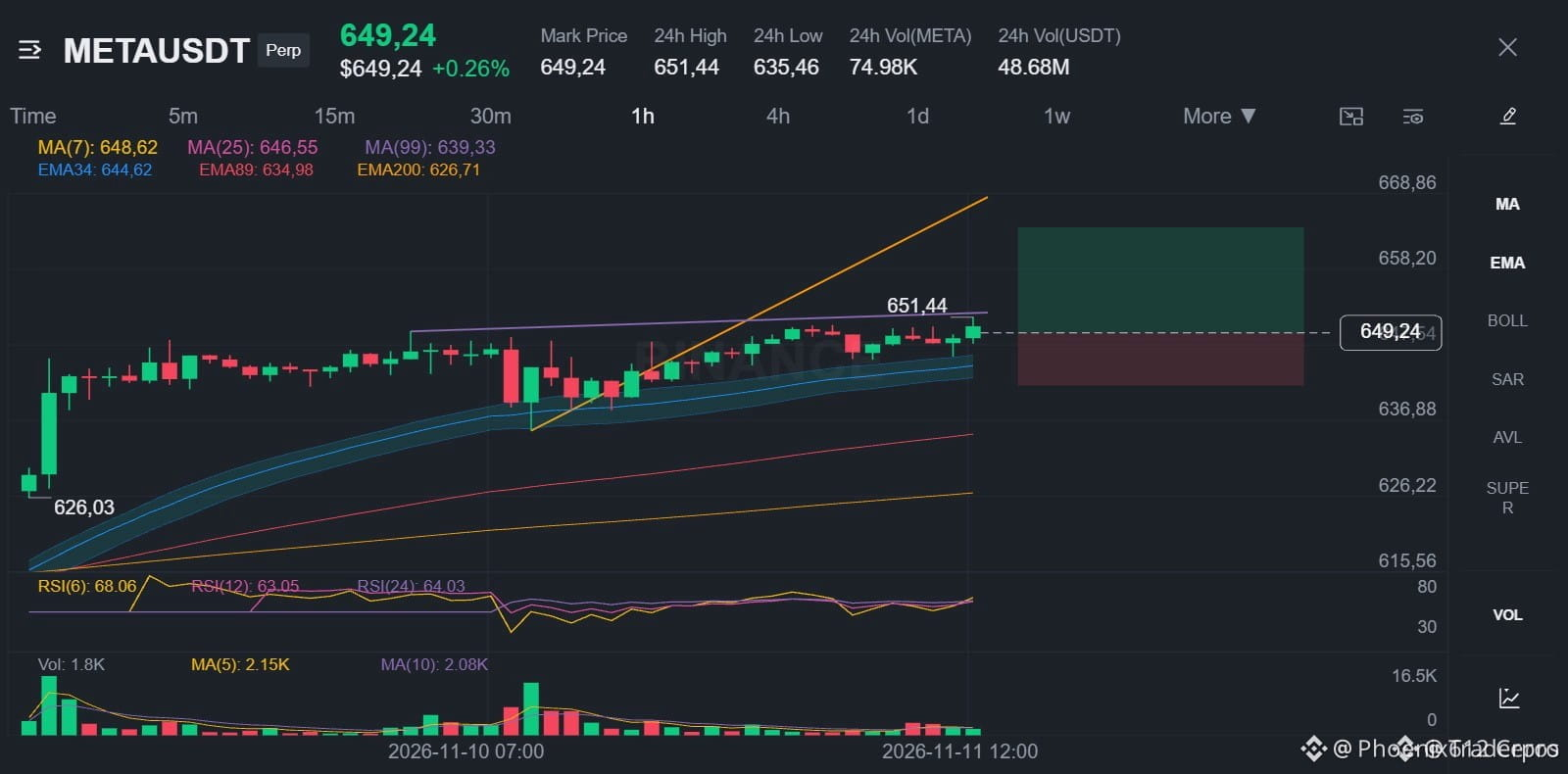
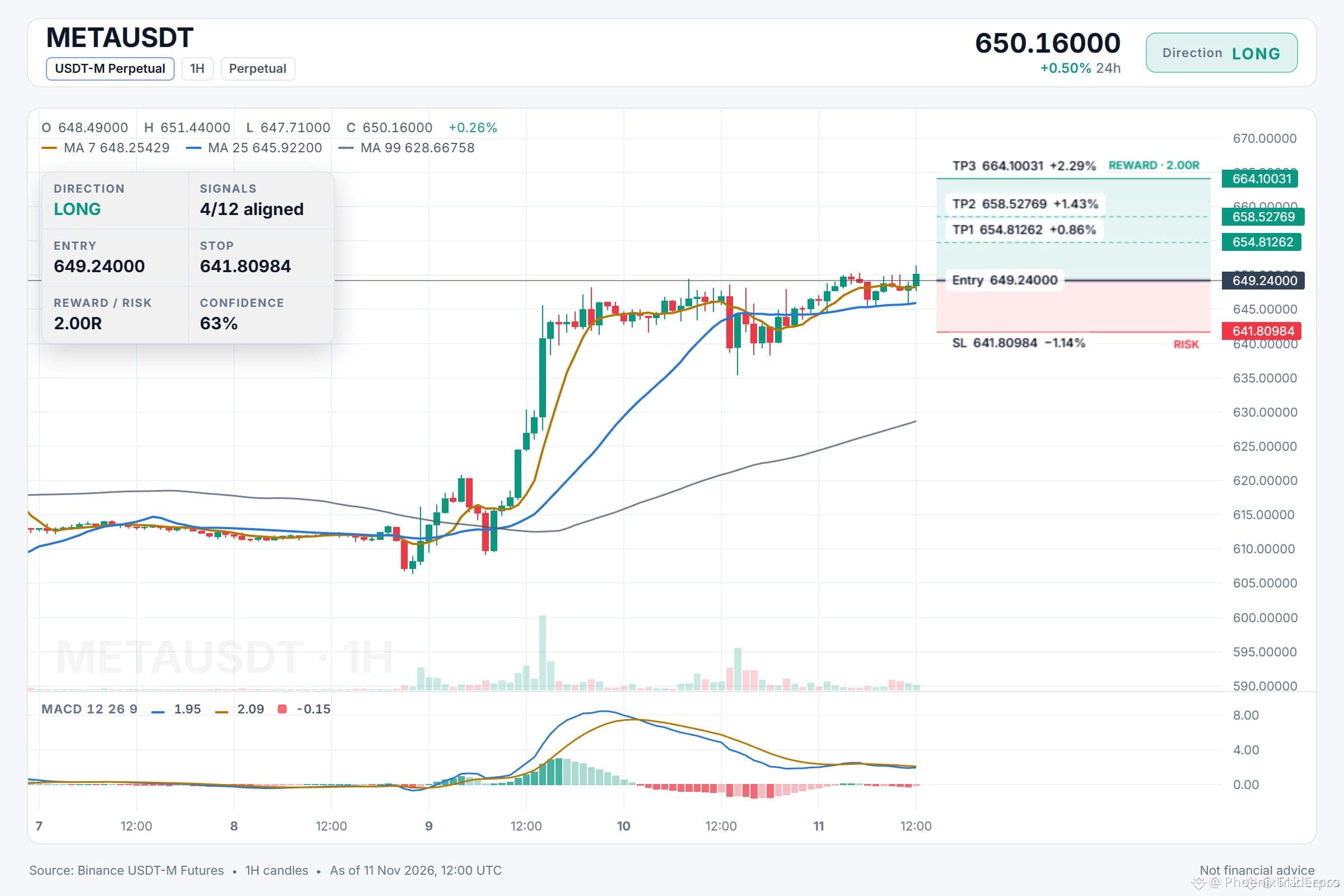
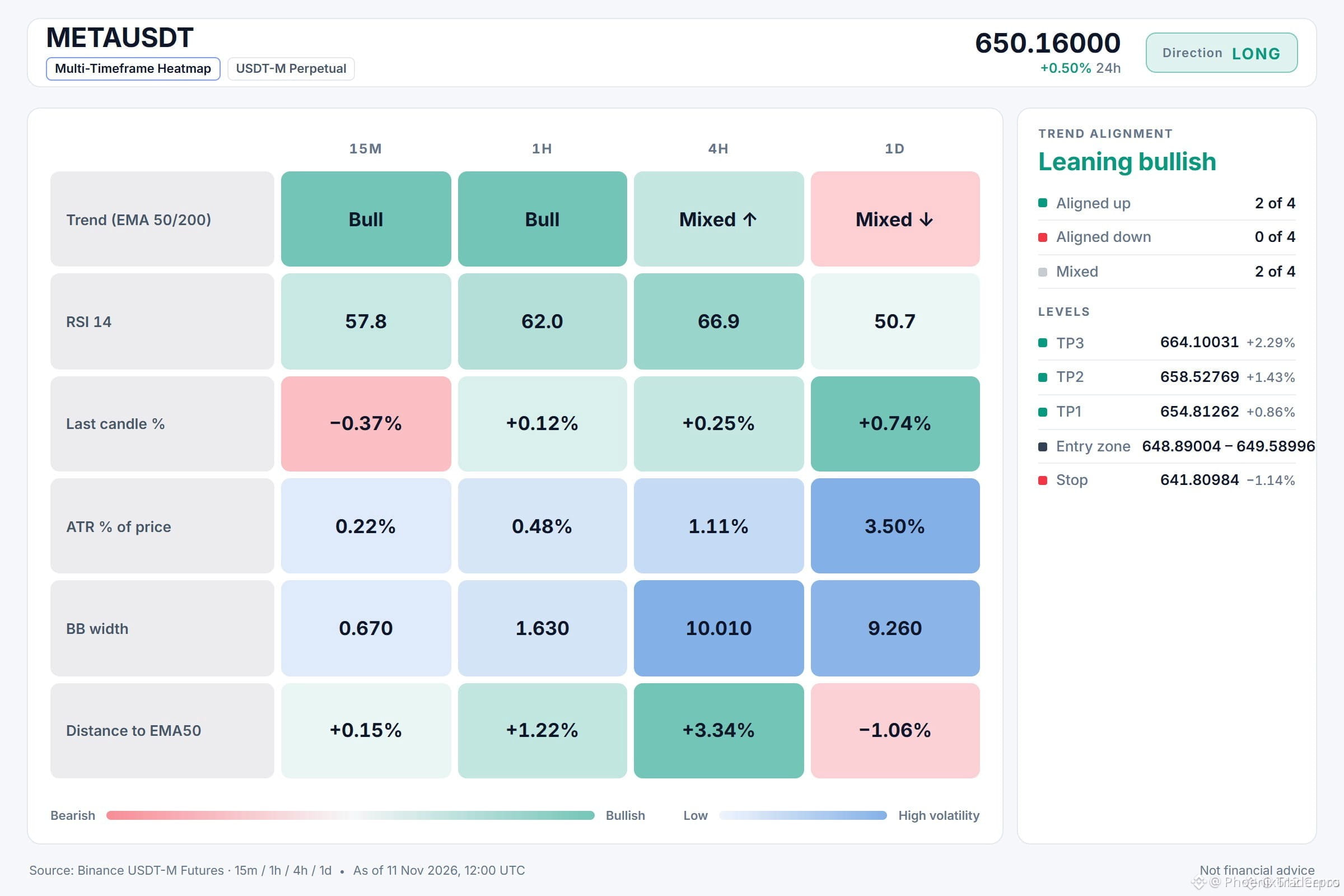
🟢 $META HOLDING FIRM ABOVE THE 1H EMA STACK AS BUYERS STEP UP 🚀
Entry: 648.89 - 649.59 ⚡
Target: 654.81, 658.53, 664.10 🚀
Stop Loss: 641.81 ⚠️
Price action on $META is quietly building a clean technical foundation. The one-hour chart shows a textbook bullish stack with price riding comfortably above the EMA50 and EMA200, signalling sustained underlying demand. 📊
Conviction here sits at a moderate level, so smart risk management and lighter sizing are key while momentum builds. We scale out progressively across the targets and shift risk to break-even once the first milestone clears. ⚡
💬 Are you riding this 1h trend continuation or waiting for a deeper pullback first? 👇
⚠️ Not financial advice. Always manage your risk. 🛡️
🏷️ #META #LongSetup #Trading #Crypto
🔥 💎
36

Meta tests a prediction app that uses 'cred' points instead of cash
- Meta employees are testing Takes, a prediction market app
- Rewards: credibility points (cred points) for accurate predictions
- No real cash is used
- Source: WSJ (no further details provided)
#BinanceSquare #CryptoNews #Meta #Web3 #PredictionMarkets
$btc $eth
vlikevn Titanbot
Source: The Block
- Meta employees are testing Takes, a prediction market app
- Rewards: credibility points (cred points) for accurate predictions
- No real cash is used
- Source: WSJ (no further details provided)
#BinanceSquare #CryptoNews #Meta #Web3 #PredictionMarkets
$btc $eth
vlikevn Titanbot
Source: The Block
248

·
--
This isn’t a reversal; it’s the timeframe talking. $META On the hourly chart, price is holding steady above the bullish moving-average stack, and the short-term trend is clearly upward. In this kind of setup, a pullback is an opportunity. ADX is nearing 30, and DI+ is clearly above DI−, with buyers setting the pace—it’s not just a false bounce.
I’m paying closer attention to how well the moving-average cluster holds as support. As long as the pullback doesn’t break the structure, the odds favor the uptrend continuing. I’d keep position sizes on the light side, though: momentum is moderate, so this isn’t a market to chase blindly. If the key level holds, it’s only a matter of time before there’s room to move higher. What do you think—does this pullback look like a good opportunity?
🟢 Trade direction: Long
📍 Entry range: 638.35449 – 640.01766
🛑 Stop loss: 622.28697
🎯 Take profit 1: 651.86039
🎯 Take profit 2: 660.30994
🎯 Take profit 3: 672.98426
Gaze upon the vast mountains and seas; observe the market’s every subtle move.
Trade alongside Uncle Xiong, and witness the gains and losses of the world.
#META
Click below to trade 👇
24

·
--
This isn’t a giveaway—the main event is speaking. The one-hour bullish alignment on $META is still holding firm, with the price above the moving average and the short-term direction still on track. The ADX is nearing 30, and DI+ is far ahead of DI−, showing that buyers are genuinely driving the move—not just retail traders making noise.
At this point, I’d rather wait for a pullback confirmation before acting. Don’t chase the highs; as long as the structure holds, there’s still potential. Momentum is moderate, so don’t go too heavy on your position—leave yourself some room. As long as key support holds, there’s still room to move up. Just keep an eye on that level. Do you think this move is holding steady?
🟢 Trade direction: Long
📍 Entry range: 638.11680 – 639.77935
🛑 Stop loss: 622.05527
🎯 Take profit 1: 651.61767
🎯 Take profit 2: 660.06408
🎯 Take profit 3: 672.73368
There’s no need to chase the wind; it will find its way to you.
Stand alongside Sister Li, and let every moment resonate.
#META
Click below to trade 👇
42
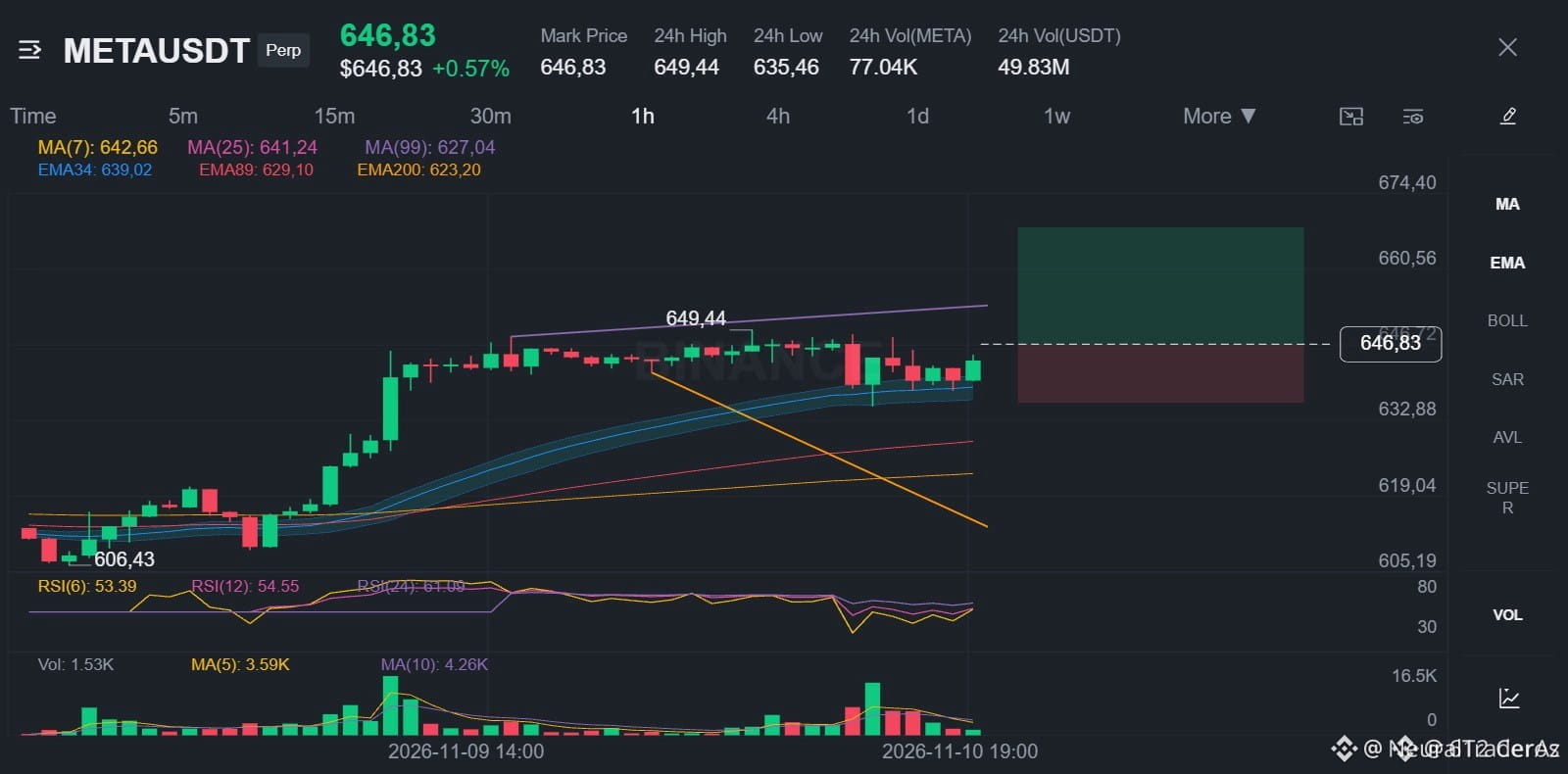
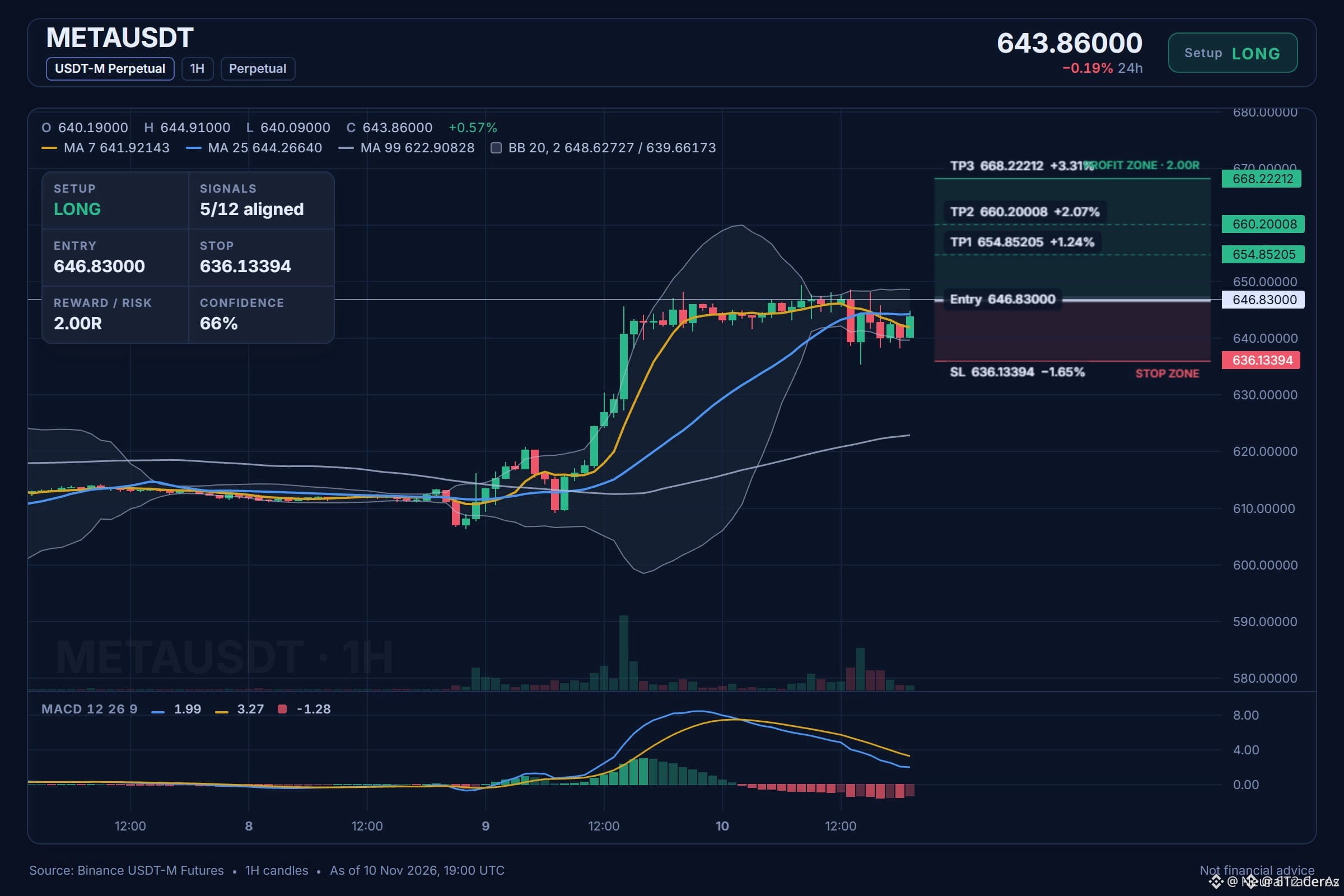
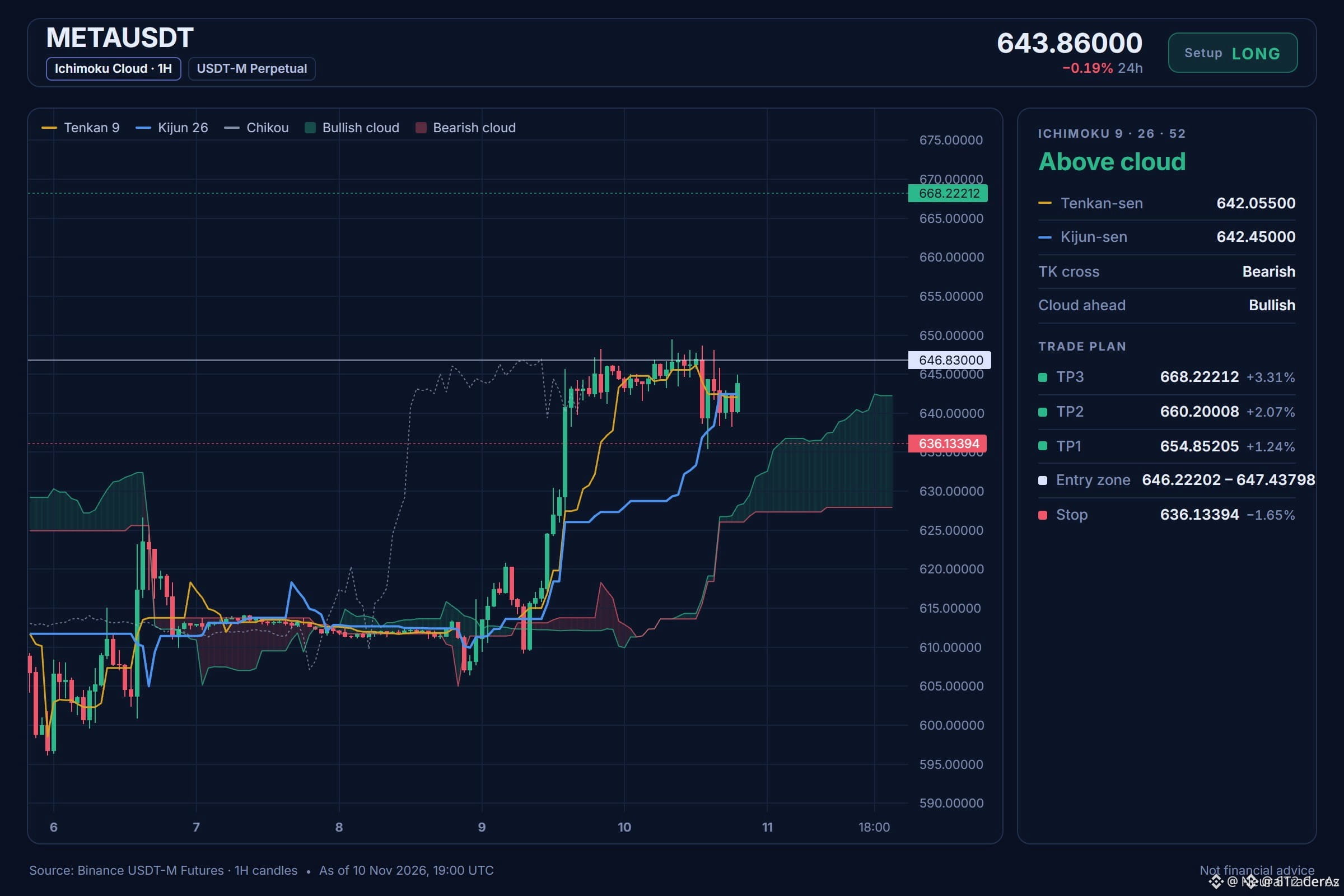
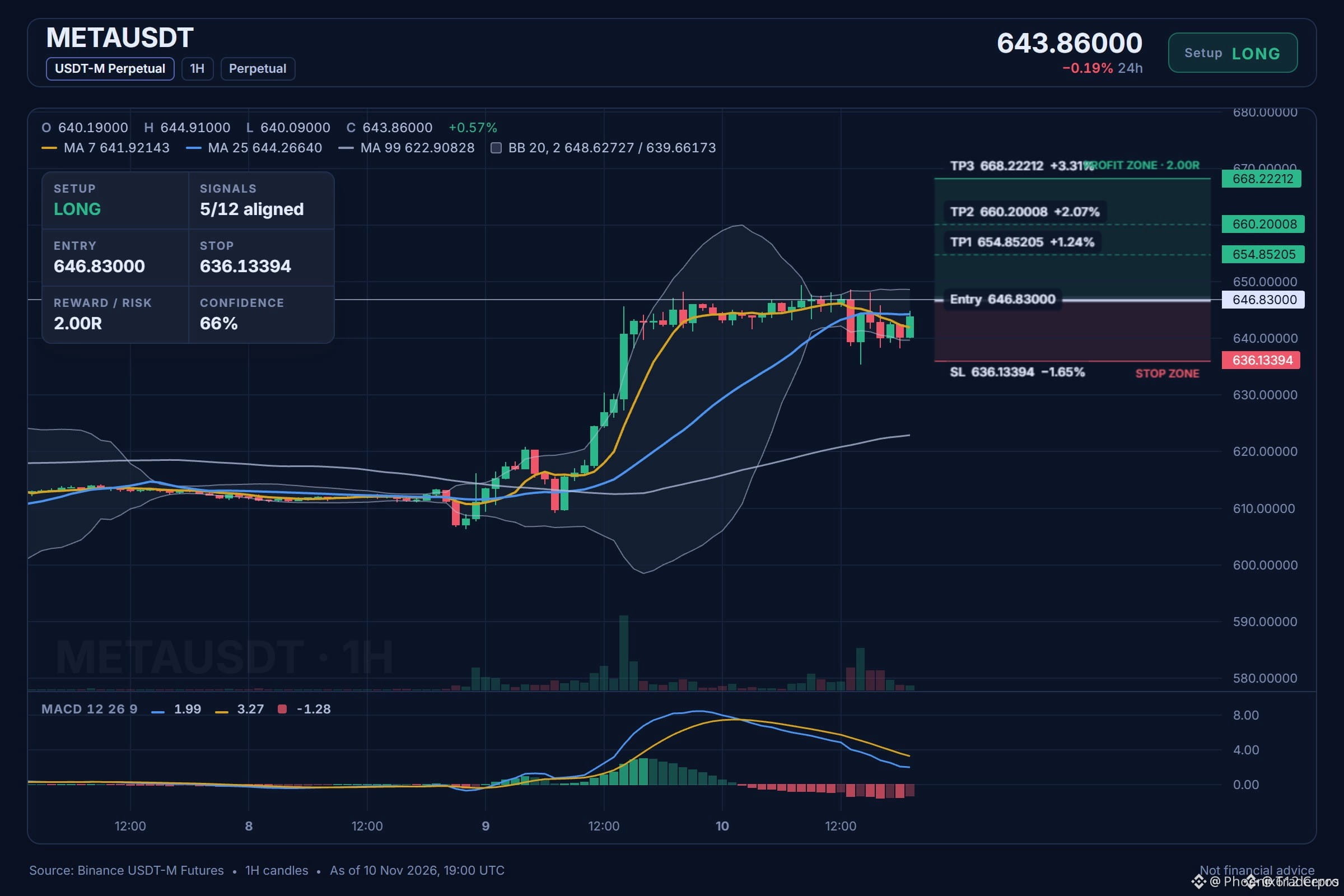
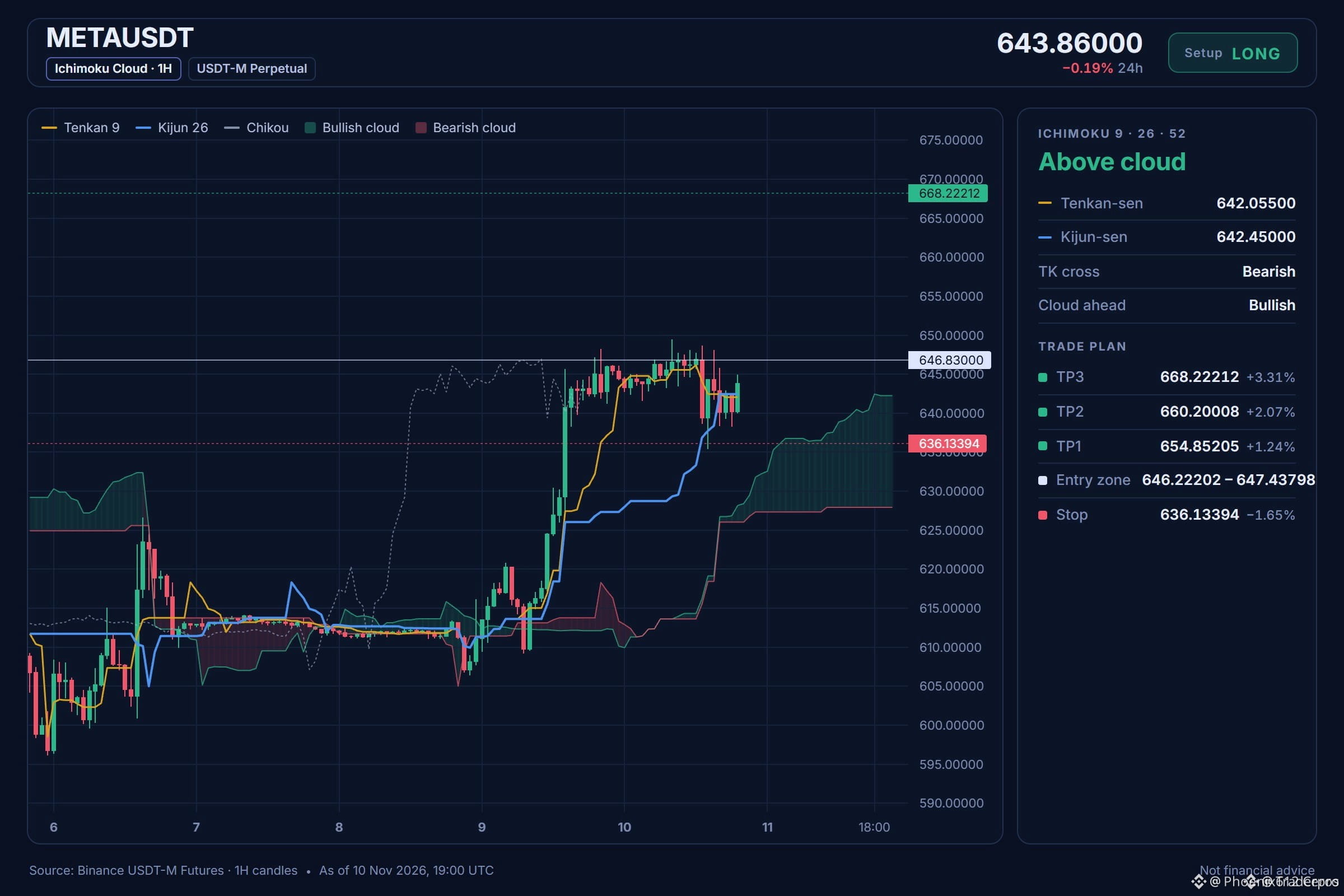
⚡ $META STRUCTURE ALIGNS FOR A MEASURED CONTINUATION PHASE ACROSS THE 1H TIMEFRAME 📈
Entry: 646.22202 - 647.43798 ⚡
Target: 654.85205 🚀
Stop Loss: 636.13394 ⚠️
Price action is establishing a clean structural footprint as the one-hour moving averages print a textbook bullish stack. Institutional buyers are steadily defending the range while momentum builds above the core equilibrium zones. 📊
With moderate conviction backing this expansion, position sizing should remain calibrated while we target scaling out at primary resistance levels. Risk parameters are locked with the invalidation point sitting right below structural support. 💡
💬 Are you scaling into this structural continuation or waiting for a deeper liquidity test first? 👇
⚠️ Not financial advice. Always manage your risk. 🛡️
🏷️ #META #LongSetup #SmartMoney #Crypto #PriceAction
🔥 💎
4
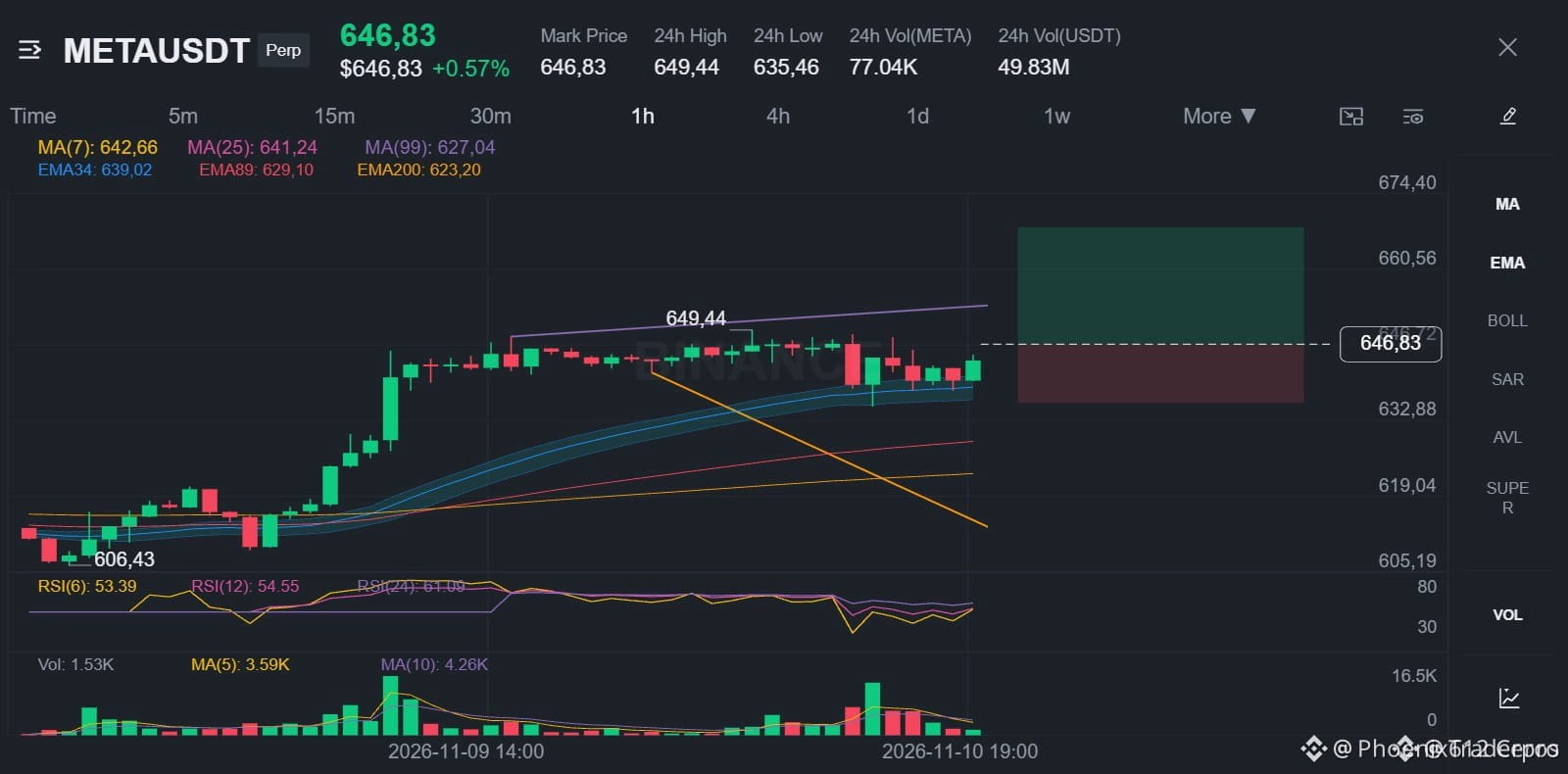
🟢 $META BULLISH EMA STACK IGNITES A CONTROLLED MOMENTUM PUSH TOWARDS HIGHER TARGETS 🚀
Entry: 646.22202 - 647.43798 ⚡
Target: 654.85205 - 668.22212 🚀
Stop Loss: 636.13394 ⚠️
Bulls are maintaining firm structural control here as the short-term chart prints a textbook moving average stack. 📊
Momentum is steadily favoring the upside while price defends critical support boundaries with quiet confidence. ⚡ Keep position sizing measured on this setup since overall conviction sits at a moderate tier.
Are you scaling into bids right here or waiting to see how price reacts near the initial target? 🤔
⚠️ Not financial advice. Always manage your risk. 🛡️
🏷️ #META #LongSetup #Momentum #Trading
🔥 💎
10

·
--
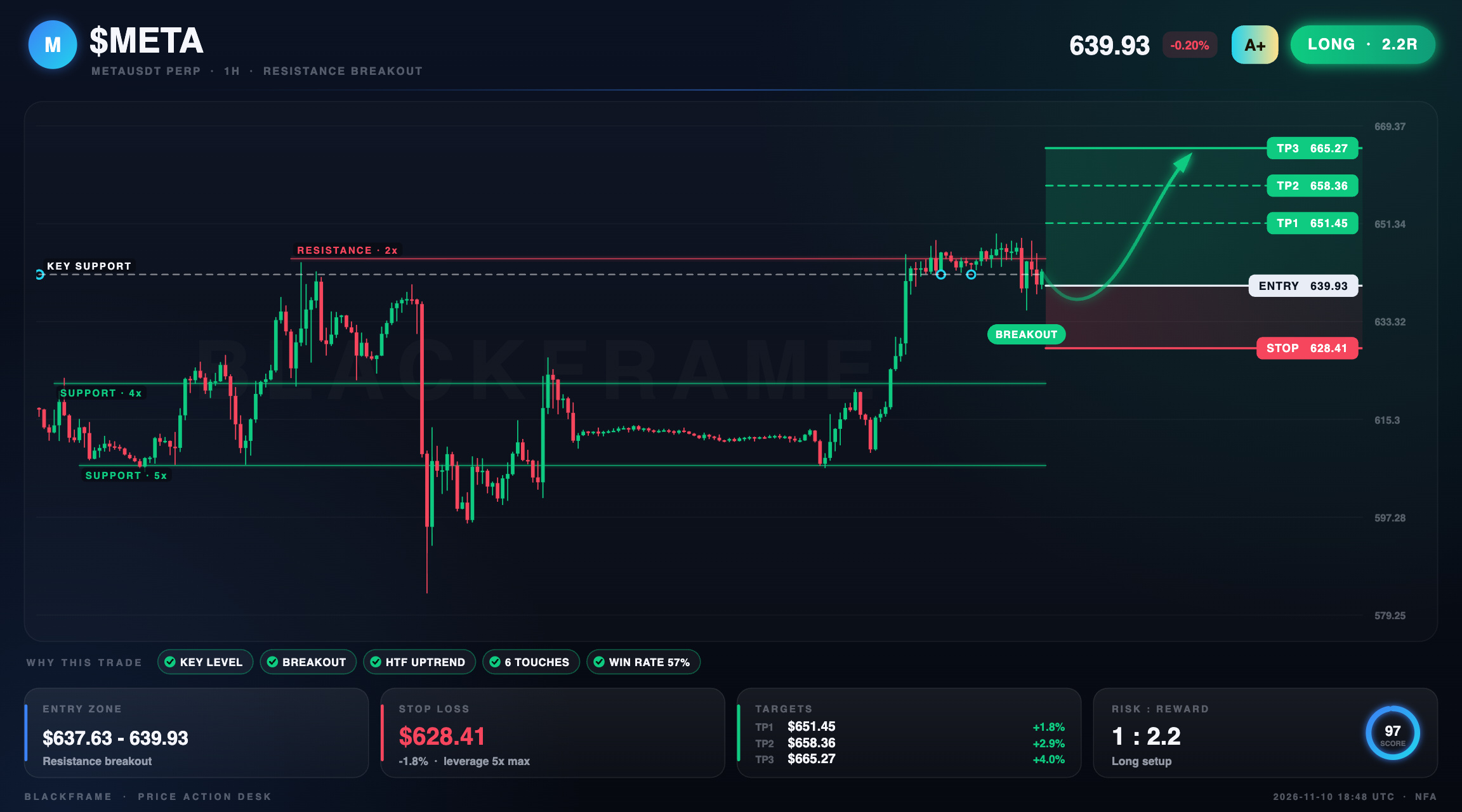
🚀 $META just broke out
LONG · 1H
Entry: $637.05 - $639.93
TP1: $651.45
TP2: $658.36
TP3: $665.27
SL: $628.41
Price broke above a key level near $641.99 and is holding it. The higher timeframe trend agrees.
#META #Crypto #CryptoTrading · NFA
🚀 $META just broke out
LONG · 1H
Entry: $637.05 - $639.93
TP1: $651.45
TP2: $658.36
TP3: $665.27
SL: $628.41
Price broke above a key level near $641.99 and is holding it. The higher timeframe trend agrees.
#META #Crypto #CryptoTrading · NFA
LONG · 1H
Entry: $637.05 - $639.93
TP1: $651.45
TP2: $658.36
TP3: $665.27
SL: $628.41
Price broke above a key level near $641.99 and is holding it. The higher timeframe trend agrees.
#META #Crypto #CryptoTrading · NFA
4
Log in to explore more content
Join global crypto users on Binance Square
⚡️ Get latest and useful information about crypto.
💬 Trusted by the world’s largest crypto exchange.
👍 Discover real insights from verified creators.
Email / Phone number
Trending Topics
1
#WhoWillSucceedJensenHuangatNvidia?
101,138 views
1,268 Discussing
2
#WhatWillDriveCryptoandStocks’NextRebound?
469,724 views
3,164 Discussing
3
#BitcoinActiveSupplyInProfitDropsBelow45%
35,818 views
465 Discussing
4
#KavaSaysAbnormalActivityLimitedToKavaLend
15,635 views
241 Discussing
5
#USSpotXRPETFsSeeLargestWeeklyOutflowIn8Months
13,654 views
221 Discussing
6
#USPPIMissMayEaseBTCPressure
228,882 views
2,110 Discussing
7
#WORPTLetsTouristsConvertCryptoToThaiBaht
3,813 views
61 Discussing
8
#TONStrategyReports$23.97MQ3NetLoss
5,108 views
41 Discussing
9
#PolkadotCommunityApprovesNewStrategyWith97%Vote
21,165 views
255 Discussing
10
#dYdXPlansV9.9UpgradeToShiftUSDCToInjective
14,462 views
209 Discussing